
Catalogue Search | MBRL


Are you sure you want to remove the book from the shelf?

{{itemTitle}}
118,722
result(s) for
"American and Latin American"
Sort by:


Ghost-Watching American Modernity:Haunting, Landscape, and the Hemispheric Imagination
In Ghost-Watching American Modernity, Maria del Pilar Blanco revisits nineteenth- and twentieth-century texts from Spanish America and the United States to ask how different landscapes are represented as haunted sites. Moving from foundational fictions to Westerns, Blanco explores the diverse ways in which ghosts and haunting emerge across the American hemisphere for authors who are preoccupied with evoking the experience of geographical transformations during a period of unprecedented development. The book offers an innovative approach that seeks to understand ghosts in their local specificity, rather than as products of generic conventions or as allegories of hidden desires. Its chapters pursue formally attentive readings of texts by Domingo Sarmiento, Henry James, Jose Marti, W. E. B. Du Bois, Juan Rulfo, Felisberto Hernandez, and Clint Eastwood. In an intervention that will reconfigure the critical uses of spectrality for scholars in U.S./Latin American Studies, narrative theory, and comparative literature, Blanco advances ghost-watching as a method for rediscovering haunting on its own terms.
eBook

Gothic imagination in Latin American fiction and film
\"This work traces how Gothic imagination from the literature and culture of eighteenth- and nineteenth-century Europe and twentieth-century US and European film has impacted Latin American literature and film culture. Serrano argues that the Gothic has provided Latin American authors with a way to critique a number of issues, including colonization, authoritarianism, feudalism, and patriarchy. The book includes a literary history of the European Gothic to demonstrate how Latin American authors have incorporated its characteristics but also how they have broken away or inverted some elements, such as traditional plot lines, to suit their work and address a unique set of issues. The book examines both the modernistas of the nineteenth century and the avant-garde writers of the twentieth century, including Huidobro, Bombal, Rulfo, Roa Bastos, and Fuentes. Looking at the Gothic in Latin American literature and film, this book is a groundbreaking study that brings a fresh perspective to Latin American creative culture\"-- Provided by publisher.
Book

Segregated Miscegenation
First Published in 2003. Routledge is an imprint of Taylor & Francis, an informa company.
Carlos Hiraldo earned his Ph.D. from SUNY at Stony Brook and is currently an Assistant Professor of English at LaGuardia Community College.
eBook

Poetic encounters in the Americas : remarkable bridge
Poetic Encounters in the Americas: Remarkable Bridge examines the ways in which U.S. and Latin American modernist canons have been in cross-cultural, mutually enabling conversation, especially through the act of literary translation. Examining eighteen U.S. and Latin American poets, my book is one of the few works of criticism to present case studies in U.S. and Latin American poetries in dialogues that highlight the social life and imaginative encounters obtained through methodologies of translation and innovations in poetic technique.
Book

Mayaya Rising
Who are the Black heroines of Latin America and the Caribbean? Where do we turn for models of transcendence among women of African ancestry in the region? In answer to the historical dearth of such exemplars, Mayaya Rising explores and celebrates the work of writers who intentionally center powerful female cultural archetypes. In this inventive analysis, Duke proposes three case studies and a corresponding womanist methodology through which to study and rediscover these figures. The musical Cuban-Dominican sisters and former slaves Teodora and Micaela Ginés inspired Aida Cartagena Portalatin's epic poem Yania tierra; the Nicaraguan matriarch of the May Pole, \"Miss Lizzie,\" figures prominently in four anthologies from the country's Bluefields region; and the iconic palenqueras of Cartagena, Colombia are magnified in the work of poets María Teresa Ramírez Neiva and Mirian Díaz Pérez. In elevating these figures and foregrounding these works, Duke restores and repairs the scholarly record.
eBook


Urban Chroniclers in Modern Latin America
An unstructured genre that blends high aesthetic standards with nonfiction commentary, the journalistic crónica, or chronicle, has played a vital role in Latin American urban life since the nineteenth century. Drawing on extensive archival research, Viviane Mahieux delivers new testimony on how chroniclers engaged with modernity in Mexico City, Buenos Aires, and São Paulo during the 1920s and 1930s, a time when avant-garde movements transformed writers' and readers' conceptions of literature. Urban Chroniclers in Modern Latin America: The Shared Intimacy of Everyday Life examines the work of extraordinary raconteurs Salvador Novo, Cube Bonifant, Roberto Arlt, Alfonsina Storni, and Mário de Andrade, restoring the original newspaper contexts in which their articles first emerged. Each of these writers guided their readers through a constantly changing cityscape and advised them on matters of cultural taste, using their ties to journalism and their participation in urban practice to share accessible wisdom and establish their role as intellectual arbiters. The intimate ties they developed with their audience fostered a permeable concept of literature that would pave the way for overtly politically engaged chroniclers of the 1960s and 1970s. Providing comparative analysis as well as reflection on the evolution of this important genre, Urban Chroniclers in Modern Latin America is the first systematic study of the Latin American writers who forged a new reading public in the early twentieth century.
eBook

The Cambridge companion to Latina/o American literature
\"The Cambridge Companion to Latina/o American Literature provides a thorough yet accessible overview of a literary phenomenon that has been rapidly globalizing over the past two decades. It takes an innovative approach that underscores the importance of understanding Latina/o literature not merely as an ethnic phenomenon in the United States, but more broadly as a crucial element of a trans-American literary imagination. Leading scholars in the field present critical analyses of key texts, authors, themes, and contexts, from the early nineteenth century to the present. They engage with the dynamics of migration, linguistic and cultural translation, and the uneven distribution of resources across the Americas that characterize Latina/o literature. This Companion will be an invaluable resource, introducing undergraduate and graduate students to the complexities of the field\"-- Provided by publisher.
Book
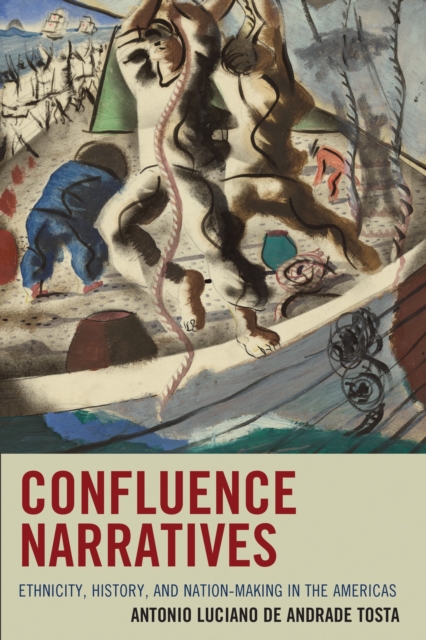
Confluence narratives
Confluence Narratives: Ethnicity, History and Nation-Making in the Americas explores how a collection of contemporary novels calls attention to the impact of ethnicity on national identities in the Americas. These historical narratives portray the cultural encounters—the conflicts and alliances, peaceful borrowings and violent seizures—that have characterized the history of the American continents since the colonial period. In the second half of the twentieth century, North and South American readers have witnessed a steady output of novels that revisit moments of cultural confluence as a means of revising national histories. Confluence Narratives proposes that these historical novels, published in such places as Brazil, Argentina, Mexico, the United States, and Canada, make up a key literary genre in the Americas. The genre links the various parts of the hemisphere together through three common historical experiences: colonization, slavery, and immigration. Luciano Tosta demonstrates how numerous texts from the United States, Canada, Spanish America, the Caribbean, and Brazil fall into the genre. The book focuses on four case studies from ethnic groups in the Americas: Amerindians, Afro-descendants, Jewish Americans, and Japanese Americans. Tosta uses the experience of the American nations as a springboard to problematize the concept of the contemporary nation, an identity marked by border-crossings and other experiences of deterritorialization. Based on the exploration of \"confluence narratives,\" Tosta argues that the \"contemporary\" nation is not as contemporary as one may think. Informed by postcolonial theory and transnational and ethnic studies, this book offers an important comparative study for and of inter-American literature. Its analysis of the representation of cultural encounters within distinctive national histories underscores the complex nature of 'otherness' in the Americas, as well as the inherently transcultural aspect of a trans-continental American identity.
eBook