
Catalogue Search | MBRL


Are you sure you want to remove the book from the shelf?

{{itemTitle}}
2,499
result(s) for
"American comics"
Sort by:

Strange fruit : more uncelebrated narratives from Black history
A collection of stories from early African American history that represent the oddity of success in the face of great adversity. Each of the eight illustrated chapters chronicles an uncelebrated African American hero or event. Joel Christian Gill offers historical and cultural commentary on heroes whose stories are not often found in history books, such as Cathay Williams, the only known female buffalo soldier, and Eugene Bullard, a fighter pilot who flew for France during World War II.
Book
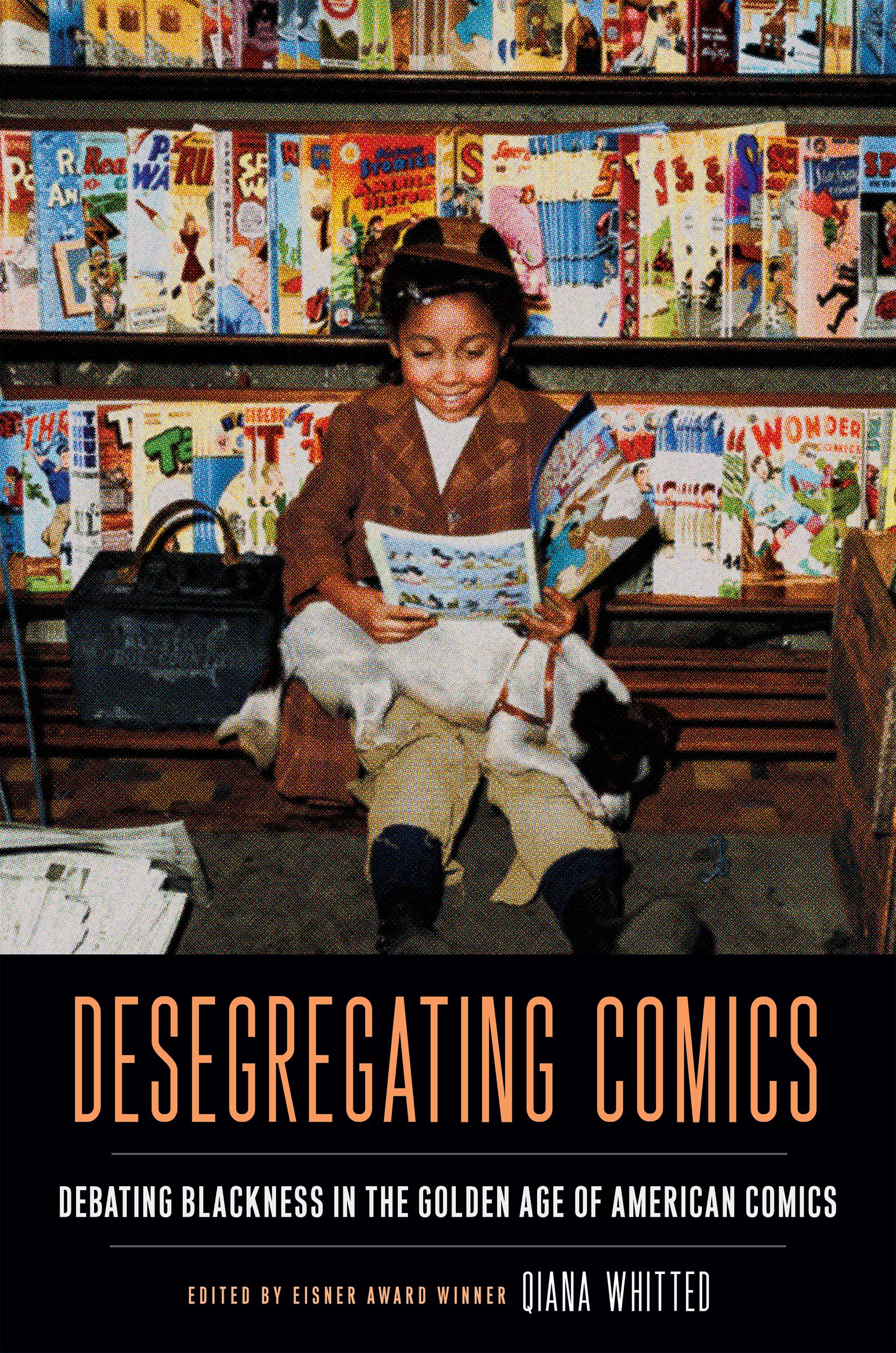
Desegregating Comics
Some comics fans view the industry's Golden Age (1930s-1950s) as a
challenging time when it comes to representations of race, an era
when the few Black characters appeared as brutal savages, devious
witch doctors, or unintelligible minstrels. Yet the true portrait
is more complex and reveals that even as caricatures predominated,
some Golden Age comics creators offered more progressive and
nuanced depictions of Black people. Desegregating Comics
assembles a team of leading scholars to explore how debates about
the representation of Blackness shaped both the production and
reception of Golden Age comics. Some essays showcase rare titles
like Negro Romance and consider the formal innovations
introduced by Black comics creators like Matt Baker and Alvin
Hollingsworth, while others examine the treatment of race in the
work of such canonical cartoonists as George Herriman and Will
Eisner. The collection also investigates how Black fans read and
loved comics, but implored publishers to stop including hurtful
stereotypes. As this book shows, Golden Age comics artists,
writers, editors, distributors, and readers engaged in heated
negotiations over how Blackness should be portrayed, and the
outcomes of those debates continue to shape popular culture today.
eBook

Sequential drawings : the New Yorker series
\"Sequential Drawings gathers together more than a decade of McGuire's witty and endlessly inventive spots--a veritable short story collection--each drawing given its own spread, which, in turn, assures for the reader the experience of surprise and delight that the drawings unfailingly deliver. Richard McGuire's first series of \"spot\" drawings debuted in the New Yorker in February 2005 for the magazine's 80th anniversary issue. Spot drawings, scattered among the magazine's text, had been a long-running feature of The New Yorker, and over the years, many artists had contributed them. But McGuire was the first to conceive them as a sequence, and his drawings were something altogether new: deceptively simple images that imbued the series with movement and narrative, telling their own unexpected stories\"-- Provided by publisher.
Book

Your Brain on Latino Comics
Though the field of comic book studies has burgeoned in recent years, Latino characters and creators have received little attention. Putting the spotlight on this vibrant segment, Your Brain on Latino Comics illuminates the world of superheroes Firebird, Vibe, and the new Blue Beetle while also examining the effects on readers who are challenged to envision such worlds. Exploring mainstream companies such as Marvel and DC as well as rising stars from other segments of the industry, Frederick Aldama provides a new reading of race, ethnicity, and the relatively new storytelling medium of comics themselves. Overview chapters cover the evolution of Latino influences in comics, innovations, and representations of women, demonstrating Latino transcendence of many mainstream techniques. The author then probes the rich and complex ways in which such artists affect the cognitive and emotional responses of readers as they imagine past, present, and future worlds. Twenty-one interviews with Latino comic book and comic strip authors and artists, including Laura Molina, Frank Espinosa, and Rafael Navarro, complete the study, yielding captivating commentary on the current state of the trade, cultural perceptions, and the intentions of creative individuals who shape their readers in powerful ways.
eBook

Garfield feeds the kitty
\"Garfield, the fat cat with the bottomless stomach, dishes up another tasty serving of cartoon comedy. So whether he's celebrating the official Kick-Odie-Across-the-Room Day, playing connect-the-freckles on Jon's chest, or perfecting his insincere smile, Garfield's always on the prowl for food and fun! The GARFIELD CLASSICS series collects the early years of the Garfield comic strip in a larger, full-color format. Garfield may have gone through a few changes, but one thing has stayed the same: his enormous appetite for food and fun. So laugh along with the classic cat, because classics are always in style\"-- Amazon.com.
Book

W. E. B. Du Bois Souls of Black Folk
No detailed description available for \"W. E. B. Du Bois Souls of Black Folk\".
eBook

Poe : stories and poems : a graphic novel adaptation
A volume of graphic novel renderings of some of Edgar Allan Poe's best-known works includes \"The Cask of Amontillado,\" \"The Tell-Tale Heart\" and \"The Raven.\"
BOOK

Robin and the Making of American Adolescence
Holy adolescence, Batman! Robin and the Making of American Adolescence offers the first character history and analysis of the most famous superhero sidekick, Robin. Debuting just a few months after Batman himself, Robin has been an integral part of the Dark Knight's history-and debuting just a few months prior to the word \"teenager\" first appearing in print, Robin has from the outset both reflected and reinforced particular images of American adolescence. Closely reading several characters who have \"played\" Robin over the past eighty years, Robin and the Making of American Adolescence reveals the Boy (and sometimes Girl!) Wonder as a complex figure through whom mainstream culture has addressed anxieties about adolescents in relation to sexuality, gender, and race. This book partners up comics studies and adolescent studies as a new Dynamic Duo, following Robin as he swings alongside the ever-changing American teenager and finally shining the Bat-signal on the latter half of \"Batman and-.\"
eBook

Rosa Parks and the Montgomery Bus Boycott
\"The Montgomery bus boycott was a pivotal event that launched the civil rights movement and helped transform American society. This epic tale of courage and peaceful resistance began with a simple No spoken by an African American seamstress. When Rosa Parks, exhausted after a long day at work, refused to give up her bus seat for a white man, she defied the strict segregation laws that made blacks second-class citizens. What followed was a test of courage and resolve that ultimately reshaped the nation. Using powerful illustrations and accessible text, this exciting graphic novel tells the story of actions, arrests, and the dramatic even events that followed.\"--Provided by publisher.
Book

Funnybooks
Funnybooksis the story of the most popular American comic books of the 1940s and 1950s, those published under the Dell label. For a time, \"Dell Comics Are Good Comics\" was more than a slogan-it was a simple statement of fact. Many of the stories written and drawn by people like Carl Barks(Donald Duck, Uncle Scrooge),John Stanley(Little Lulu),and Walt Kelly(Pogo)repay reading and rereading by educated adults even today, decades after they were published as disposable entertainment for children. Such triumphs were improbable, to say the least, because midcentury comics were so widely dismissed as trash by angry parents, indignant librarians, and even many of the people who published them. It was all but miraculous that a few great cartoonists were able to look past that nearly universal scorn and grasp the artistic potential of their medium. With clarity and enthusiasm, Barrier explains what made the best stories in the Dell comic books so special. He deftly turns a complex and detailed history into an expressive narrative sure to appeal to an audience beyond scholars and historians.
eBook