
Catalogue Search | MBRL


Are you sure you want to remove the book from the shelf?

{{itemTitle}}
13,234
result(s) for
"American letters."
Sort by:

The selected letters of Ralph Ellison
\"The previously unpublished letters of the ... author of Invisible Man [offer] insights into the riddle of American identity, the writer's craft, and his own life and work\"-- Provided by publisher.
Book
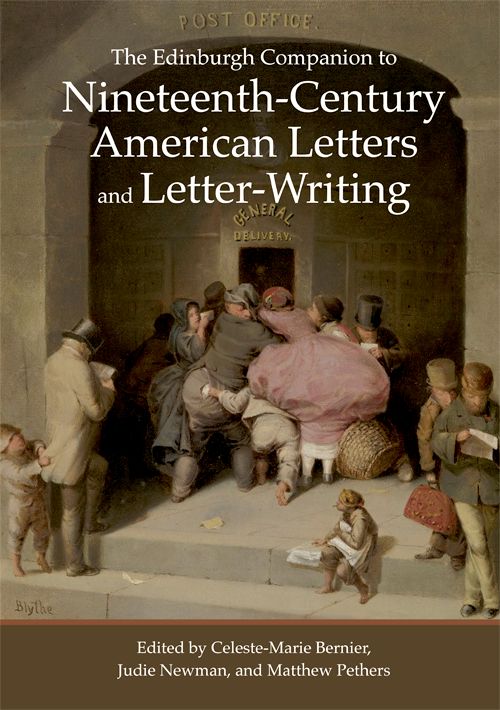
The Edinburgh Companion to Nineteenth-Century American Letters and Letter-Writing
This comprehensive study by leading scholars in an important new field-the history of letters and letter writing-is essential reading for anyone interested in nineteenth-century American politics, history or literature.
eBook

Abuela's special letters
Sofia is making a family time capsule, filled with pictures and mementos from their lives, to be opened in fifteen years, and Abuela contributes letters to each of her grandchildren--but Sofia is so consumed with curiosity that she decides to sneak a peak at what her letter says.
Book

In My Power
In My Powertells the story of letter writing and communications in the creation of the British Empire and the formation of the United States. In an era of bewildering geographical mobility, economic metamorphosis, and political upheaval, the proliferation of letter writing and the development of a communications infrastructure enabled middle-class Britons and Americans to rise to advantage in the British Atlantic world.
Everyday letter writing demonstrated that the blessings of success in the early modern world could come less from the control of overt political power than from the cultivation of social skills that assured the middle class of their technical credentials, moral deserving, and social innocence. In writing letters, the middle class not only took effective action in a turbulent world but also defined what they believed themselves to be able to do in that world. Because this ideology of agency was extended to women and the youngest of children in the eighteenth century, it could be presented as universalized even as it was withheld from Native Americans and enslaved blacks.
Whatever the explicit purposes behind letter writing may have been-educational improvement, family connection, business enterprise-the effect was to render the full terms of social division invisible both to those who accumulated power and to those who did not. The uncontested power that came from letter writing was, Konstantin Dierks provocatively argues, as important as racist violence to the rise of the white middle class in the British Atlantic world.
eBook


Up in the Rocky Mountains
Jennifer Eastman Attebery offers a new perspective on Swedish immigrants’s experiences in Idaho, Montana, Utah, Wyoming, Colorado, and New Mexico from 1880 to 1917 by interpreting their letters home. Recognizing the letters’s power as a folk form, Attebery provides a model for discerning immigrants’s shared culture in correspondence collections and brings to life small Swedish communities throughout the Rocky Mountain region._x000B_ _x000B_
eBook

Meanwhile there are letters : the correspondence of Eudora Welty and Ross Macdonald
\"The moving portrait in letters of two American literary icons and their deeply loving friendship. Though separated by background, geography, genre, and his marriage, the two authors shared their lives in witty, wry, tender, and at times profoundly romantic letters, each drawing on the other for inspiration, comfort, and strength. The letters reveal the impact each had on the other's work, and they show the personal support Welty provided when Alzheimer's destroyed Macdonald's ability to communicate and write\"-- Provided by publisher.
BOOK
Epistolary practices : letter writing in America before telecommunications
Letters have long been read as primary sources for biography and history, but their performative, fictive, and textual dimensions have only recently attracted serious notice. In this book, William Merrill Decker examines the place of the personal letter in American popular and literary culture from the colonial to the postmodern period. After offering an overview of the genre, Decker explores epistolary practices that coincide with American experiences of space, settlement, separation, and reunion. He discusses letters written by such well-known and well-educated persons as John Winthrop, Benjamin Franklin, Thomas Jefferson, Abigail and John Adams, Nathaniel Hawthorne, Margaret Fuller, Henry David Thoreau, Samuel Clemens, Henry James, and Alice James, but also letters by persons who, except in their correspondence, were not writers at all: indentured servants, New England factory workers, slaves, soldiers, and Western pioneers. Individual chapters explore the letter writing of Ralph Waldo Emerson, Emily Dickinson, and Henry Adams--three of America's most ambitious, accomplished, and theoretically astute letter writers. Finally, Decker considers the ongoing transformation of letter writing in the electronic age. |Using letters written by John Winthrop, Benjamin Franklin, Thomas Jefferson, Abigail and John Adams, and others, this book examines the place of the personal letter in American popular and literary culture from the colonial to the postmodern period. Decker explores epistolary practices that coincide with American experiences of space, settlement, separation, and reunion.
eBook

Kay Boyle : a twentieth-century life in letters
\"Kay Boyle knew everybody. In a long life (1902-1992) spent in motion between the United States and Europe she was the friend of Robert McAlmon (whose Being Geniuses Together she supplemented), with Harry and Caresse Crosby (founders of The Black Sun Press), Peggy Guggenheim and Max Ernst (with whom she fled World War II France), Marianne Moore, William Carlos Williams, Janet Flanner, Katherine Anne Porter, and a host of other powers and talents. Twice recipient of the O. Henry award for the best short story of the year (in 1935 for \"The White Horses of Vienna\" and 1941 for \"Defeat\"), Boyle was also an early contributor to Harriet Monroe's Poetry and published novels in every decade between the 1930s and 1990s. She published more than forty books, including fourteen novels, eleven collections of short fiction, eight volumes of poetry, children's books, memoirs, and translations. Throughout her life Boyle wrote letters. Boyle was a foreign correspondent for The New Yorker from 1946 until 1953, when she and her Austrian husband were caught by McCarthy's red scare. Her famous correspondents include William Carlos Williams, Ezra Pound, Richard Wright, Djuna Barnes, Alfred Stieglitz, Katherine Anne Porter, Howard Nemerov, Jessica Mitford, and Louise Erdrich. Kay Boyle: A Twentieth-Century Life in Letters gathers hundreds of her letters to tell in her own words the excitement, frustrations, intrigues, dangers, and satisfactions of the intersecting careers of Boyle and her friends. Candid and canny, Boyle wrote with freedom and wit, haste, ire, and affection. Her letters reveal as nothing else can her involvement with writing and writers\"-- Provided by publisher.
Book
Edinburgh Companion 19th Century American Letters
Provides a wide-ranging entry point and intervention into scholarship on nineteenth-century American letter-writing This comprehensive study by leading scholars in an important new field-the history of letters and letter writing-is essential reading for anyone interested in nineteenth-century American politics, history or literature. Because of its mass literacy, population mobility, and extensive postal system, nineteenth-century America is a crucial site for the exploration of letters and their meanings, whether they be written by presidents and statesmen, scientists and philosophers, novelists and poets, feminists and reformers, immigrants, Native Americans, or African Americans. This book breaks new ground by mapping the voluminous correspondence of these figures and other important American writers and thinkers. Rather than treating the letter as a spontaneous private document, the contributors understand it as a self-conscious artefact, circulating between friends and strangers and across multiple genres in ways that both make and break social ties. Key Features Draws together different emphases on the intellectual, literary and social uses of letter writing Provides students and researchers with a means to situate letters in their wider theoretical and historical contexts Methodologically expansive, intellectually interrogative chapters based on original research by leading academics Offers new insights into the lives and careers of Louisa May Alcott, Charles Brockden Brown, Emily Dickinson, Frederick Douglass, Margaret Fuller, Henry James, Thomas Jefferson, Abraham Lincoln, Herman Melville, Harriet Beecher Stowe, and Edgar Allan Poe, among many others
eBook