
Catalogue Search | MBRL


Are you sure you want to remove the book from the shelf?

{{itemTitle}}
280
result(s) for
"American literature -- Afro-American authors -- History and criticism"
Sort by:

Race and Gender in the Making of an African American Literary Tradition
This book examines the ways in which race and gender have shaped and continue to inform African American literature.African American texts create a black literary and cultural identity interpreting and recording the survival of their cultures shattered by years of slavery.
eBook
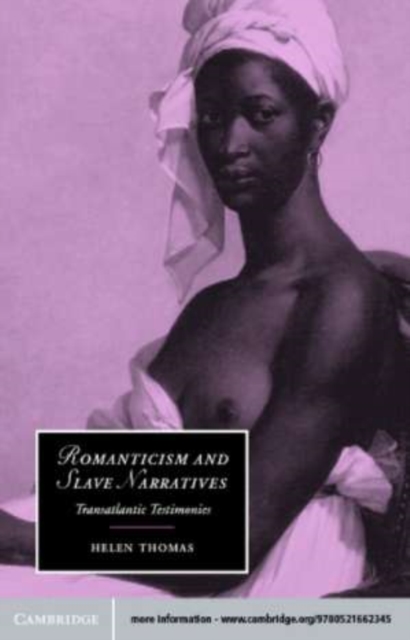
Romanticism and slave narratives : transatlantic testimonies
The first major attempt to relate canonical Romantic texts to the African diaspora, this study explores connections with literature produced by slaves, slave owners, abolitionists and radical dissenters between 1770 and 1830. Thomas reveals a dialogue between two diverse cultural spheres, and their corresponding systems of thought, epistemology and expression.
eBook

Spiritual Interrogations
The late eighteenth century witnessed an influx of black women to the slave-trading ports of the American Northeast. The formation of an early African American community, bound together by shared experiences and spiritual values, owed much to these women's voices. The significance of their writings would be profound for all African Americans' sense of their own identity as a people.
Katherine Clay Bassard's book is the first detailed account of pre-Emancipation writings from the period of 1760 to 1863, in light of a developing African American religious culture and emerging free black communities. Her study--which examines the relationship among race, culture, and community--focuses on four women: the poet Phillis Wheatley and poet and essayist Ann Plato, both Congregationalists; and the itinerant preacher Jarena Lee, and Shaker eldress Rebecca Cox Jackson, who, with Lee, had connections with African Methodism.
Together, these women drew on what Bassard calls a \"spirituals matrix,\" which transformed existing literary genres to accommodate the spiritual music and sacred rituals tied to the African diaspora. Bassard's important illumination of these writers resurrects their path-breaking work. They were cocreators, with all black women who followed, of African American intellectual life.
eBook

The dialect of modernism : race, language, and twentieth-century literature
The second volume in Oxford’s new Race and American Culture series, The Dialect of Modernism uncovers the crucial role of racial masquerade and linguistic imitation in the emergence of literary modernism. Rebelling against the standard language, and literature written in it, modernists, such as Joseph Conrad, Gertrude Stein, T.S. Eliot, Ezra Pound, and William Carlos Williams reimagined themselves as racial aliens and mimicked the strategies of dialect speakers in their work. In doing so, they made possible the most radical representational strategies of modern literature, which emerged from their attack on the privilege of standard language. At the same time, however, another movement, identified with Harlem, was struggling to free itself from the very dialect the modernists appropriated, at least as it had been rendered by two generations of white dialect writers. For writers such as Claude McKay, Jean Toomer, and Zora Neale Hurston, this dialect became a barrier as rigid as the standard language itself. Thus, the two modern movements, which arrived simultaneously in 1922, were linked and divided by their different stakes in the same language. In The Dialect of Modernism, Michael North shows, through biographical and historical investigation, and through careful readings of major literary works, that however different they were, the two movements are inextricably connected, and thus, cannot be considered in isolation. Each was marked, for good and bad, by the other.
eBook

Figures in black : words, signs and the \racial\ self
A study which focuses on Afro-American literature.
eBook

Raising the dead : readings of death and (black) subjectivity
Raising the Dead is a groundbreaking, interdisciplinary exploration of death's relation to subjectivity in twentieth-century American literature and culture. Sharon Patricia Holland contends that black subjectivity in particular is connected intimately to death. For Holland, travelling through \"the space of death\" gives us, as cultural readers, a nuanced and appropriate metaphor for understanding what is at stake when bodies, discourses, and communities collide.
Holland argues that the presence of blacks, Native Americans, women, queers, and other \"minorities\" in society is, like death, \"almost unspeakable.\" She gives voice to—or raises—the dead through her examination of works such as the movie Menace II Society, Toni Morrison's novel Beloved, Leslie Marmon Silko's Almanac of the Dead, Randall Kenan's A Visitation of Spirits, and the work of the all-white, male, feminist hip-hop band Consolidated. In challenging established methods of literary investigation by putting often-disparate voices in dialogue with each other, Holland forges connections among African-American literature and culture, queer and feminist theory.
Raising the Dead will be of interest to students and scholars of American culture, African-American literature, literary theory, gender studies, queer theory, and cultural studies.
eBook

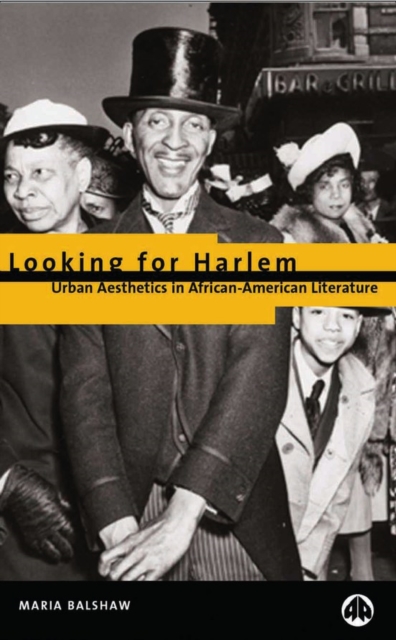
Looking for Harlem
Taking the incredible flowering of African-American literature in the 1920s as its starting point, Looking for Harlem offers a cogent and persuasive new reading of a diverse range of twentieth-century black American writing.
From the streets, subways, hotels and cabarets of New York's Harlem and Chicago's Southside, Maria Balshaw moves beyond the canon to encompass often neglected writing by Rudolph Fisher, Wallace Thurman and Claude McKay, as well as the more familiar work of Richard Wright, Ralph Ellison, Nella Larsen and Toni Morrison. In a provocative revision of African-American literary history, Balshaw examines the creation of an ‘urban aesthetic’ and explores the links between the engagement with the city and fictional reconstructions of racial identity and race writing. Focusing on the material culture of the city, the visual sense of the urban environment, the class dynamics of urban culture and the crucial importance of consumerism, this study presents a critically astute, challenging and very welcome new approach to a much-studied area of contemporary American fiction.
eBook
