
Catalogue Search | MBRL


Are you sure you want to remove the book from the shelf?

{{itemTitle}}
72
result(s) for
"American literature -- West (U.S.) -- History and criticism"
Sort by:


Dirty Wars
Since World War II, the American West has become the nation's military arsenal, proving ground, and disposal site. Through a wide-ranging discussion of recent literature produced in and about the West,Dirty Warsexplores how the region's iconic landscapes, invested with myths of national virtue, have obscured the West's crucial role in a post-World War II age of \"permanent war.\"
In readings of western-particularly southwestern-literature, John Beck provides a historically informed account of how the military-industrial economy, established to protect the United States after Pearl Harbor, has instead produced western waste lands and \"waste populations\" as the enemies and collateral casualties of a permanent state of emergency. Beck offers new readings of writers such as Cormac McCarthy, Leslie Marmon Silko, Don DeLillo, Rebecca Solnit, Julie Otsuka, and Terry Tempest Williams. He also draws on a variety of sources in history, political theory, philosophy, environmental studies, and other fields. ThroughoutDirty Wars, he identifies resonances between different experiences and representations of the West that allow us to think about internment policies, the manufacture of atomic weapons, the culture of Cold War security, border policing, and toxic pollution as part of a broader program of a sustained and invasive management of western space.
eBook

The Cambridge companion to the literature of the American West
\"This Companion provides a comprehensive introduction to one of the most vibrant and expansive traditions in world literature. The American West occupies a unique place in the global imagination, and the literature it produced transcends the category of 'region' in theme and form. Written by prominent international scholars, the essays cover a diverse group of key texts and authors, including major figures in the Native American, Hispanic, Asian American, and African American movements. Treatments range from environmental and ecopoetic to transnational and transcultural, reflecting the richness of the field. This volume places the literature in deep historical context and features a chronology and a bibliography for further reading. It will be an essential guide for students of literature of the American West and of American literature generally\"-- Provided by publisher.
Book

Women Writers of the American West, 1833-1927
Women Writers of the American West, 1833-1927 recovers the names and works of hundreds of women who wrote about the American West during the nineteenth and early twentieth centuries, some of them long forgotten and others better known novelists, poets, memoirists, and historians such as Willa Cather and Mary Austin Holley. Nina Baym mined literary and cultural histories, anthologies, scholarly essays, catalogs, advertisements, and online resources to debunk critical assumptions that women did not publish about the West as much as they did about other regions. Elucidating a substantial body of nearly 650 books of all kinds by more than 300 writers, Baym reveals how the authors showed women making lives for themselves in the West, how they represented the diverse region, and how they represented themselves. _x000B__x000B_Baym accounts for a wide range of genres and geographies, affirming that the literature of the West was always more than cowboy tales and dime novels. Nor did the West consist of a single landscape, as women living in the expanses of Texas saw a different world from that seen by women in gold rush California. Although many women writers of the American West accepted domestic agendas crucial to the development of families, farms, and businesses, they also found ways to be forceful agents of change, whether by taking on political positions, deriding male arrogance, or, as their voluminous published works show, speaking out when they were expected to be silent.
eBook


Hoo-Doo Cowboys and Bronze Buckaroos
Hoo-Doo Cowboys and Bronze Buckaroosundertakes an interdisciplinary exploration of the African American West through close readings of texts from a variety of media. This approach allows for both an in-depth analysis of individual texts and a discussion of material often left out or underrepresented in studies focused only on traditional literary material. The book engages heretofore unexamined writing by Rose Gordon, who wrote for local Montana newspapers rather than for a national audience; memoirs and letters of musicians, performers, and singers (such as W. C. Handy and Taylor Gordon), who lived in or wrote about touring the American West; the novels and films of Oscar Micheaux; black-cast westerns starring Herb Jeffries; largely unappreciated and unexamined episodes from the \"golden age of western television\" that feature African American actors; film and television westerns that use science fiction settings to imagine a \"postracial\" or \"postsoul\" frontier; Percival Everett's fiction addressing contemporary black western experience; and movies as recent as Quentin Tarantino'sDjango Unchained.
Despite recent interest in the history of the African American West, we know very little about how the African American past in the West has been depicted in a full range of imaginative forms.Hoo-Doo Cowboys and Bronze Buckaroosadvances our discovery of how the African American West has been experienced, imagined, portrayed, and performed.
eBook


Captivating Westerns
Tracing the transnational influences of what has been known as a uniquely American genre, \"the Western,\" Susan Kollin'sCaptivating Westernsanalyzes key moments in the history of multicultural encounters between the Middle East and the American West. In particular, the book examines how experiences of contact and conflict have played a role in defining the western United States as a crucial American landscape. Kollin interprets the popular Western as a powerful national narrative and presents the cowboy hero as a captivating figure who upholds traditional American notions of freedom and promise, not just in the region but across the globe.Captivating Westernsrevisits popular uses of the Western plot and cowboy hero in understanding American global power in the post-9/11 period.
Although various attempts to build a case for the war on terror have referenced this quintessential American region, genre, and hero, they have largely overlooked the ways in which these celebrated spaces, icons, and forms, rather than being uniquely American, are instead the result of numerous encounters with and influences from the Middle East. By tracing this history of contact, encounter, and borrowing, this study expands the scope of transnational studies of the cowboy and the Western and in so doing discloses the powerful and productive influence of the Middle East on the American West.
eBook

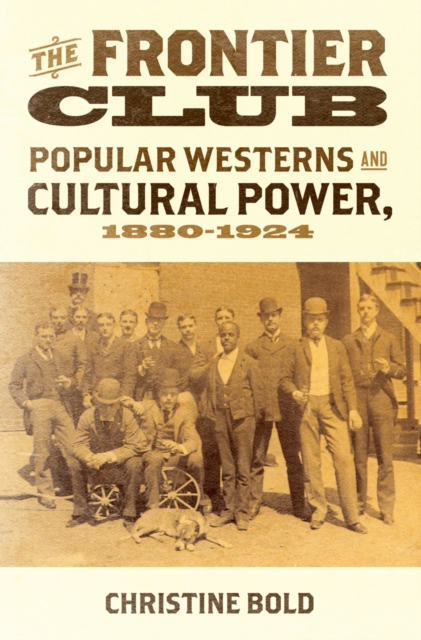
The frontier club : popular westerns and cultural power, 1880-1924
“The Frontier Club” is Christine Bold’s name for the network of eastern aristocrats who created the western as we now most commonly know it. At the turn of the twentieth century, they yoked this most popular formula to their own elite causes—from big-game hunting to conservation, immigration restriction to Jim Crow segregation—and aligned themselves with cattle kings and “quality” publishers. This book tells the story of that cultural sleight-of-hand. It delves into institutional archives and personal papers to excavate the hidden social, political, and financial interests in the making of the modern western. It re-reads frontier club fiction in relation to the federal policies and cultural spaces (from exclusive gentlemen’s clubs to national parks to zoos) with which it was intimately connected; the centerpiece is Owen Wister’s bestselling novel The Virginian. It casts new light on nine key clubmen, both the famous and the forgotten—in addition to Wister, the network included Theodore Roosevelt, George Bird Grinnell, Silas Weir Mitchell, Henry Cabot Lodge, Madison Grant, Caspar Whitney, Winthrop Chanler, and Frederic Remington—while recovering the women on whom these men depended and without whom this version of the popular West would not exist. Bold also considers some of the costs of the frontier club formula, in terms of its impact on Indigenous peoples and its marginalization of other popular voices, including western writings by African Americans, white women, and non-elite white men. The book ends by briefly charting the frontier club’s enduring impression on western movies.
eBook