
Catalogue Search | MBRL


Are you sure you want to remove the book from the shelf?

{{itemTitle}}
43
result(s) for
"American literature -- West (US) -- History and criticism"
Sort by:

Marriage, Violence and the Nation in the American Literary West
In Marriage, Violence and the Nation in the American Literary West, William R. Handley examines literary interpretations of the Western American past. Handley argues that although scholarship provides a narrative of western history that counters optimistic story of frontier individualism by focusing on the victims of conquest, twentieth-century American fiction tells a different story of intra-ethnic violence surrounding marriages and families. He examines works of historiography,as well as writing by Zane Grey, Willa Cather, Wallace Stegner and Joan Didion among others, to argue that these works highlight white Americans' anxiety about what happens to American 'character' when domestic enemies such as Indians and Mormon polygamists, against whom the nation had defined itself in the nineteenth century, no longer threaten its homes. Handley explains that once its enemies are gone, imperialism brings violence home in retrospective narratives that allegorise national pasts and futures through intimate relationships.
eBook

Dirty Wars
Since World War II, the American West has become the nation's military arsenal, proving ground, and disposal site. Through a wide-ranging discussion of recent literature produced in and about the West,Dirty Warsexplores how the region's iconic landscapes, invested with myths of national virtue, have obscured the West's crucial role in a post-World War II age of \"permanent war.\"
In readings of western-particularly southwestern-literature, John Beck provides a historically informed account of how the military-industrial economy, established to protect the United States after Pearl Harbor, has instead produced western waste lands and \"waste populations\" as the enemies and collateral casualties of a permanent state of emergency. Beck offers new readings of writers such as Cormac McCarthy, Leslie Marmon Silko, Don DeLillo, Rebecca Solnit, Julie Otsuka, and Terry Tempest Williams. He also draws on a variety of sources in history, political theory, philosophy, environmental studies, and other fields. ThroughoutDirty Wars, he identifies resonances between different experiences and representations of the West that allow us to think about internment policies, the manufacture of atomic weapons, the culture of Cold War security, border policing, and toxic pollution as part of a broader program of a sustained and invasive management of western space.
eBook

Women Writers of the American West, 1833-1927
Women Writers of the American West, 1833-1927 recovers the names and works of hundreds of women who wrote about the American West during the nineteenth and early twentieth centuries, some of them long forgotten and others better known novelists, poets, memoirists, and historians such as Willa Cather and Mary Austin Holley. Nina Baym mined literary and cultural histories, anthologies, scholarly essays, catalogs, advertisements, and online resources to debunk critical assumptions that women did not publish about the West as much as they did about other regions. Elucidating a substantial body of nearly 650 books of all kinds by more than 300 writers, Baym reveals how the authors showed women making lives for themselves in the West, how they represented the diverse region, and how they represented themselves. _x000B__x000B_Baym accounts for a wide range of genres and geographies, affirming that the literature of the West was always more than cowboy tales and dime novels. Nor did the West consist of a single landscape, as women living in the expanses of Texas saw a different world from that seen by women in gold rush California. Although many women writers of the American West accepted domestic agendas crucial to the development of families, farms, and businesses, they also found ways to be forceful agents of change, whether by taking on political positions, deriding male arrogance, or, as their voluminous published works show, speaking out when they were expected to be silent.
eBook
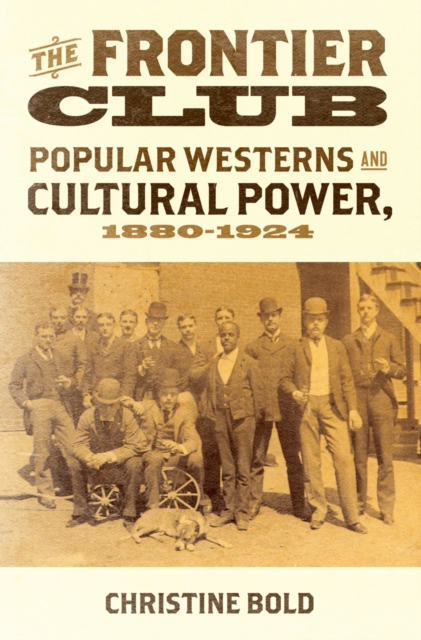
The frontier club : popular westerns and cultural power, 1880-1924
“The Frontier Club” is Christine Bold’s name for the network of eastern aristocrats who created the western as we now most commonly know it. At the turn of the twentieth century, they yoked this most popular formula to their own elite causes—from big-game hunting to conservation, immigration restriction to Jim Crow segregation—and aligned themselves with cattle kings and “quality” publishers. This book tells the story of that cultural sleight-of-hand. It delves into institutional archives and personal papers to excavate the hidden social, political, and financial interests in the making of the modern western. It re-reads frontier club fiction in relation to the federal policies and cultural spaces (from exclusive gentlemen’s clubs to national parks to zoos) with which it was intimately connected; the centerpiece is Owen Wister’s bestselling novel The Virginian. It casts new light on nine key clubmen, both the famous and the forgotten—in addition to Wister, the network included Theodore Roosevelt, George Bird Grinnell, Silas Weir Mitchell, Henry Cabot Lodge, Madison Grant, Caspar Whitney, Winthrop Chanler, and Frederic Remington—while recovering the women on whom these men depended and without whom this version of the popular West would not exist. Bold also considers some of the costs of the frontier club formula, in terms of its impact on Indigenous peoples and its marginalization of other popular voices, including western writings by African Americans, white women, and non-elite white men. The book ends by briefly charting the frontier club’s enduring impression on western movies.
eBook

Exploding the Western : myths of empire on the postmodern frontier
The frontier and Western expansionism are so quintessentially a part of American history that the literature of the West and Southwest is in some senses the least regional and the most national literature of all. The frontier—the place where cultures meet and rewrite themselves upon each other’s texts—continues to energize writers whose fiction evokes, destroys, and rebuilds the myth in ways that attract popular audiences and critics alike. Sara L. Spurgeon focuses on three writers whose works not only exemplify the kind of engagement with the theme of the frontier that modern authors make, but also show the range of cultural voices that are present in Southwestern literature: Cormac McCarthy, Leslie Marmon Silko, and Ana Castillo. Her central purposes are to consider how the differing versions of the Western “mythic” tales are being recast in a globalized world and to examine the ways in which they challenge and accommodate increasingly fluid and even dangerous racial, cultural, and international borders. In Spurgeon’s analysis, the spaces in which the works of these three writers collide offer some sharply differentiated visions but also create new and unsuspected forms, providing the most startling insights. Sometimes beautiful, sometimes tragic, the new myths are the expressions of the larger culture from which they spring, both a projection onto a troubled and troubling past and an insistent, prophetic vision of a shared future.
eBook
New Wests and Post-Wests
The writers of these chapters are often working with changing assumptions about literary and media interpretations of an American West. Here we see critical approaches to a West that never was, a West of myth so enduring that the myth dominates nearly all artistic representation about this place that never was. In this collection, we see critical approaches to a New West, a West that is a state of mind, not a geographical place but a mythic space with no boundaries and no political inevitabilities. These New Western studies accept the idea of a West that includes Canada, Mexico, Alaska, and, in the case of the US, every geographic and historical point west of the historic founding settlements. The West we study today is a post-West, an idea of the West past the traditional views of an old West dominated by white US nationalism and gendered as uncompromisingly masculine. The idea itself of a single West no longer holds validity. We now understand that all renderings of the West are renderings of multiple Wests; Wests constructed by American nationalists, Wests constructed by EuroAmerican writers and filmmakers, Wests constructed by native peoples, or Wests constructed outside the geographical boundaries of the US.This collection presents an eclectic array of new scholarship ranging freely over the New Wests and Post Wests, dealing with issues such as the literature of a 1950s California West; eco-crime genre fiction; the West of Edward Dorn and the Beat Movement; images of prostitution in California Gold Rush literature; European perspectives on film representations of the first peoples; the six shooter and the American West; German Westerns and Italian Westerns; The Authentic Death of Hendry Jones, by Charles Neider; and films such as The Treasure of Sierra Madre, Into the Wild, There Will Be Blood, and The Last Picture Show.A unique aspect of
this collection is the range of writers interpreting the American West in film and literature; besides those writing from within the United States, five of the writers provide international perspectives from the United Kingdom, and the Universities of Tunis, Vienna, and Rome.Each chapter includes a review of scholarship on its subject and an extended bibliography for further research.
eBook

Faithful Transgressions In The American West
The central issue Bush finds in these works is how their authors have dealt with the authority of Mormon Church leaders. As she puts it in her preface, \"I use the phrase 'faithful transgression' to describe moments in the texts when each writer, explicitly or implicitly, commits herself in writing to trust her own ideas and authority over official religious authority while also conceiving of and depicting herself to be a 'faithful' member of the Church.\" Bush recognizes her book as her own act of faithful transgression. Writing it involved wrestling, she states, \"with my own deeply ingrained religious beliefs and my equally compelling education in feminist theories that mean to liberate and empower women.\" Faithful Transgressions examines a remarkable group of authors and their highly readable and entertaining books. In producing the first significant book-length study of Mormon women's autobiographical writing, Bush rides a wave of memoir publishing and academic interest in autobiography and other life narratives. As she elucidates these works in relation to the religious tradition that played a major role in shaping them, she not only positions them in relation to feminist theory and current work on women's life writings but ties them to the long literary tradition of spiritual autobiography.
eBook

Reading for Liberalism
Founded in 1868, theOverland Monthlywas a San Francisco-based literary magazine whose mix of humor, pathos, and romantic nostalgia for a lost frontier was an immediate sensation on the East Coast. Due in part to a regional desire to attract settlers and financial investment, the essays and short fiction published in theOverland Monthlyoften portrayed the American West as a civilized evolution of, and not a savage regression from, eastern bourgeois modernity and democracy.
Stories about the American West have for centuries been integral to the way we imagine freedom, the individual, and the possibility for alternate political realities.Reading for Liberalismexamines the shifting literary and narrative construction of liberal selfhood in California in the late nineteenth century through case studies of a number of western American writers who wrote for theOverland Monthly, including Noah Brooks, Ina Coolbrith, Bret Harte, Jack London, John Muir, and Frank Norris, among others.Reading for Liberalismargues that Harte, the magazine's founding editor, and the other members of theOverlandgroup critiqued and reimagined the often invisible fabric of American freedom.Reading for Liberalismuncovers and examines in the text of theOverland Monthlythe relationship between wilderness, literature, race, and the production of individual freedom in late nineteenth-century California.
eBook

Unexpected Places
Winner 2010 Outstanding Academic Title ChoiceWinner 2010 EBSCOhost / Research Society for American Periodicals Book PrizeHonorable Mention 2010 Thomas J. Lyon Book Award, Western Literature Association
In January of 1861, on the eve of both the Civil War and the rebirth of the African Methodist Episcopal Church'sChristian Recorder, John Mifflin Brown wrote to the paper praising its editor Elisha Weaver: \"It takes our Western boys to lead off. I amproud of your paper.\"
Weaver's story, though, like many of the contributions of early black literature outside of the urban Northeast, has almost vanished.Unexpected Places: Relocating Nineteenth-Century African American Literaturerecovers the work of early African American authors and editors such as Weaver who have been left off maps drawn by historians and literary critics. Individual chapters restore to consideration black literary locations in antebellum St. Louis, antebellum Indiana, Reconstruction-era San Francisco, and several sites tied to the Philadelphia-based Recorder during and after the Civil War.
In conversation with both archival sources and contemporary scholarship,Unexpected Placescalls for a large-scale rethinking of the nineteenth-century African American literary landscape. In addition to revisiting such better-known writers as William Wells Brown, Maria Stewart, and Hannah Crafts,Unexpected Placesoffers the first critical considerations of important figures including William Jay Greenly, Jennie Carter, Polly Wash, and Lizzie Hart. The book's discussion of physical locations leads naturally to careful study of how region is tied to genre, authorship, publication circumstances, the black press, domestic and nascent black nationalist ideologies, and black mobility in the nineteenth century.
eBook

Playing House in the American West
Examines an eclectic group of western women’s
autobiographical texts—canonical and otherwise—
Playing House in the American West argues for a distinct
regional literary tradition characterized by strategic
representations of unconventional domestic life The
controlling metaphor Cathryn Halverson uses in her engrossing
study is “playing house.” From Caroline Kirkland and
Laura Ingalls Wilder to Willa Cather and Marilynne Robinson, from
the mid-nineteenth to the late-twentieth centuries, western
authors have persistently embraced wayward or eccentric
housekeeping to prove a woman’s difference from western
neighbors and eastern readers alike. The readings in
Playing House investigate the surprising textual ends to
which westerners turn the familiar terrain of the home:
evaluating community; arguing for different conceptions of race
and class; and perhaps most especially, resisting traditional
gender roles. Western women writers, Halverson argues, render the
home as a stage for autonomy, resistance, and imagination rather
than as a site of sacrifice and obligation. The western women
examined in
Playing House in the American West are promoted and read
as representatives of a region, as insiders offering views of
distant and intriguing ways of life, even as they conceive of
themselves as outsiders. By playing with domestic conventions,
they recast the region they describe, portraying the West as a
place that fosters female agency, individuality, and
subjectivity.
eBook