
Catalogue Search | MBRL


Are you sure you want to remove the book from the shelf?

{{itemTitle}}
95
result(s) for
"American literature-21st century-History and criticism"
Sort by:


Everyday Ecofascism
A timely look into how fascist ideas permeate contemporary culture well beyond the far right As challenges posed by climate change have intensified in the twenty-first century, right-wing figures in the United States and abroad have increasingly framed anti-immigrant, anti-Indigenous, and white-supremacist sentiments in terms of environmental survival. Everyday Ecofascism explores the insidious nature of this tendency, revealing how permutations of these perspectives in fact resonate across the political spectrum. Drawing on comparative studies of fascism writ large, Alexander Menrisky demonstrates that ecofascism is best understood not as a uniquely right-wing ideology but as a political genre that reinforces white supremacy and other forms of domination. Presenting a view of fascism as a complex power network that plays out on scales both large and small, Menrisky shows how extremist sentiments have crept into everyday language, stories, and ideas. Through a literary and cultural studies lens, he illuminates ecofascism's narrative patterns and their easy permeation of environmentalist discourses, from back-to-the-land movements to the resurgence of psychedelic drugs, food localism, and pandemic politics. Opposite his analysis of ecofascism in action, Menrisky sheds important light on narrative resistances to dominant conceptions of race, nation, and territory by Native, queer, and women-of-color writers who have countered ethnonationalism for generations. Bridging past and present, Menrisky powerfully nails down the emergent concept of ecofascism and forms a basis for understanding phenomena like Covid-19, ecological utopianism, and psychedelic environmentalism that detangles ecofascist tendencies from justice-oriented visions of place-based belonging. Retail e-book files for this title are screen-reader friendly.
eBook


Ugly White People
Whiteness revealed: an analysis of the destructive
complacency of white self-consciousness
White Americans are confronting their whiteness more than ever
before, with political and social shifts ushering in a newfound
racial awareness. And with white people increasingly seeing
themselves as distinctly racialized (not simply as American or
human), white writers are exposing a self-awareness of white
racialized behavior-from staunch antiracism to virulent forms of
xenophobic nationalism. Ugly White People explores
representations of whiteness from twenty-first-century white
American authors, revealing white recognition of the ugly forms
whiteness can take.
Stephanie Li argues that much of the twenty-first century has
been defined by this rising consciousness of whiteness because of
the imminent shift to a \"majority minority\" population and the
growing diversification of America's political, social, and
cultural institutions. The result is literature that more directly
grapples with whiteness as its own construct rather than a wrongly
assumed norm. Li contextualizes a series of literary novels as
collectively influenced by changes in racial and political
attitudes. Turning to works by Dave Eggers, Sarah Smarsh, J. D.
Vance, Claire Messud, Ben Lerner, and others, she traces the
responses to white consciousness that breed shared manifestations
of ugliness. The tension between acknowledging whiteness as an
identity built on domination and the failure to remedy inequalities
that have proliferated from this founding injustice is often the
source of the ugly whiteness portrayed through these
narratives.
The questions posed in Ugly White People about the
nature and future of whiteness are vital to understanding
contemporary race relations in America. From the election of Trump
and the rise of white nationalism to Karen memes and the war
against critical race theory to the pervasive pattern of behavior
among largely liberal-leaning whites, Li elucidates truths about
whiteness that challenge any hope of national unity and, most
devastatingly, the basic humanity of others.
Retail e-book files for this title are screen-reader
friendly.
eBook


Light and Legacies
An engaging examination of Black Girl Magic and its
significance in American literature
In Light and Legacies , author Janaka Bowman Lewis
examines Black girlhood in American literature from the
mid-twentieth century to the present. The representation of Black
girlhood in contemporary literature has long remained
underexplored. Through this literary history of \"Black Girl Magic,\"
Lewis offers one of the first studies in this rapidly growing field
of study. Light and Legacies poignantly showcases the
activist dimensions of creative literature through work by women
writers such as Toni Morrison and Toni Cade. As vectors of protest,
these stories reflect historical events while also creating an
enduring space of liberation and expression. The book provides
didactic and reflective portrayals of the Black experience-an
experience that has long been misunderstood. In a work both
enlightening and personal, Lewis brilliantly weaves accounts of her
own journey together with the liberating stories that shaped her
and so many others.
eBook

The Cambridge companion to Latina/o American literature
\"The Cambridge Companion to Latina/o American Literature provides a thorough yet accessible overview of a literary phenomenon that has been rapidly globalizing over the past two decades. It takes an innovative approach that underscores the importance of understanding Latina/o literature not merely as an ethnic phenomenon in the United States, but more broadly as a crucial element of a trans-American literary imagination. Leading scholars in the field present critical analyses of key texts, authors, themes, and contexts, from the early nineteenth century to the present. They engage with the dynamics of migration, linguistic and cultural translation, and the uneven distribution of resources across the Americas that characterize Latina/o literature. This Companion will be an invaluable resource, introducing undergraduate and graduate students to the complexities of the field\"-- Provided by publisher.
Book
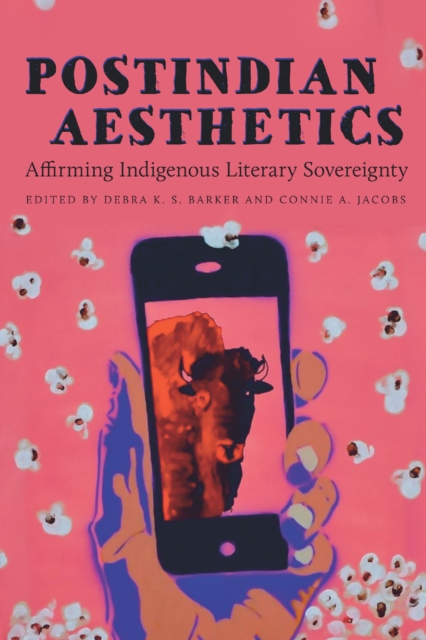
Postindian Aesthetics
Postindian Aesthetics is a collection of critical,
cutting-edge essays on Indigenous writers who are creatively and
powerfully contributing to a thriving Indigenous literary
aesthetic. This book argues for a literary canon that includes
Indigenous literature that resists colonizing stereotypes of what
has been and often still is expected in art produced by American
Indians. The works featured are inventive and current, and the
writers covered are visionaries who are boldly redefining
Indigenous literary aesthetics. The artists covered include Orlando
White, LeAnne Howe, Stephen Graham Jones, Deborah Miranda, Heid E.
Erdrich, Sherwin Bitsui, and many others. Postindian
Aesthetics is expansive and comprehensive with essays by many
of today's leading Indigenous studies scholars. Organized
thematically into four sections, the topics in this book include
working-class and labor politics, queer embodiment, national and
tribal narratives, and new directions in Indigenous literatures. By
urging readers to think beyond the more popularized Indigenous
literary canon, the essays in this book open up a new world of
possibilities for understanding the contemporary Indigenous
experience. The volume showcases thought-provoking scholarship
about literature written by important contemporary Indigenous
authors who are inspiring critical acclaim and offers new ways to
think about the Indigenous literary canon and encourages
instructors to broaden the scope of works taught in literature
courses more broadly. ContributorsEric Gary Anderson Ellen L.
Arnold Debra K. S. Barker Laura J. Beard Esther G. Belin Jeff
Berglund Sherwin Bitsui Frank Buffalo Hyde Jeremy M. Carnes Gabriel
S. Estrada Stephanie Fitzgerald Jane Haladay Connie A. Jacobs
Daniel Heath Justice Virginia Kennedy Denise Low Molly McGlennen
Dean Rader Kenneth M. Roemer Susan Scarberry-García Siobhan Senier
Kirstin L. Squint Robert Warrior
eBook


Challenging the Black Atlantic
The historical novels of Manuel Zapata Olivella and Ana Maria Gonçalves map black journeys from Africa to the Americas in a way that challenges the Black Atlantic paradigm that has become synonymous with cosmopolitan African diaspora studies. Unlike Paul Gilroy, who coined the term and based it on W.E.B. DuBois’s double consciousness, Zapata, in Changó el gran putas (1983), creates an empowering mythology that reframes black resistance in Colombia, Haiti, Mexico, Brazil, and the United States. In Um defeito de cor (2006), Gonçalves imagines the survival strategies of a legendary woman said to be the mother of black abolitionist poet Luís Gama and a conspirator in an African Muslim–led revolt in Brazil’s “Black Rome.” These novels show differing visions of revolution, black community, femininity, sexuality, and captivity. They skillfully reveal how events preceding the UNESCO Decade of Afro-Descent (2015–2024) alter our understanding of Afro-Latin America as it gains increased visibility.
Published by Bucknell University Press. Distributed worldwide by Rutgers University Press.
eBook