
Catalogue Search | MBRL


Are you sure you want to remove the book from the shelf?

{{itemTitle}}
721
result(s) for
"American poetry 20th century History and criticism."
Sort by:


After Translation
Translation--from both a theoretical and practical point of view--articulates differing but interconnected modes of circulation in the work of writers originally from different geographical areas of transatlantic encounter, such as Europe, Latin America, North America, and the Caribbean. After Translation examines from a transnational perspective the various ways in which translation facilitates the circulation of modern poetry and poetics across the Atlantic. It rethinks the theoretical paradigm of Anglo-American \"modernism\" based on the transnational, interlingual and transhistorical features of the work of key modern poets writing at both sides of the Atlantic--namely, the Portuguese Fernando Pessoa; the Chilean Vicente Huidobro; the Spaniard Federico García Lorca; the San Francisco-based poets Jack Spicer, Robert Duncan, and Robin Blaser; the Barbadian Kamau Brathwaite; and the Brazilian brothers Haroldo and Augusto de Campos.
eBook
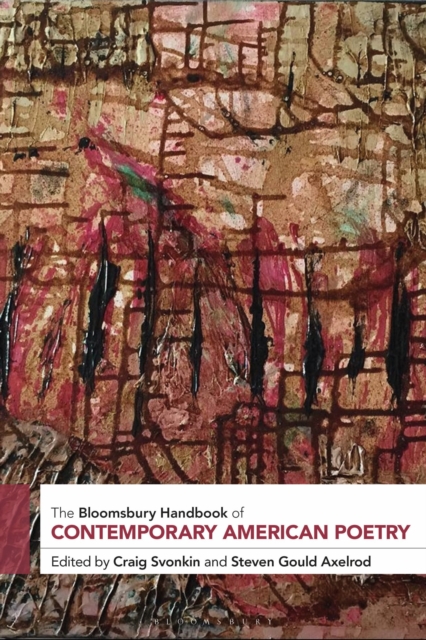
The Bloomsbury Handbook of Contemporary American Poetry
With chapters written by leading scholars such as Steven Gould Axelrod, Cary Nelson, Aldon Lynn Nielsen and Marjorie Perloff, this comprehensive Handbook explores the full range and diversity of poetry and criticism in 21st-century America. The Bloomsbury Handbook of Contemporary American Poetry covers such topics as: • Major histories and genealogies of post-war poetry – from the language poets and the Black Arts Movement to New York school and the Beats • Poetry, identity and community – from African American, Chicana/o and Native American poetry to Queer verse and the poetics of disability • Key genres and forms – including digital, visual, documentary and children’s poetry • Central critical themes – economics, publishing, popular culture, ecopoetics, translation and biography The book also includes an interview section in which major contemporary poets such as Rae Armantrout, Charles Bernstein and Claudia Rankine reflect on the craft and value of poetry today.
eBook


Ecopoetics
Ecocritics and other literary scholars interested in the environment have tended to examine writings that pertain directly to nature and to focus on subject matter more than expression. In this book, Scott Knickerbocker argues that it is time for the next step in ecocriticism: scholars need to explore the figurative and aural capacity of language to evoke the natural world in powerful ways. Ecopoetics probes the complex relationship between artifice and the natural world in the work of modern American poets—in particular Wallace Stevens, Elizabeth Bishop, Richard Wilbur, and Sylvia Plath. These poets relate to nature as a deep wellspring of meaning, although they all avoid using language the way most nature writers do, merely to reflect or refer directly to the world. Each of these poets, in his or her own distinct way, employs instead what Knickerbocker terms sensuous poesis, the process of rematerializing language through sound effects and other formal devices as a sophisticated response to nonhuman nature. Rather than attempt to erase the artifice of their own poems, to make them seem more natural and thus supposedly closer to nature, the poets in this book unapologetically embrace artifice—not for its own sake but in order to perform and enact the natural world. Indeed, for them, artifice is natural. In examining their work, Knickerbocker charts a new direction for ecocriticism.
eBook


Red modernism : American poetry and the spirit of communism
How did modernist poetry respond—both thematically and technically—to communism? In Red Modernism, Mark Steven asserts that modernism was highly attuned—and aesthetically responsive—to the overall spirit of communism. He considers the maturation of American poetry as a longitudinal arc, one that roughly followed the rise of the USSR through the Russian Revolution and its subsequent descent into Stalinism, opening up a hitherto underexplored domain in the political history of avant-garde literature. In doing so, Steven amplifies the resonance among the universal idea of communism, the revolutionary socialist state, and the American modernist poem. Focusing on three of the most significant figures in modernist poetry—Ezra Pound, William Carlos Williams, and Louis Zukofsky—Steven provides a theoretical and historical introduction to modernism's unique sense of communism while revealing how communist ideals and references were deeply embedded in modernist poetry. Moving between these poets and the work of T. S. Eliot, Langston Hughes, Muriel Rukeyser, Gertrude Stein, Wallace Stevens, and many others, the book combines a detailed analysis of technical devices and poetic values with a rich political and economic context. Persuasively charting a history of the avant-garde modernist poem in relation to communism, beginning in the 1910s and reaching into the 1940s, Red Modernism is an audacious examination of the twinned history of politics and poetry.
eBook


The Great War and the language of modernism
In The Great War and the Language of Modernism, Vincent Sherry reopens long unanswered questions regarding the influence of the 1914 war on the verbal experiments of modernist poetry and fiction. Sherry recovers the political discourses of the British campaign and establishes the language to which literary modernism responds with its boldest initiatives. In its wholly new reading of Woolf, Eliot, and Pound, this book restores the historical content and depth of this literature and reveals its most daring import.
eBook