
Catalogue Search | MBRL


Are you sure you want to remove the book from the shelf?

{{itemTitle}}
63
result(s) for
"American prose literature -- 19th century -- History and criticism"
Sort by:

The American essay in the American century
\"With extensive research and a cultural context, Stuckey-French describes the many reasons essays grew in appeal and importance for Americans. He also explores the rise of E.B. White, considered by many the greatest American essayist of the first half of the twentieth century... This book is one of the first to consider and reflect on the contributions of E.B. White to the personal essay tradition and American culture more generally\"--Book jacket.
Book

Panic Fiction
Panic Fiction explores a unique body of antebellum American women’s writing that illuminates women’s relationships to the marketplace and the links between developing ideologies of domesticity and the formation of an American middle class. Between the mid-1830s and the late 1850s, authors such as Hannah Lee, Catharine Sedgwick, Eliza Follen, Maria McIntosh, and Maria Cummins wrote dozens of novels and stories depicting the effects of financial panic on the home and proposing solutions to economic instability. This unique body of antebellum American women’s writing, which integrated economic discourse with the language and conventions of domestic fiction, is what critic Mary Templin terms “panic fiction.” In Panic Fiction: Antebellum Women Writers and Economic Crisis , Templin draws in part from the methods of New Historicism and cultural studies, situating these authors and their texts within the historical and cultural contexts of their time. She explores events surrounding the panics of 1837 and 1857, prevalent attitudes toward speculation and failure as seen in newspapers and other contemporaneous texts, women’s relationships to the marketplace, and the connections between domestic ideology and middle-class formation. Although largely unknown today, the phenomena of “panic fiction” was extremely popular in its time and had an enormous influence on nineteenth-century popular conceptions of speculation, failure, and the need for marketplace reform, providing a distinct counterpoint to the analysis of panic found in newspapers, public speeches, and male-authored literary texts of the time.
eBook

Panic fiction : women and antebellum economic crisis
\"Panic Fiction explores a unique body of antebellum American women's writing that illuminates women's relationships to the marketplace and the links between developing ideologies of domesticity and the formation of an American middle class\"-- Provided by publisher.
Book

Mediating American autobiography : photography in Emerson, Thoreau, Douglass, and Whitman
Both photography and autobiography involve a tension between disclosing and concealing their means of production: a chemical process for one, the writing process for the other. Meehan examines how four major authors-Ralph Waldo Emerson, Henry David Thoreau, Frederick Douglass, and Walt Whitman-were well aware of this tension and explored it in their work. By examining the implications of early photography in their writings, he shows how each engaged the new visual medium, how photography mediated their conceptions of self-representation, and how their appropriation of photographic thinking created a new kind of autobiography. He intertwines these four writers' reflections on photography with theories of photography as expounded by its inventors and observers, from Louis Daguerre and William Talbot in Europe to Oliver Well Holmes and Marcus Root in America.
eBook


Inexpressible Privacy
Selected by Choice magazine as an Outstanding Academic TitleFew concepts are more widely discussed or more passionately invoked in American public culture than that of privacy. What these discussions have lacked, however, is a historically informed sense of privacy's genealogy in U.S. culture. Now, Milette Shamir traces this peculiarly American obsession back to the middle decades of the nineteenth century, when our modern understanding of privacy took hold.Shamir explores how various discourses, as well as changes in the built environment, worked in tandem to seal, regulate, and sanctify private spaces, both domestic and subjective. She offers revelatory readings of texts by Nathaniel Hawthorne, Frederick Douglass, Herman Melville, Harriet Beecher Stowe, Henry David Thoreau, and other, less familiar antebellum writers and looks to a wide array of sources, including architectural blueprints for private homes, legal cases in which a \"right to privacy\" supplements and exceeds property rights, examples of political rhetoric vaunting the sacred inviolability of personal privacy, and conduct manuals prescribing new codes of behavior to protect against intrusion.
eBook


John Burroughs and the Place of Nature
This study situates John Burroughs, together with John Muir and Theodore Roosevelt, as one of a trinity of thinkers who, between the Civil War and World War I, defined and secured a place for nature in mainstream American culture. Though not as well known today, Burroughs was the most popular American nature writer of his time. Prolific and consistent, he published scores of essays in influential large-circulation magazines and was often compared to Thoreau. Unlike Thoreau, however, whose reputation grew posthumously, Burroughs wasa celebrity during his lifetime: he wrote more than thirty books, enjoyed a continual high level of visibility, and saw his work taught widely in public schools. James Perrin Warren shows how Burroughs helped guide urban and suburban middle-class readers \"back to nature\" during a time of intense industrialization and urbanization. Warren discusses Burroughs's connections not only to Muir and Roosevelt but also to his forebears Emerson, Thoreau, and Whitman. By tracing the complex philosophical, creative, and temperamental lineage of these six giants, Warren shows how, in their friendships and rivalries, Burroughs, Muir, and Roosevelt made the high literary romanticism of Emerson, Thoreau, and Whitman relevant to late-nineteenth- and early-twentieth-century Americans. At the same time, Warren offers insights into the rise of the nature essay as a genre, the role of popular magazines as shapers and conveyors of public values, and the dynamism of place in terms of such opposed concepts as retreat and engagement, nature and culture, and wilderness and civilization. Because Warren draws on Burroughs's personal, critical, and philosophical writings as well as his better-known narrative essays, readers will come away with a more informed sense of Burroughs as a literary naturalist and a major early practitioner of ecocriticism. John Burroughs and the Place of Nature helps extend the map of America's cultural landscape during the period 1870-1920 by recovering an unfairly neglected practitioner of one of his era's most effective forces for change: nature writing.
eBook

The American essay in the American century
In modern culture, the essay is often considered an old-fashioned, unoriginal form of literary styling. The word essay brings to mind the uninspired five-paragraph theme taught in schools around the country or the antiquated, Edwardian meanderings of English gentlemen rattling on about art and old books. These connotations exist despite the fact that Americans have been reading and enjoying personal essays in popular magazines for decades, engaging with a multitude of ideas through this short-form means of expression. To defend the essay—that misunderstood staple of first-year composition courses—Ned Stuckey-French has written The American Essay in the American Century. This book uncovers the buried history of the American personal essay and reveals how it played a significant role in twentieth-century cultural history. In the early 1900s, writers and critics debated the \"death of the essay,\" claiming it was too traditional to survive the era's growing commercialism, labeling it a bastion of British upper-class conventions. Yet in that period, the essay blossomed into a cultural force as a new group of writers composed essays that responded to the concerns of America's expanding cosmopolitan readership. These essays would spark the \"magazine revolution,\" giving a fresh voice to the ascendant middle class of the young century. With extensive research and a cultural context, Stuckey-French describes the many reasons essays grew in appeal and importance for Americans. He also explores the rise of E. B. White, considered by many the greatest American essayist of the first half of the twentieth century whose prowess was overshadowed by his success in other fields of writing. White's work introduced a new voice, creating an American essay that melded seriousness and political resolve with humor and self-deprecation. This book is one of the first to consider and reflect on the contributions of E. B. White to the personal essay tradition and American culture more generally. The American Essay in the American Century is a compelling, highly readable book that illuminates the history of a secretly beloved literary genre. A work that will appeal to fiction readers, scholars, and students alike, this book offers fundamental insight into modern American literary history and the intersections of literature, culture, and class through the personal essay. This thoroughly researched volume dismisses, once and for all, the \"death of the essay,\" proving that the essay will remain relevant for a very long time to come.
eBook
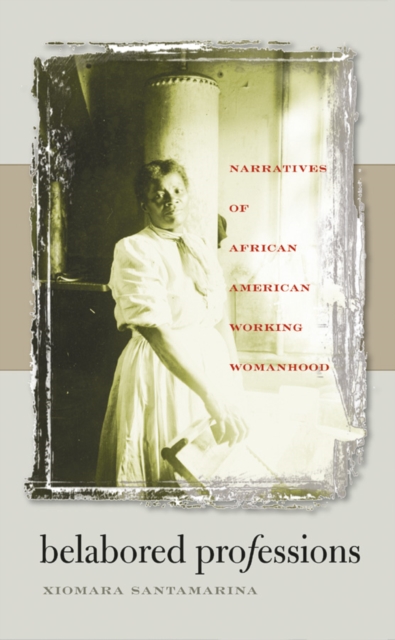
Belabored professions : narratives of African American working womanhood
According to nineteenth-century racial uplift ideology, African American women served their race best as reformers and activists, or as \"doers of the word.\" In Belabored Professions, Xiomara Santamarina examines the autobiographies of four women who diverged from that ideal and defended the legitimacy of their self-supporting wage labor. Santamarina focuses on The Narrative of Sojourner Truth, Eliza Potters A Hairdressers Experience in High Life, Harriet Wilsons Our Nig, and Elizabeth Keckleys Behind the Scenes. She argues that beyond black reformers' calls for abolitionist work, these former slaves and freeborn black women wrote about their own overlooked or disparaged work as socially and culturally valuable to the nation. They promoted the status of wage labor as a mark of self-reliance and civic virtue when many viewed African American working women as \"drudges.\" As Santamarina demonstrates, these texts offer modern readers new perspectives on the emergence of the vital African American autobiographical tradition, dramatizing the degree to which black working women participated in and shaped American rhetorics of labor, race, and femininity.
eBook