
Catalogue Search | MBRL


Are you sure you want to remove the book from the shelf?

{{itemTitle}}
27
result(s) for
"Americans Spain Fiction"
Sort by:


The Censorship Files
Drawing on extensive research in the Spanish National Archive, Alejandro Herrero-Olaizola examines the role played by the censorship apparatus of Franco's Spain in bringing about the Latin American literary Boom of the 1960s and 1970s. He reveals the negotiations and behind-the-scenes maneuvering among those involved in the Spanish publishing industry. Converging interests made strange bedfellows of the often left-wing authors and the staid officials appointed to stand guard over Francoist morality and to defend the supposed purity of Castilian Spanish. Between these two uneasily allied groups circulated larger-than-life real-world characters like the Barcelona publisher Carlos Barral and the all-powerful literary agent Carmen Balcells. The author details the fascinating story of how novels by Mario Vargas Llosa, Guillermo Cabrera Infante, Gabriel García Márquez, and Manuel Puig achieved publication in Spain, and in doing so reached a worldwide market. This colorful account underpins a compelling claim that even the most innovative and aesthetically challenging literature has its roots in the economics of the book trade, as well as the institutions of government and the exigencies of everyday politics and ideology.
eBook

Bilingual Legacies
Bilingual Legacies examines fatherhood in the work of four canonical Spanish authors born in Barcelona and raised during the dictatorship of Francisco Franco. Drawing on the autobiographical texts of Juan Goytisolo, Carlos Barral, Terenci Moix, and Clara Janes, the book explores how these authors understood gender roles and paternal figures as well as how they positioned themselves in relation to Spanish and Catalan literary traditions.Anna Casas Aguilar contends that through their presentation of father figures, these authors subvert static ideas surrounding fatherhood. She argues that this diversity was crucial in opening the door to revised gender models in Spain during the democratic period. Moving beyond the shadow of the dictator, Casas Aguilar shows how these writers distinguished between the patriarchal \"father of the nation\" and their own paternal figures. In doing so, Bilingual Legacies sheds light on the complexity of Spanish conceptions of gender, language, and family and illustrates how notions of masculinity, authorship, and canon are interrelated.
eBook

Harmony and hoops
After Nate's middle school basketball team suffers a frustrating loss, he and his cousin Rachel travel back in time to see the 1992 Dream Team in Barcelona, and learn about teamwork-- but, he still needs to convince the other players on his team to share the ball.
Book

The Rise of Spanish-Language Filmmaking
Silent film was universally understood and could be exported anywhere. But when \"talkies\" arrived, the industry began experimenting with dubbing, subtitling, and dual track productions in more than one language. Where language fractured the European film market, for Spanish-speaking countries and communities, it created new opportunities. InThe Rise of Spanish-Language Filmmaking, Lisa Jarvinen focuses specifically on how Hollywood lost ground in the lucrative international Spanish-speaking audience between 1929 and 1939.
Hollywood studios initially trained cadres of Spanish-speaking film professionals, created networks among them, and demonstrated the viability of a broadly conceived, transnational, Spanish-speaking film market in an attempt to forestall the competition from other national film industries. By the late 1930s, these efforts led to unintended consequences and helped to foster the growth of remarkably robust film industries in Mexico, Spain, and Argentina. Using studio records, Jarvinen examines the lasting effects of the transition to sound on both Hollywood practices and cultural politics in the Spanish-speaking world. She shows through case studies based on archival research in the United States, Spain, and Mexico how language, as a key marker of cultural identity, led to new expectations from audiences and new possibilities for film producers.
eBook

“A Girl Is Like a Flower. … If a Rough Wind Blows near Her, Her Bloom Is Faded”: The Southern Lady in Macaria, The Battle-Ground, and Gone with the Wind
This article examines how the Southern lady is represented in three major Southern women’s novels set during the American Civil War: Macaria (1864) by Augusta Jane Evans Wilson, The Battle-Ground (1902) by Ellen Glasgow, and Gone with the Wind (1936) by Margaret Mitchell. Although separated by over seven decades and distinct historical perspectives—Wilson as a contemporary witness, Glasgow as a postwar observer, and Mitchell as a nostalgic inheritor—their works collectively shaped enduring images of the South in American popular culture. Through textual analysis, the study explores how each author depicts female endurance, illness, and mortality to symbolize both individual and social transformation. The heroines (Wilson’s Electra and Irene, Glasgow’s Betty Ambler, and Mitchell’s Scarlett O’Hara) embody resilience amid collapse, assuming active roles in the reconstruction of Southern identity. Their struggles reflect broader tensions between traditional femininity and emerging female agency. Ultimately, the article argues that portrayals of women’s frailty and death function as metaphors for the decline of the antebellum order and the inevitable demise of the Southern lady ideal, revealing illness and death as physical and cultural markers of the South’s transformation in war and its aftermath.
Journal Article

Madness, Marriage, and “The Right Way to Be Happy” in Eudora Welty’s Fiction
Most of Eudora Welty’s fiction, specifically her story “Music from Spain” (1948) and short novel The Ponder Heart (1954), appeared during a time when medical authorities still viewed same-sex desire as a mental illness. Welty’s work, however, suggests the problem lies not with the individual but with society’s prejudice and strict prescriptions of happiness contingent on marriage and domesticity, which do not account for sexual alterities. Eugene and Daniel, the texts’ respective male protagonists, struggle to find fulfillment within the confines of traditional marriage, rupturing the purported link between happiness and heterosexuality.
Journal Article

Breaking the Silence
This article analyzes the strange eco-cosmopolitan detective attributes of Ivon, the protagonist in Alicia Gaspar de Alba’s 2005 novel Desert Blood: The Juárez Murders. Through this willful, queer, and feminist mestiza character, who continually trespasses and transgresses cultural borders, Gaspar de Alba challenges the standards of crime fiction in numerous ways, as argued in this paper. Moreover, she also manages to expose the transnational dimension of the exploitation, mistreatment, and even murder of women in Ciudad Juárez. Simultaneously, Ivon’s eco-cosmopolitanism acknowledges how the expendability thinking of free trade that partly sanctions the murder of women, also results in the environmental degradation of, and the free flow of toxins and pollution in the border. Ultimately, Ivon’s strange, eco-cosmopolitan investigative traits, serve as the tools to break the silence and start confronting the feminicides in Ciudad Juárez as well as the socio-environmental exploitation of the US-Mexico border region, fostering a positive socio-environmental change.
Journal Article
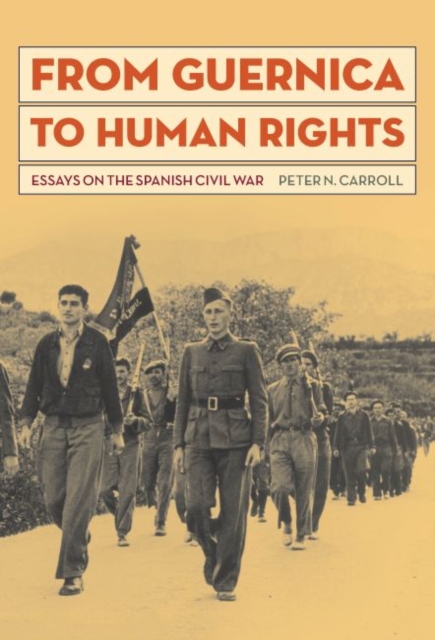
From Guernica to Human Rights
The best essays by one of the leading experts on the Spanish Civil War The Spanish Civil War, a military rebellion supported by Hitler and Mussolini, attracted the greatest writers of the age.Among them were Ernest Hemingway, George Orwell, André Malraux, Arthur Koestler, Langston Hughes, and Martha Gellhorn.
eBook