
Catalogue Search | MBRL


Are you sure you want to remove the book from the shelf?

{{itemTitle}}
2
result(s) for
"Ammi, Ben,-1939-2014"
Sort by:

The African Hebrew Israelites of Jerusalem and Ben Ammi’s Theology of Marginalisation and Reorientation
This paper will look at the way the African Hebrew Israelites of Jerusalem have utilised the theological narrative of marginalisation in their quest for identity and self-determination. The African Hebrew Israelites of Jerusalem are an expatriate black American group who have lived in Israel since 1969, when their spiritual leader, Detroit-born Ben Ammi, received a vision commanding him to take his people back to the Promised Land. Drawing on a long tradition in the African American community that self-identified as the biblical Israelites, the African Hebrew Israelites are marginalised in their status as Americans, as Jews, and as Israelis. We will examine the writings of Ben Ammi in order to demonstrate that this biblically based motif of marginalisation was a key part of his theology, and one which enabled his movement to grow and sustain itself; yet, in comparison with other contemporaneous theological movements, Ben Ammi utilised a specific variant of this motif. Rejecting the more common emphasis on liberation, Ammi argued for an eschatological reorientation around the marginalised. This article will conclude that Ben Ammi’s theology is key to understanding how the community has oriented itself and how it has proved successful in lasting 50 years against both internal disputes and external attacks.
Journal Article
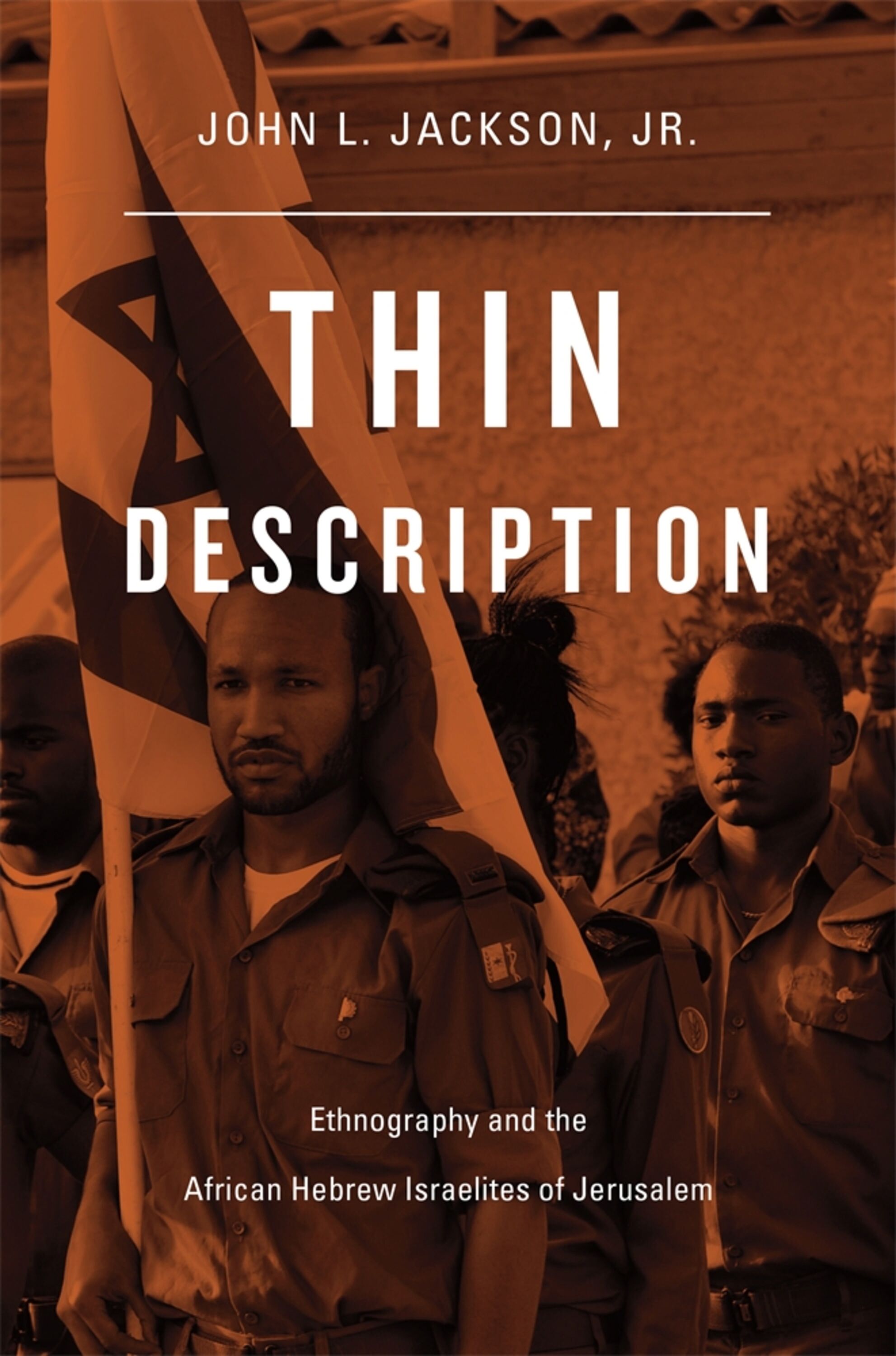
Thin description : ethnography and the African Hebrew Israelites of Jerusalem
African Hebrew Israelites of Jerusalem are often dismissed as a fringe cult, but John L. Jackson questions what \"fringe\" means when cultural practices of every stripe circulate freely on the Internet. He reveals how race, religion, and ethnographic representation must be understood anew in the 21st century lest we reenact past errors.
eBook