
Catalogue Search | MBRL


Are you sure you want to remove the book from the shelf?

{{itemTitle}}
2,049
result(s) for
"Anarchy"
Sort by:

The trial of the Haymarket Anarchists : terrorism and justice in the Gilded Age
\"The Trial of the Haymarket Anarchists is the culmination of seven years of research into the 1886 Haymarket bombing and subsequent trial. It not only overturns the prevailing consensus on this event, it documents in detail how the basic facts, as far as they can be determined, have been distorted, obscured, or suppressed for seventy years. Based on both a reexamination of well-known sources and the discovery of many new ones, Timothy Messer-Kruse demonstrates that the received wisdom regarding Chicago's anarchist leaders--that they were tried and convicted for their ideas in a trial in which little evidence of their guilt was presented--is absolutely false\"--Provided by publisher.
Book

Two Metaverse Dystopias
In recent years, the metaverse—some form of immersive digital extension of the physical world—has received much attention. As tech companies present their bold visions, scientists and scholars have also turned to metaverse issues, from technological challenges via societal implications to profound philosophical questions. This article contributes to this growing literature by identifying the possibilities of two dystopian metaverse scenarios, namely one based on the experience machine and one based on demoktesis—two concepts from Nozick (Anarchy, State, and Utopia, Basic Books, 1974). These dystopian scenarios are introduced, and the potential for a metaverse to evolve into either of them is explained. The article is concluded with an argument for why the two dystopian scenarios are not strongly wedded to any particular theory of ethics or political philosophy, but constitute a more general contribution.
Journal Article


Algorithmic Fairness, Risk, and the Dominant Protective Agency
With increasing use of automated algorithmic decision-making, issues of algorithmic fairness have attracted much attention lately. In this growing literature, existing concepts from ethics and political philosophy are often applied to new contexts. The reverse—that novel insights from the algorithmic fairness literature are fed back into ethics and political philosophy—is far less established. However, this short commentary on Baumann and Loi (Philosophy & Technology, 36(3), 45 2023) aims to do precisely this. Baumann and Loi argue that among algorithmic group fairness measures proposed, one—sufficiency (well-calibration) is morally defensible for insurers to use, whereas independence (statistical parity or demographic parity) and separation (equalized odds) are not normatively appropriate in the insurance context. Such a result may seem to be of relatively narrow interest to insurers and insurance scholars only. We argue, however, that arguments such as that offered by Baumann and Loi have an important but so far overlooked connection to the derivation of the minimal state offered by Nozick (1974) and thus to political philosophy at large.
Journal Article


Why a World State is Inevitable
Long dismissed as unscientific, teleological explanation has been undergoing something of a revival as a result of the emergence of self-organization theory, which combines micro-level dynamics with macro-level boundary conditions to explain the tendency of systems to develop toward stable end-states. On that methodological basis this article argues that a global monopoly on the legitimate use of organized violence — a world state — is inevitable. At the micro-level world state formation is driven by the struggle of individuals and groups for recognition of their subjectivity. At the macro-level this struggle is channeled toward a world state by the logic of anarchy, which generates a tendency for military technology and war to become increasingly destructive. The process moves through five stages, each responding to the instabilities of the one before — a system of states, a society of states, world society, collective security, and the world state. Human agency matters all along the way, but is increasingly constrained and enabled by the requirements of universal recognition.
Journal Article
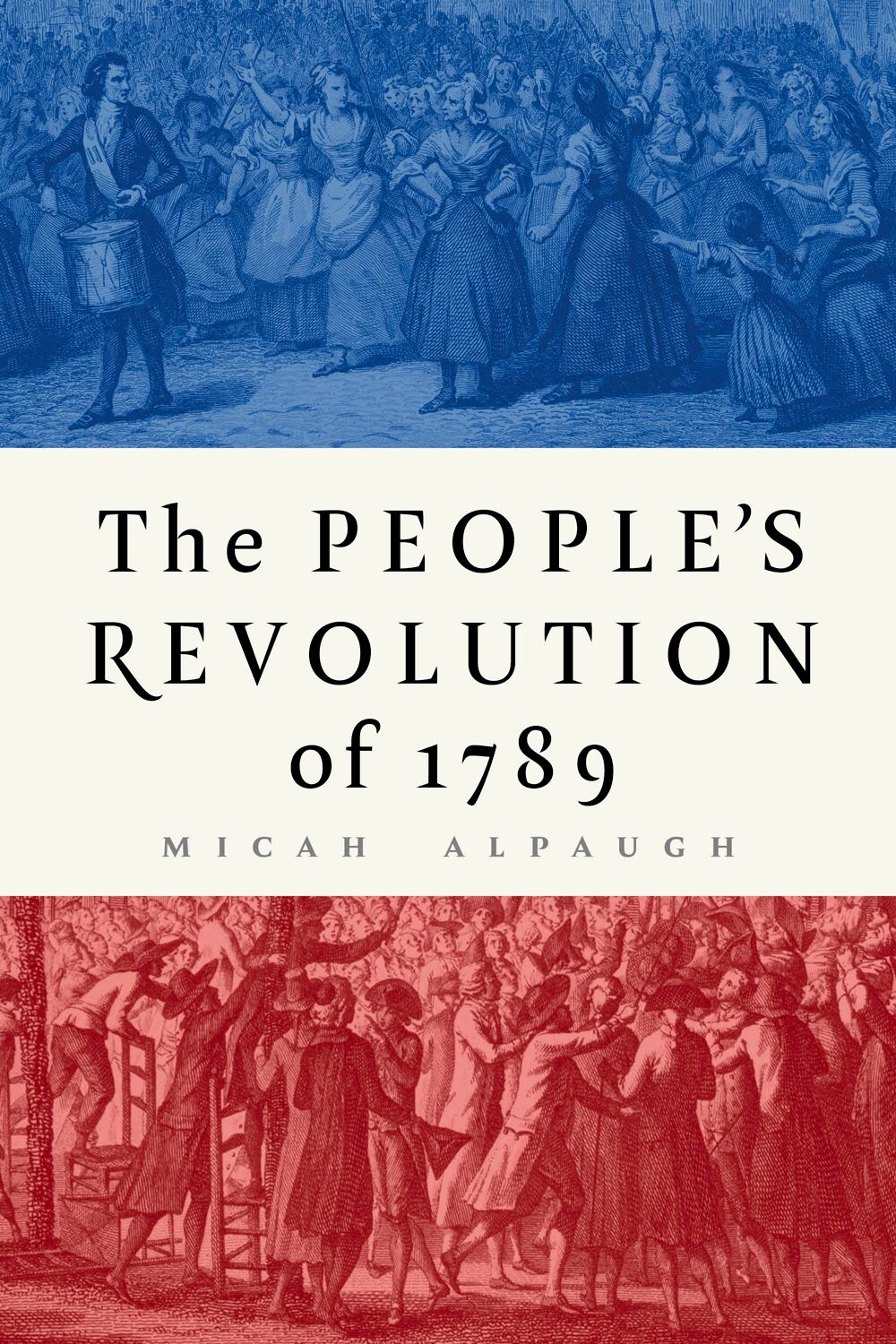
The People's Revolution of 1789
The People's Revolution of 1789
analyzes the historic events that unleashed a vast panoply
of anarchic, destructive, and creative disorders that demolished
France's Old Regime and founded a new revolutionary order.
It captures the complex and dynamic interplay of uprisings,
elections, meetings, and revolutionary moments that helped create
modern freedom.
The People's Revolution of 1789 is the first book to
chronicle the Parisian, provincial, and colonial movements of 1789
together. In doing so, Micah Alpaugh builds from hundreds of local
and regional studies and sources on the French Revolution to
provide a new interpretation of the powerful contestations that
created the modern revolutionary tradition. He explores the
multiplicity of movements-anarchistically operating without a
common leader and usually in only loose coordination-that gave the
revolutionary dynamic its power, without which the legislators'
revolution at Versailles would have failed or been severely
curtailed. The rapid onslaught of protests across the First Year of
Liberty compounded their effects, overpowering authorities' efforts
to maintain a degenerating order and forcing the establishment of a
more open system.
The People's Revolution of 1789 reveals in new ways how
the French revolutionaries ended feudalism, established human
rights, abolished the police, and instituted new elected
governments. By returning emphasis to the people's revolution, we
can better understand how world history's most consequential
revolution developed, as millions of French people embraced direct
action in hopes of fundamental change. Through the movements of
millions, the French created the most powerful revolution the world
had yet experienced.
eBook

Unruly equality
The first intellectual and social history of American anarchist thought and activism across the twentieth centuryIn this highly accessible history of anarchism in the United States, Andrew Cornell reveals an astounding continuity and development across the century. Far from fading away, anarchists dealt with major events such as the rise of Communism, the New Deal, atomic warfare, the black freedom struggle, and a succession of artistic avant-gardes stretching from 1915 to 1975.Unruly Equalitytraces U.S. anarchism as it evolved from the creed of poor immigrants militantly opposed to capitalism early in the twentieth century to one that today sees resurgent appeal among middle-class youth and foregrounds political activism around ecology, feminism, and opposition to cultural alienation.
eBook

The price of anarchy in routing games as a function of the demand
The price of anarchy has become a standard measure of the efficiency of equilibria in games. Most of the literature in this area has focused on establishing worst-case bounds for specific classes of games, such as routing games or more general congestion games. Recently, the price of anarchy in routing games has been studied as a function of the traffic demand, providing asymptotic results in light and heavy traffic. The aim of this paper is to study the price of anarchy in nonatomic routing games in the intermediate region of the demand. To achieve this goal, we begin by establishing some smoothness properties of Wardrop equilibria and social optima for general smooth costs. In the case of affine costs we show that the equilibrium is piecewise linear, with break points at the demand levels at which the set of active paths changes. We prove that the number of such break points is finite, although it can be exponential in the size of the network. Exploiting a scaling law between the equilibrium and the social optimum, we derive a similar behavior for the optimal flows. We then prove that in any interval between break points the price of anarchy is smooth and it is either monotone (decreasing or increasing) over the full interval, or it decreases up to a certain minimum point in the interior of the interval and increases afterwards. We deduce that for affine costs the maximum of the price of anarchy can only occur at the break points. For general costs we provide counterexamples showing that the set of break points is not always finite.
Journal Article
Anarchy in the World-System
The world-system has been in a crisis for a while. The decline of U.S. hegemony, the rise of China, and Russia’s assertive foreign policy are the most important issues regarding the course of the world-system. On the one hand, the United States and its allies (in Samir Amin’s words, “the triad”) have desperately tried to protect the status quo. On the other hand, China and Russia have tried to create an alternative to sustain the capitalist world-system instead of U.S. hegemony. For this reason, to analyze the world-system, I argue that core-periphery relations should be reevaluated regarding China and Russia with the concept of semi-core. This study aims to evaluate the possible outcomes and prospects in the world-system in light of the rivalry between core and semi-core, and asserts that the world-system is in the phase of interregnum that consists of instabilities and disorders. This phase of interregnum has stemmed from the existence of semi-core and the structural crisis of the system.
Journal Article