
Catalogue Search | MBRL


Are you sure you want to remove the book from the shelf?

{{itemTitle}}
42
result(s) for
"Andes Region -- Colonization"
Sort by:

The course of Andean history
\"A student-friendly text that tells the story of the development of the Andean republics and their people by emphasizing the themes of continuity and change over time. Henderson presents a succinct, narrative approach to Andean history that limits details about political coups and instead focuses on broader comparative social and culture aspects\"--Provided by publisher.
Book

The course of Andean history
The only comprehensive history of Andean South America from initial settlement to the present, this useful book focuses on Colombia, Ecuador, Peru, and Bolivia, the four countries where the Andes have played a major role in shaping history.
Although Henderson emphasizes the period since the winning of independence in 1825, he argues that the region’s republican history cannot be explained without a clear understanding of what happened in the pre-Hispanic and colonial eras Henderson carefully explores the complex relationship between the Andean peoples and their land up until the fall of the Inka Empire in 1532 before addressing the Spanish conquest and the colonial aftermath, emphasizing the syncretism often unwillingly forced upon the original inhabitants of the region. His account of the nineteenth century discusses the attempts of the Andean elite to fashion modern nation-states in the face of many divisive factors, including race. The final chapters carry the story from 1930 to the present as the Andean countries debated different ways to create a more inclusive and prosperous society.
eBook

Decolonizing the sodomite : queer tropes of sexuality in colonial Andean culture
Early Andean historiography reveals a subaltern history of indigenous gender and sexuality that saw masculinity and femininity not as essential absolutes. Third-gender ritualists, Ipas, mediated between the masculine and feminine spheres of culture in important ceremonies and were recorded in fragments of myths and transcribed oral accounts. Ritual performance by cross-dressed men symbolically created a third space of mediation that invoked the mythic androgyne of the pre-Hispanic Andes. The missionaries and civil authorities colonizing the Andes deemed these performances transgressive and sodomitical. In this book, Michael J. Horswell examines alternative gender and sexuality in the colonial Andean world, and uses the concept of the third gender to reconsider some fundamental paradigms of Andean culture. By deconstructing what literary tropes of sexuality reveal about Andean pre-Hispanic and colonial indigenous culture, he provides an alternative history and interpretation of the much-maligned aboriginal subjects the Spanish often referred to as “sodomites.” Horswell traces the origin of the dominant tropes of masculinist sexuality from canonical medieval texts to early modern Spanish secular and moralist literature produced in the context of material persecution of effeminates and sodomites in Spain. These values traveled to the Andes and were used as powerful rhetorical weapons in the struggle to justify the conquest of the Incas.
eBook
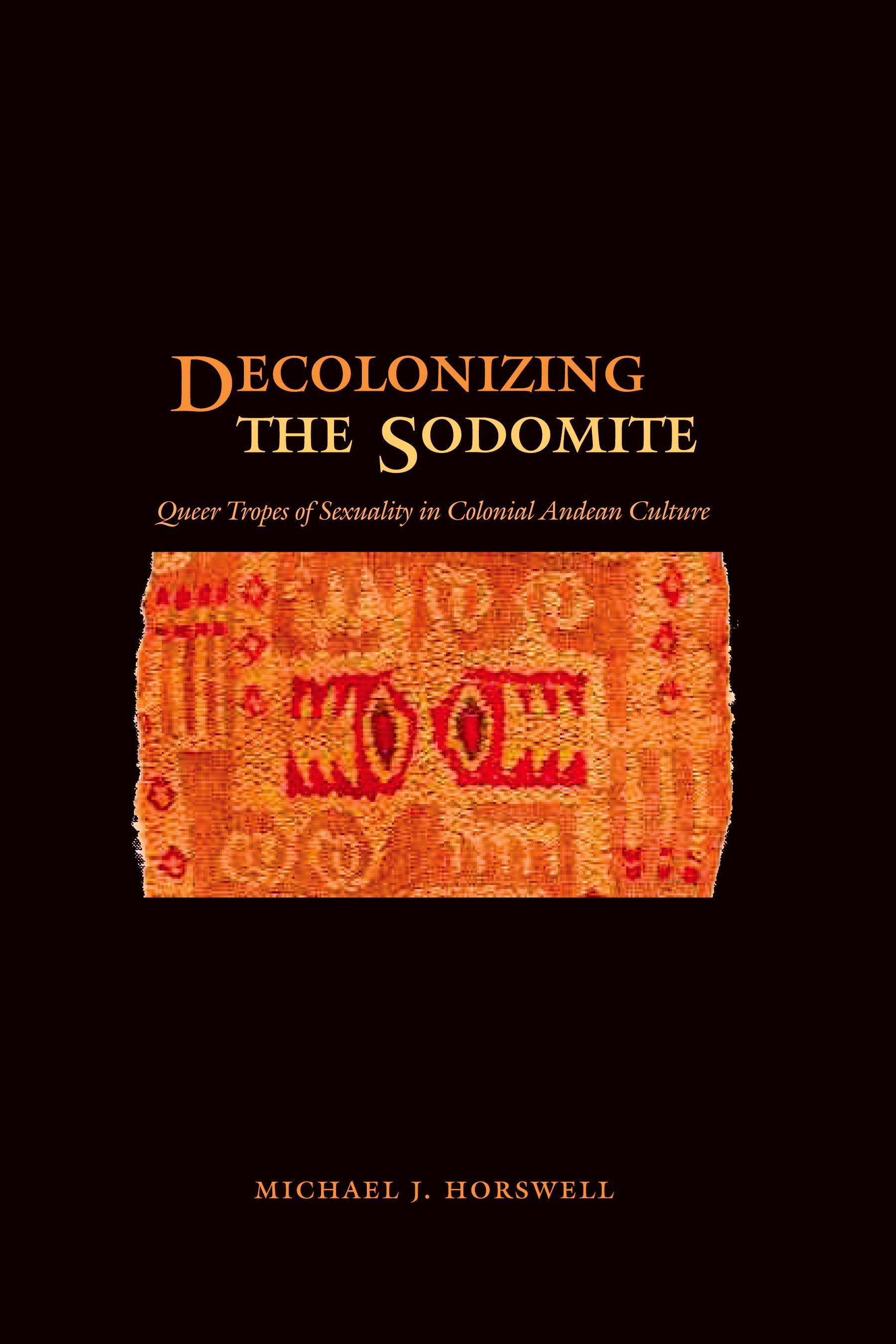
Decolonizing the Sodomite
Early Andean historiography reveals a subaltern history of indigenous gender and sexuality that saw masculinity and femininity not as essential absolutes. Third-gender ritualists, Ipas, mediated between the masculine and feminine spheres of culture in important ceremonies and were recorded in fragments of myths and transcribed oral accounts. Ritual performance by cross-dressed men symbolically created a third space of mediation that invoked the mythic androgyne of the pre-Hispanic Andes. The missionaries and civil authorities colonizing the Andes deemed these performances transgressive and sodomitical. In this book, Michael J. Horswell examines alternative gender and sexuality in the colonial Andean world, and uses the concept of the third gender to reconsider some fundamental paradigms of Andean culture. By deconstructing what literary tropes of sexuality reveal about Andean pre-Hispanic and colonial indigenous culture, he provides an alternative history and interpretation of the much-maligned aboriginal subjects the Spanish often referred to as \"sodomites.\" Horswell traces the origin of the dominant tropes of masculinist sexuality from canonical medieval texts to early modern Spanish secular and moralist literature produced in the context of material persecution of effeminates and sodomites in Spain. These values traveled to the Andes and were used as powerful rhetorical weapons in the struggle to justify the conquest of the Incas.
eBook

Inca apocalypse : the Spanish conquest and the transformation of the Andean world
This book describes a period of several decades during the sixteenth century when conquistadores, Catholic friars, and imperial officials attempted to conquer the Inca Empire and impose Spanish colonial rule. When Francisco Pizarro captured the Inca warlord Atahuallpa at Cajamarca in 1532, European Catholics and Andean peoples interpreted the event using long-held beliefs about how their worlds would end, and what the next era might look like. The Inca world did not end at Cajamarca, despite some popular misunderstandings of the Spanish conquest of Peru. In the years that followed, some Inca lords resisted Spanish rule, but many Andean nobles converted to Christianity and renegotiated their sovereign claims into privileges as Spanish subjects. Catholic empire took a lifetime to establish in the Inca world, and it required the repeated conquest of rebellious conquistadores, the reorganization of native populations, and the economic overhaul of diverse Andean landscapes. These disruptive processes of modern world-building carried forward old ideas about sovereignty, social change, and human progress. Although they are overshadowed by the Western philosophies and technologies that drive our world today, those apocalyptic relics remain with us to the present.
eBook

The legacy of biogeographic history on the composition and structure of Andean forests
The biogeographic origin of species may help to explain differences in average tree height and aboveground biomass (AGB) of tropical mountain forests. After the Andean uplift, small-statured trees should have been among the initial colonizers of the highlands (new cold environment) from the lowland tropics, since these species are pre-adapted to cold conditions with narrow vessels that are relatively resistant to freezing. If the descendants of these small-statured clades continue to dominate tropical highland forests, there will be a high co-occurrence of close relatives at high elevations. In other words, this scenario predicts a systematic decline in tree size, AGB, and phylogenetic diversity with elevation. In contrast, the colonization of Andean forests by some large-statured clades that originated in temperate regions may modify this expectation and promote a mixing of tropical and temperate clades, thereby increasing the phylogenetic diversity in tropical highland forests. This latter scenario predicts an increase or no change of tree size, AGB, and phylogenetic diversity with elevation. We assessed how the historical immigration of large-statured temperate-affiliated tree lineages adapted to cold conditions may have influenced the composition and structure of Andean forests. Specifically, we used 92 0.25-ha forest inventory plots distributed in the tropical Andes Mountains of Colombia to assess the relationship between the phylogenetic diversity and AGB along elevational gradients. We classified tree species as being either “tropical affiliated” or “temperate affiliated” and estimated their independent contribution to forest AGB. We used structural equation modeling to separate the direct and indirect effect of elevation on AGB. We found a hump-shaped relationship of phylogenetic diversity, AGB, and tree size with elevation. The high phylogenetic diversity found between 1,800–2,200 m above sea level (asl) was due to the mixing of highland floras containing many temperate-affiliated species, and lowland floras containing mostly tropical-affiliated species. The high AGB in highland forests, which contrasted with the expected decline of AGB with elevation, was likely due to the significant contribution of temperate-affiliated species. Our findings highlight the lasting importance of biogeographic history on the composition and structure of Andean mountain forests.
Journal Article

Phylogeny of the Neotropical sages (Salvia subg. Calosphace; Lamiaceae) and insights into pollinator and area shifts
Salvia subg. Calosphace (Lamiaceae, Lamiales) is a highly diverse clade endemic to the New World. The phylogenetic relationships of Calosphace have been previously investigated using DNA sequences of nuclear ITS region and plastid psbA-trriH intergenic spacer, but the resulting trees lack resolution and support for many clades. The present paper reassesses the phylogenetic relationships of subgenus Calosphace, including a broader taxon sampling, with a special focus on representing previously unsampled sections, and using an additional plastid marker (trnL-trnF region). Our results show increased resolution and overall patterns of support, recovering ten main clades. Within core Calosphace, the most inclusive of these main clades, 17 new subclades were identified. Of the 42 sections for which more than one species was analysed, only 12 are monophyletic. Our biogeographical analysis identified at least twelve migrations to South America from Mexican and Central American lineages, in agreement with previous suggestions of multiple origins of South American Calosphace diversity. This analysis also confirmed a colonization of the Antilles by Andean lineages. The reconstruction of ancestral states of pollination syndromes showed multiple shifts to ornithophily from melittophily and one reversal to the latter.
Journal Article

Parasite specialization in a unique habitat: hummingbirds as reservoirs of generalist blood parasites of Andean birds
Understanding how parasites fill their ecological niches requires information on the processes involved in the colonization and exploitation of unique host species. Switching to hosts with atypical attributes may favour generalists broadening their niches or may promote specialization and parasite diversification as the consequence. We analysed which blood parasites have successfully colonized hummingbirds, and how they have evolved to exploit such a unique habitat. We specifically asked (i) whether the assemblage of Haemoproteus parasites of hummingbirds is the result of single or multiple colonization events, (ii) to what extent these parasites are specialized in hummingbirds or shared with other birds and (iii) how hummingbirds contribute to sustain the populations of these parasites, in terms of both prevalence and infection intensity. We sampled 169 hummingbirds of 19 species along an elevation gradient in Southern Ecuador to analyse the host specificity, diversity and infection intensity of Haemoproteus by molecular and microscopy techniques. In addition, 736 birds of 112 species were analysed to explore whether hummingbird parasites are shared with other birds. Hummingbirds hosted a phylogenetically diverse assemblage of generalist Haemoproteus lineages shared with other host orders. Among these parasites, Haemoproteus witti stood out as the most generalized. Interestingly, we found that infection intensities of this parasite were extremely low in passerines (with no detectable gametocytes), but very high in hummingbirds, with many gametocytes seen. Moreover, infection intensities of H. witti were positively correlated with the prevalence across host species. Our results show that hummingbirds have been colonized by generalist Haemoproteus lineages on multiple occasions. However, one of these generalist parasites (H. witti) seems to be highly dependent on hummingbirds, which arise as the most relevant reservoirs in terms of both prevalence and gametocytaemia. From this perspective, this generalist parasite may be viewed as a hummingbird specialist. This challenges the current paradigm of how to measure host specialization in these parasites, which has important implications to understand disease ecology.
Journal Article

Divergence of tropical pitvipers promoted by independent colonization events of dry montane Andean habitats
Aim A poorly explored feature of the origin and maintenance of Neotropical biodiversity is how the evolutionary dynamics of colonization and differentiation in relation to lowland and highland habitats has impacted lineage formation. Most speciation models for this region have focused on vicariant events, whereas the need to assess the influence of demographic processes has been recognized only recently. We evaluate if the origin of Andean montane lineages of terciopelo pitvipers is explained by either of two historical processes that represent distinct phylogeographic mechanisms: differentiation by isolation within the highlands or different dispersal events from the lowlands. Location Western Ecuador. Taxon Terciopelo pitvipers (Bothrops asper species complex). Methods We use genomic data and genetic clustering analyses, evaluation of historical migration between genetic clusters and demographic model selection to investigate recent diversification events in South America using a vertebrate group rarely explored in phylogeographic studies: tropical Andean snakes. Specifically, the origin of two Ecuadorian montane lineages of terciopelo pitvipers was evaluated given ambiguous phylogenetic relationships with the presumably ancestral Pacific lowland lineage. Results Discrepancies of evolutionary relationships previously obtained with tree‐like methods are resolved through the use of modelling approaches. We found strong support for the independent origin of montane lineages based on topologies inferred by maximum‐likelihood trees and modelling approaches that take into account possible gene flow. This suggests dispersal rather than in‐situ differentiation as the most likely mechanism by which the montane linages originated. Main conclusions Recent large‐scale studies have found support for identifying dispersal events as important drivers of diversification in the Neotropical region. We contribute to these ideas by identifying a fine‐scale case in a rarely studied group of animals ‐Andean snakes‐ in which river valleys acted as an entrance for the upward colonization of montane dry habitats and subsequent ecological diversification.
Journal Article

An experimental test of colonization traits at a patch-scale in Andean Neotropical streams
Characterizing dispersal traits can further our ecological understanding of Neotropical stream macroinvertebrate communities, allowing us to test fundamental questions about disturbance and functional diversity responses in these systems. We combine observational and experimental approaches to measure short-term colonization of cobbles by stream invertebrates at five headwater streams arrayed along a habitat stability gradient in the Ecuadorian Andes, along with conducting drift and benthic surveys along the same gradient. Cobbles were sampled for benthic macroinvertebrate community composition and basal resource accrual at five time points over the 23-day experimental period. We found that taxonomic richness did not show clear trends across colonization time. Invertebrate community composition in the cobble colonization experiment did not approach the background benthic and drift composition over colonization time. Focal taxa showed variation in their drift and colonization propensities, with no clear relationship to habitat stability. We also found that benthic communities from less stable streams differed greatly between experimental years, highlighting the need to account for intra- and interannual differences in colonization experiments.
Journal Article