
Catalogue Search | MBRL


Are you sure you want to remove the book from the shelf?

{{itemTitle}}
19,939
result(s) for
"Animal fossils"
Sort by:

Beast Companions
Despite their fame and reputation, dinosaurs represent only half
the story of the Mesozoic Era. In Beast Companions: The Unsung
Animals of the Dinosaurs' World , paleontologist John Foster
explores the often-overlooked animals that coexisted with them.
These ancient species, often equally remarkable as their dinosaur
neighbors, can provide valuable insights into the biotic history of
our planet. In some cases, these animals reveal just as much, if
not more, about the extinct ecosystems of the time as the dinosaurs
themselves.
By drawing on a wealth of current and past discoveries, Foster
embarks on a sweeping journey across 164 million years to visit the
beast companions of the dinosaurs. Along the way, he examines fish,
insects, the first frogs and salamanders, turtles, snakes and
lizards, marine reptiles, crocodiles, pterosaurs, birds, mammals,
and other animals of the Mesozoic Er a.
Beast Companions is a groundbreaking exploration of the
story of these contemporaries of the dinosaurs that set the modern
world in motion more than 200 million years ago
eBook

Possible solutions to several enigmas of Cretaceous climate
The nature of the warm climates of the Cretaceous has been enigmatic since the first numerical climate models were run in the late 1970s. Quantitative simulations of the paleoclimate have consistently failed to agree with information from plant and animal fossils and climate sensitive sediments. The ‘cold continental interior paradox’ (first described by DeConto et al. in Barrera E, Johnson C (eds) Evolution of the Cretaceous Ocean/climate system, vol 332. Geological Society of America Special Paper, Boulder, pp 391–406, 1999), has been an enigma, with extensive continental interiors, especially in northeast Asia, modeled as below freezing in spite of plant and other evidence to the contrary. We reconsider the paleoelevations of specific areas, particularly along the northeastern Siberian continental margin, where paleofloras indeed indicate higher temperatures than suggested by current climate models. Evidence for significant masses of ice on land during even the otherwise warmest times of the Cretaceous is solved by reinterpretation of the δ18O record of fossil plankton. The signal interpreted as an increase in ice volume on land is the same as the signal for an increase in the volume of groundwater reservoirs on land. The problem of a warm Arctic, where fossil floras indicate that they never experienced freezing conditions in winter, could not be solved by numerical simulations using higher CO2 equivalent greenhouse gas concentrations. We propose a solution by assuming that paleoelevations were less than today and that there were much more extensive wetlands (lakes, meandering rivers, swamps, bogs) on the continents than previously assumed. Using ~ 8 × CO2 equivalent greenhouse gas concentrations and assuming 50–75% water surfaces providing water vapor as a supplementary greenhouse gas on the continents reduces the meridional temperature gradients. Under these conditions the equatorial to polar region temperature gradients produce conditions compatible with fossil and sedimentological evidence.
Journal Article

New materials of acanthomorphic acritarchs from the Ediacaran Weng'an Biota (South China)
The Weng'an Biota, found in the Doushantuo Formation in Guizhou Province, South China, is a remarkable fossil assemblage known for its well-preserved ancient life forms. These include small organisms called acritarchs, algae, and even embryo-like fossils. Among these, acritarchs, shaped like spiny spheres, have been essential for understanding the age and relationships of rocks from the Ediacaran Period. Previous studies mainly focused on larger spiny acritarchs, overlooking the smaller ones. In our study, we carefully examined over 500 thin sections and discovered a wealth of well-preserved small and medium-sized acritarchs. These tiny fossils, with diameters ranging 20–150 µm, help us understand the ancient ecosystems and how life evolved during this critical time in Earth's history. We identified several different species of small spiny acritarchs, e.g., Tanarium conoideum, Tanarium elegans, Mengeosphaera membranifera, Mengeosphaera minima, and Variomargosphaeridium gracile. Additionally, we found medium-sized acritarchs, e.g., Tanarium tuberosum and Weissiella cf. W. grandistella. These new findings provide important clues for correlating the rocks of the Doushantuo Formation in the Weng'an area with those in the Yangtze Gorges region. They also help us understand the evolution of acritarchs in different parts of the world, including Australia, Siberia, and the East European Platform. The Weng'an Biota from the Ediacaran Doushantuo Formation in Guizhou Province, southwestern China, is known for its three-dimensionally phosphatized acritarchs, multicellular algae, and embryo-like animal fossils. Among these diverse microfossils, acanthomorphic acritarchs have played a significant role in the biostratigraphic subdivision and correlation of the lower-middle Ediacaran System. However, most previous studies on the biostratigraphy of the Doushantuo Formation in the Weng'an area have focused on large acanthomorphic acritarchs (LAAs, vesicle diameter >200 µm), whereas the smaller acanthomorphic acritarchs (SAAs, vesicle diameter <100 µm) from the Weng'an Biota have been largely overlooked. In this study, we examined >500 thin sections and discovered a large number of well-preserved, small (<100 µm) and medium-sized acanthomorphic acritarchs (MAAs, vesicle diameter ranging 100–200 µm). In total, we have identified SAAs in four genera and six species (Tanarium conoideumKolosova, 1991, emend. Moczydłowska et al., 1993; Tanarium elegansLiu et al., 2014; Mengeosphaera membraniferaShang, Liu, and Moczydłowska, 2019; Mengeosphaera minimaLiu et al., 2014; Estrella rectaLiu and Moczydłowska, 2019; Variomargosphaeridium gracileXiao et al., 2014), as well as two types of MAAs (Tanarium tuberosumMoczydłowska, Vidal, and Rudavskaya, 1993, emend. Moczydłowska, 2015;Weissiella cf. W. grandistellaVorob'eva, Sergeev, and Knoll, 2009, emend. Liu and Moczydłowska, 2019). This updated acritarch assemblage of the Weng'an Biota is valuable for correlating the Ediacaran Doushantuo Formation between the Weng'an and Yangtze Gorges areas. It also serves as a tool to test the proposed acritarch biozones in Ediacaran formations of South China and other localities, including Australia, Siberia, and the East European Platform.
Journal Article

Introduction: from snowball Earth to the Cambrian explosion–evidence from China
The Neoproterozoic–Palaeozoic transition (NPT) around 600 Ma ago was a critical time interval when the Earth experienced fundamental change, manifested as climatic extremes – ‘snowball Earth’ – followed by the emergence and rapid diversification of animals – ‘Cambrian explosion’. How animals and environments co-evolved, and what caused these fundamental changes to the Earth system during the NPT, is a great scientific puzzle, which has been a rapidly developing frontier of interdisciplinary research between bio- and geosciences. South China preserves a complete stratigraphic succession of the NPT developed in various facies ranging from shallow to deep marine realms with extraordinarily well-preserved, successive fossil biotas in various taphonomic settings (Zhu, 2010; Fig. 1), making it a key area and global focus of studies in the field over recent decades. Indeed, the current narrative of early animal evolution has largely been based on the fossil biotas from South China. These include: (1) the world's oldest microscopic animal fossils with cellular details from the early Ediacaran Weng'an biota (Doushantuo Formation); (2) putative macroscopic animal fossils preserved as carbonaceous imprints from the early Ediacaran Lantian, Wenghui and Miaohe biotas (also Doushantuo Formation); (3) typical late Ediacaran faunas, preserved in dark limestone (Shibantan biota) and as large and poorly mineralized tubular animal fossils (Gaojiashan biota), both from the Dengying Formation; (4) phosphatized small shelly and soft-bodied animal fossils from the early Cambrian Meishucun and Kuanchuanpu faunas; and (5) Cambrian fossil Lagerstätten (Chengjiang, Guanshan and Kaili faunas) with typical Burgess Shale-type soft-bodied preservation.
Journal Article
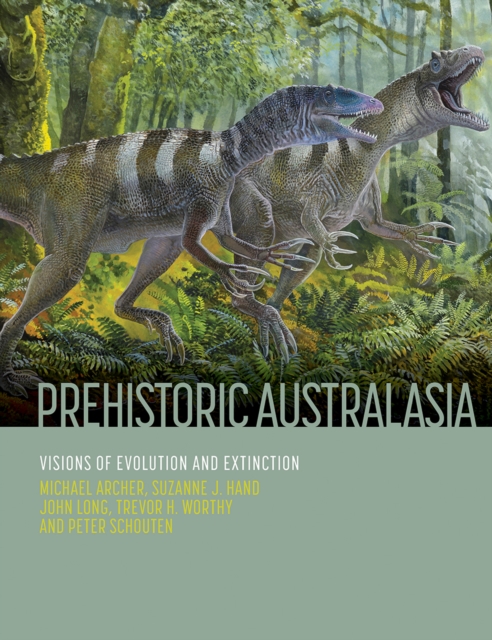
Prehistoric Australasia
For most of the past 300 million years, the world's continents were interlinked as the supercontinents Pangaea and then Gondwana. Around 50 million years ago, Australia tore itself free from Antarctica to become the huge, splendidly isolated island it is today. Over time, its creatures began to evolve in ways not seen anywhere else on Earth, with tree-climbing crocodiles, gigantic venomous lizards, walking omnivorous bats and flesh-eating kangaroos roaming the continent. Prehistoric Australasia: Visions of Evolution and Extinction presents some of the most extraordinary creatures the world has ever seen - all unique to Australia, New Guinea, New Zealand and their surrounding islands.Over 100 meticulously painted panoramas by palaeoartist Peter Schouten are accompanied by descriptions of the unique environments and features of these animals, written by four of Australia's foremost palaeontologists. This book explores the nature and timing of extinction events in the Southern Hemisphere, considers whether some of these losses might be able to be reversed, and how we can use the fossil record to help save today's critically endangered species.Through stunning artwork and fascinating text, Prehistoric Australasia brings this globally unique transformation over time to glorious, colourful life.FeaturesOffers fascinating glimpses into the prehistoric past of Australia, New Zealand and New Guinea.More than 100 paintings showcasing the changing biotas of Australasia over the last 3.6 billion years.Reveals the unique features of prehistoric animals and the environments where they lived.
eBook

Dragons' Teeth and Thunderstones
For at least half a million years, people have been doing some very strange things with fossils. Long before a few seventeenth-century minds started to decipher their true, organic nature, fossils had been eaten, dropped in goblets of wine, buried with the dead, and adorned bodies. What triggered such curious behavior was the belief that some fossils could cure illness, protect against being poisoned, ease the passage into the afterlife, ward off evil spirits, and even kill those who were just plain annoying. But above all, to our early prehistoric ancestors, fossils were the very stuff of artistic inspiration. Drawing on archaeology, mythology, and folklore, Ken McNamara takes us on a journey through prehistory with these curious stones, and he explores humankind's unending quest for the meaning of fossils.
eBook
Quaternary Palaeontology and Archaeology of Sumatra
\"The Indonesian island of Sumatra is part of a chain of islands making up Sunda and the Malay Archipelago. Sumatra is one of the largest islands in the world, housing unique and globally important tropical rainforests, a diverse array of rare plants and magnificent animals, and a population of 60 million who speak a range of Austronesian languages. As beautifully exemplified in this volume, Sumatra is a place which preserves a distinct and long-term human history, studies of which began in earnest with Eugene Dubois's explorations in the 1880s to find our ancestral 'missing link’. Archaeological investigation of megaliths and historic empires carry on to this day. A range of topics are explored here, including palaeontological study of fossil mammals and their environments, the routes that Homo erectus took during their wanderings across Indonesia, and the growth and development of societies and empires in more recent periods. This exemplary volume presents a revised view of the history of palaeontological and archaeological research as well as new ground-breaking field research, laying the foundation for future research on the biological and cultural evolution of one of the most majestic islands of the world.\" — Professor Michael Petraglia, Director of the Australian Research Centre for Human Evolution, Griffith University
eBook
Deconstructing Olduvai: A Taphonomic Study of the Bed I Sites
Plio-Pleistocene sites are a rare occurrence in same sites. This combination of factors is the archaeological record. When they are unique in East African Plio-Pleistocene uncovered, the faunal materials so crucial to archaeology and has stimulated much debate unlocking their behavioral meaning are often over the socioeconomic function of early sites. poorly preserved. For example, at Koobi Fora, Influential models of early hominid behavior Kenya, a prolific region that preserves several in the late 1960s and early 1970s were based classic Plio-Pleistocene sites, many bones are exclusively on information from Olduvai affected by poor cortical surface preservation Gorge (Leakey, 1971). Although Isaac's (e. g. , (Isaac, 1997). Such taphonomic vagaries limit 1978) work at Koobi Fora expanded their the range of questions that can be addressed application, the subsequent critiques, modi- with these assemblages. In other instances, cations, and reformulations of these models access to materials can be limited due to local were based almost solely on studies from politics or rivalries between individual Olduvai (Binford, 1981, 1984; Bunn, 1981; research teams. As a result, many important Potts, 1982, 1988; Bunn and Kroll, 1986; assemblages either remain unstudied or have Blumenschine, 1995; Rose and Marshall, been interpreted without the advantage of a 1996; Dominguez-Rodrigo, 1997a, 2002; fully developed taphonomic framework, a sit- Plummer, 2004). Having said that, it is also uation that all but guarantees stagnant inter- clear that continued work at Koobi Fora and pretations.
eBook

Possible poriferan body fossils in early Neoproterozoic microbial reefs
Molecular phylogeny indicates that metazoans (animals) emerged early in the Neoproterozoic era
1
, but physical evidence is lacking. The search for animal fossils from the Proterozoic eon is hampered by uncertainty about what physical characteristics to expect. Sponges are the most basic known animal type
2
,
3
; it is possible that body fossils of hitherto-undiscovered Proterozoic metazoans might resemble aspect(s) of Phanerozoic fossil sponges. Vermiform microstructure
4
,
5
, a complex petrographic feature in Phanerozoic reefal and microbial carbonates, is now known to be the body fossil of nonspicular keratosan demosponges
6
–
10
. This Article presents petrographically identical vermiform microstructure from approximately 890-million-year-old reefs. The millimetric-to-centimetric vermiform-microstructured organism lived only on, in and immediately beside reefs built by calcifying cyanobacteria (photosynthesizers), and occupied microniches in which these calcimicrobes could not live. If vermiform microstructure is in fact the fossilized tissue of keratose sponges, the material described here would represent the oldest body-fossil evidence of animals known to date, and would provide the first physical evidence that animals emerged before the Neoproterozoic oxygenation event and survived through the glacial episodes of the Cryogenian period.
Vermiform microstructure in microbial reefs dating to approximately 890 million years ago resembles the body fossils of Phanerozoic demosponges, and may represent the earliest known physical evidence of animals.
Journal Article
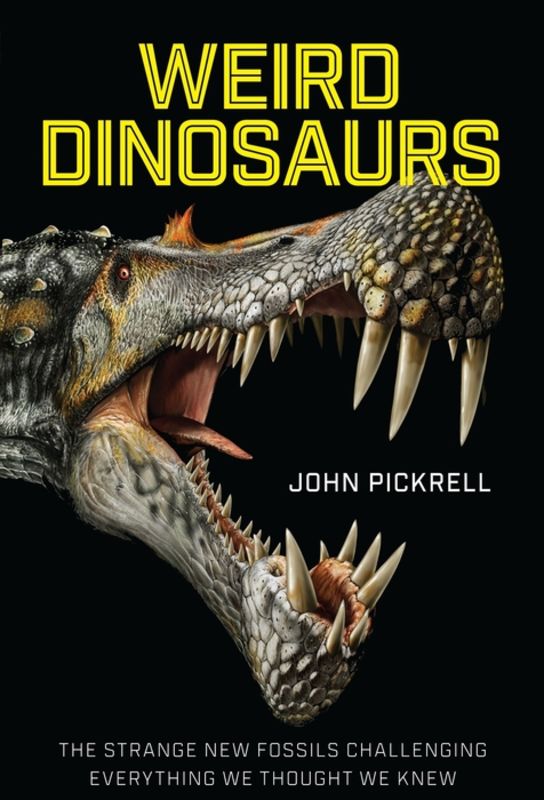
Weird Dinosaurs
From the outback of Australia to the Gobi Desert of Mongolia and the savanna of Madagascar, the award-winning science writer and dinosaur enthusiast John Pickrell embarks on a world tour of new finds, meeting the fossil hunters who work at the frontier of discovery. He reveals the dwarf dinosaurs unearthed by an eccentric Transylvanian baron; an aquatic, crocodile-snouted carnivore bigger thanT. rexthat once lurked in North African waterways; a Chinese dinosaur with wings like a bat; and a Patagonian sauropod so enormous it weighed more than two commercial jet airliners.Other surprising discoveries hail from Alaska, Siberia, Canada, Burma, and South Africa. Why did dinosaurs grow so huge? How did they spread across the world? Did they all have feathers? What do sauropods have in common with 1950s vacuum cleaners? The stuff of adventure movies and scientific revolutions,Weird Dinosaursexamines the latest breakthroughs and new technologies that are radically transforming our understanding of the distant past. Pickrell opens a vivid portal to a brand-new age of fossil discovery, in which fossil hunters are routinely redefining what we know and how we think about prehistory's most iconic and fascinating creatures.
eBook