
Catalogue Search | MBRL


Are you sure you want to remove the book from the shelf?

{{itemTitle}}
14,101
result(s) for
"Animal intelligence"
Sort by:

Far out! : animals that do amazing things
From the European eel that can migrate far distances simply from memory to chimpanzees who can learn sign language, \"Far Out!\" is packed with interesting facts about animals that can do amazing and human-like things.
Book

Animal Bodies, Renaissance Culture
Animal Bodies, Renaissance Cultureexamines how the shared embodied existence of early modern human and nonhuman animals challenged the establishment of species distinctions. The material conditions of the early modern world brought humans and animals into complex interspecies relationships that have not been fully accounted for in critical readings of the period's philosophical, scientific, or literary representations of animals. Where such prior readings have focused on the role of reason in debates about human exceptionalism, this book turns instead to a series of cultural sites in which we find animal and human bodies sharing environments, mutually transforming and defining one another's lives. To uncover the animal body's role in anatomy, eroticism, architecture, labor, and consumption, Karen Raber analyzes canonical works including More'sUtopia, Shakespeare'sHamletandRomeo and Juliet, and Sidney's poetry, situating them among readings of human and equine anatomical texts, medical recipes, theories of architecture and urban design, husbandry manuals, and horsemanship treatises. Raber reconsiders interactions between environment, body, and consciousness that we find in early modern human-animal relations. Scholars of the Renaissance period recognized animals' fundamental role in fashioning what we call \"culture,\" she demonstrates, providing historical narratives about embodiment and the cultural constructions of species difference that are often overlooked in ecocritical and posthumanist theory that attempts to address the \"question of the animal.\"
eBook

The smartest animals in the world
\"Introduces readers to some of the world's smartest animals. It will explore the creatures' basic biology and appearance, their place in their ecosystems, and the ways in which their smarter natures affect their lives\"-- Provided by publisher.
CHILDBOOK

Social Learning
Many animals, including humans, acquire valuable skills and knowledge by copying others. Scientists refer to this as social learning. It is one of the most exciting and rapidly developing areas of behavioral research and sits at the interface of many academic disciplines, including biology, experimental psychology, economics, and cognitive neuroscience.Social Learningprovides a comprehensive, practical guide to the research methods of this important emerging field. William Hoppitt and Kevin Laland define the mechanisms thought to underlie social learning and demonstrate how to distinguish them experimentally in the laboratory. They present techniques for detecting and quantifying social learning in nature, including statistical modeling of the spatial distribution of behavior traits. They also describe the latest theory and empirical findings on social learning strategies, and introduce readers to mathematical methods and models used in the study of cultural evolution. This book is an indispensable tool for researchers and an essential primer for students.
Provides a comprehensive, practical guide to social learning researchCombines theoretical and empirical approachesDescribes techniques for the laboratory and the fieldCovers social learning mechanisms and strategies, statistical modeling techniques for field data, mathematical modeling of cultural evolution, and more
eBook

Dancing cockatoos and the dead man test : how behavior evolves and why it matters
For centuries, people have been returning to the same tired nature-versus-nurture debate, trying to determine what we learn and what we inherit. In 'Dancing Cockatoos and the Dead Man Test,' biologist Marlene Zuk goes beyond the binary and instead focuses on interaction, or the way that genes and environment work together. Driving her investigation is a simple but essential question: How does behaviour evolve? Drawing from a wealth of research, including her own on insects, Zuk answers this question by turning to a wide range of animals and animal behaviour. There are stories of cockatoos that dance to rock music, ants that heal their injured companions, dogs that exhibit signs of obsessive-compulsive disorder, and so much more.
BOOK

A foray into the worlds of animals and humans : with A theory of meaning
Is the tick a machine or a machine operator? Is it a mere object or a subject? With these questions, the pioneering biophilosopher Jakob von Uexküll embarks on a remarkable exploration of the unique social and physical environments that individual animal species, as well as individuals within species, build and inhabit. This concept of the umwelt has become enormously important within posthumanist philosophy, influencing such figures as Heidegger, Merleau-Ponty, Deleuze and Guattari, and, most recently, Giorgio Agamben, who has called Uexküll \"a high point of modern antihumanism.\" A key document in the genealogy of posthumanist thought, A Foray into the Worlds of Animals and Humans advances Uexküll's revolutionary belief that nonhuman perceptions must be accounted for in any biology worth its name; it also contains his arguments against natural selection as an adequate explanation for the present orientation of a species' morphology and behavior. A Theory of Meaning extends his thinking on the umwelt , while also identifying an overarching and perceptible unity in nature. Those coming to Uexküll's work for the first time will find that his concept of the umwelt holds out new possibilities for the terms of animality, life, and the whole framework of biopolitics itself.
eBook


Cognitive performance is linked to group size and affects fitness in Australian magpies
Wild Australian magpies (
Cracticus tibicen dorsalis
) living in large groups show increased cognitive performance, which is associated with increased reproductive success.
The social brain
What determines general intelligence? Brain size, nutritional status and environmental factors play their part, but one of the most popular ideas is the 'social brain' hypothesis—that intelligence is related to societal complexity. Most studies, however, are confounded by the fact that different species are being compared. Benjamin Ashton and colleagues look at groups of different sizes in a single species, the cooperatively breeding Australian magpie. They show that wild Australian magpies living in larger groups solve puzzles more quickly than those living in smaller groups. Greater puzzle-solving performance is in turn related to reproductive success.
The social intelligence hypothesis states that the demands of social life drive cognitive evolution
1
,
2
,
3
. This idea receives support from comparative studies that link variation in group size or mating systems with cognitive and neuroanatomical differences across species
3
,
4
,
5
,
6
,
7
, but findings are contradictory and contentious
8
,
9
,
10
. To understand the cognitive consequences of sociality, it is also important to investigate social variation within species. Here we show that in wild, cooperatively breeding Australian magpies, individuals that live in large groups show increased cognitive performance, which is linked to increased reproductive success. Individual performance was highly correlated across four cognitive tasks, indicating a ‘general intelligence factor’ that underlies cognitive performance. Repeated cognitive testing of juveniles at different ages showed that the correlation between group size and cognition emerged in early life, suggesting that living in larger groups promotes cognitive development. Furthermore, we found a positive association between the task performance of females and three indicators of reproductive success, thus identifying a selective benefit of greater cognitive performance. Together, these results provide intraspecific evidence that sociality can shape cognitive development and evolution.
Journal Article

The internet of animals : discovering the collective intelligence of life on Earth
\"All we need to do is give animals a voice and our perception of the world could change forever. That's what author Martin Wikelski and his team of scientists believe, and this book shares their story for the first time. As they tag animals around the world with minuscule tracking devices, they link their movements to The International Space Station, which taps into the 'internet of animals': an astonishing network of information made up of thousands of animals communicating with each other and their environments. Called the International Cooperation for Animal Research Using Space, or ICARUS, this phenomenal project is poised to change our world. Down on the ground, Wikelski describes animals' sixth sense first-hand. Farm animals become restless when earthquakes are imminent. Animals on the African plains sense when poachers are on the move. Frigatebirds in South America depart before hurricanes arrive.\"-- Provided by publisher.
BOOK
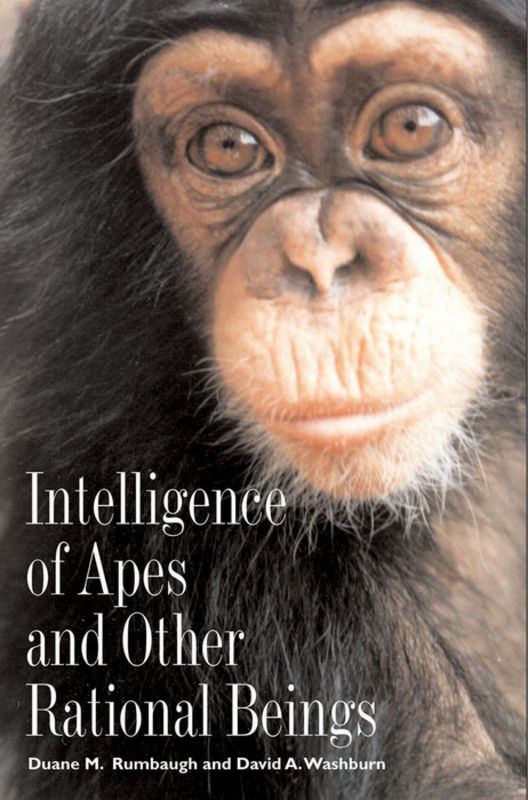
Intelligence of apes and other rational beings
What is animal intelligence? In what ways is it similar to human intelligence? Many behavioral scientists have realized that animals can be rational, can think in abstract symbols, can understand and react to human speech, and can learn through observation as well as conditioning many of the more complicated skills of life. Now Duane Rumbaugh and David Washburn probe the mysteries of the animal mind even further, identifying an advanced level of animal behavior-emergents-that reflects animals' natural and active inclination to make sense of the world. Rumbaugh and Washburn unify all behavior into a framework they call Rational Behaviorism and present it as a new way to understand learning, intelligence, and rational behavior in both animals and humans.Drawing on years of research on issues of complex learning and intelligence in primates (notably rhesus monkeys, chimpanzees, and bonobos), Rumbaugh and Washburn provide delightful examples of animal ingenuity and persistence, showing that animals are capable of very creative solutions to novel challenges. The authors analyze learning processes and research methods, discuss the meaningful differences across the primate order, and point the way to further advances, enlivening theoretical material about primates with stories about their behavior and achievements.
eBook