
Catalogue Search | MBRL


Are you sure you want to remove the book from the shelf?

{{itemTitle}}
3,824
result(s) for
"Animals Folklore."
Sort by:

The tortoise or the hare
Jamey Tortoise is smarter than anyone else and Jimi Hare is faster, but when a race is announced each consults a reporter about how to get what he really wants when and if he should win in this updated twist on the familiar fable.
Book

Hunters, predators and prey
Inuit hunting traditions are rich in perceptions, practices and stories relating to animals and human beings. The authors examine key figures such as the raven, an animal that has a central place in Inuit culture as a creator and a trickster, andqupirruit, a category consisting of insects and other small life forms. After these non-social and inedible animals, they discuss the dog, the companion of the hunter, and the fellow hunter, the bear, considered to resemble a human being. A discussion of the renewal of whale hunting accompanies the chapters about animals considered 'prey par excellence': the caribou, the seals and the whale, symbol of the whole. By giving precedence to Inuit categories such as 'inua' (owner) and 'tarniq' (shade) over European concepts such as 'spirit 'and 'soul', the book compares and contrasts human beings and animals to provide a better understanding of human-animal relationships in a hunting society.
eBook

Chicken Little
A retelling of the classic story of Chicken Little, who has an acorn fall on his head and runs in a panic to his friends Henny Penny, Lucky Ducky, and Loosey Goosey, to tell them the sky is falling.
Book

Imaginary Animals
Tales throughout the world generally place fabulous beasts in marginal locations – deserts, deep woods, remote islands, glaciers, ocean depths, mountain peaks, caves, swamps, heavenly bodies and alternate universes. Legends tell us that imaginary animals belong to a primordial time, before we had encompassed the world with names, categories and scientific knowledge. This book traces the history of imaginary animals from Palaeolithic art to the Harry Potter stories, and beyond. It shows how imagined creatures help us psychologically, giving form to our subconscious fears as 'monsters', as well as embodying our hopes as 'wonders'. Nevertheless, their greatest service may be to continually challenge our imaginations, directing us beyond the limitations of our conventional beliefs and expectations.
eBook

What makes a monster? : discovering the world's scariest creatures
\"An informative introduction to nature's scariest creatures, exploring why some animals are considered 'monsters.'\"-- Provided by publisher.
Book

Zoofolkloristics: Imagination as a Critical Component
Nonhuman animal protagonists of folklore texts in the European space have tended to be perceived primarily as performing a symbolic and metaphoric function. But behind the symbols and the metaphors hide real flesh-and-blood nonhuman animals, and flesh-and-blood humans interacting with them, mostly from a position of power. The emerging discipline of zoofolkloristics considers nonhuman animals in their own right. Through critical analysis of folklore material, zoofolkloristics examines the role of animals and power relations within the interspecies entanglement with the aim of deconstructing the oppressive system and establishing multispecies justice. We begin this paper with a brief reflection on the ‘historical animal’ as an embodied being and a human construct. We then perform a critical re-reading of three animal-related folklore texts from the Slovenian tradition and, applying Hubert Zapf’s concept of imaginative counter-discourse, consider the potential of imagination as a methodological tool in the transformative program of zoofolkloristics. Implications for animal ethics, liberation, and conservation are also discussed.
Journal Article

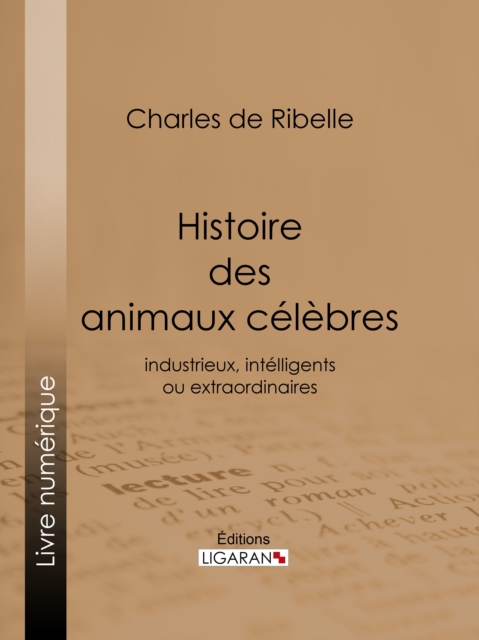
Histoire des animaux célèbres, industrieux, intelligents ou extraordinaires, et des chiens savants
Extrait: \"Le kraken est-il un animal fabuleux, créé tout simplement par l'imagination des populations du littoral des côtes de la Norvège, ou existe-t-il effectivement un montre marin approchant des proportions colossales que les riverains des mers du Nord assignent au kraken? Voilà ce que nous ne pouvons décider de prime-abord.\" À PROPOS DES ÉDITIONS LIGARAN: Les éditions LIGARAN proposent des versions numériques de grands classiques de la littérature ainsi que des livres rares, dans les domaines suivants: • Fiction: roman, poésie, théâtre, jeunesse, policier, libertin. • Non fiction: histoire, essais, biographies, pratiques.
eBook

Posthuman folklore
Can a monkey own a selfie? Can a chimp use habeas corpus to sue for freedom? Can androids be citizens? Increasingly, such difficult questions have moved from the realm of science fiction into the realm of everyday life, and scholars and laypeople alike are struggling to find ways to grasp new notions of personhood. Posthuman Folklore is the first work of its kind: both an overview of posthumanism as it applies to folklore studies and an investigation of \"vernacular posthumanisms\"--the ways in which people are increasingly performing the posthuman. Posthumanism calls for a close investigation of what is meant by the term \"human\" and a rethinking of this, our most basic ontological category. What, exactly, is human? What, exactly, am I? There are two main threads of posthumanism: the first dealing with the increasingly slippery slope between \"human\" and \"animal,\" and the second dealing with artificial intelligences and the growing cyborg quality of human culture. This work deals with both these threads, seeking to understand the cultural roles of this shifting notion of \"human\" by centering its investigation into the performances of everyday life. From funerals for AIBOs, to furries, to ghost stories told by Alexa, people are increasingly engaging with the posthuman in myriad everyday practices, setting the stage for a wholesale rethinking of our humanity. In Posthuman Folklore, author Tok Thompson traces both the philosophies behind these shifts, and the ways in which people increasingly are enacting such ideas to better understand the posthuman experience of contemporary life.
Book
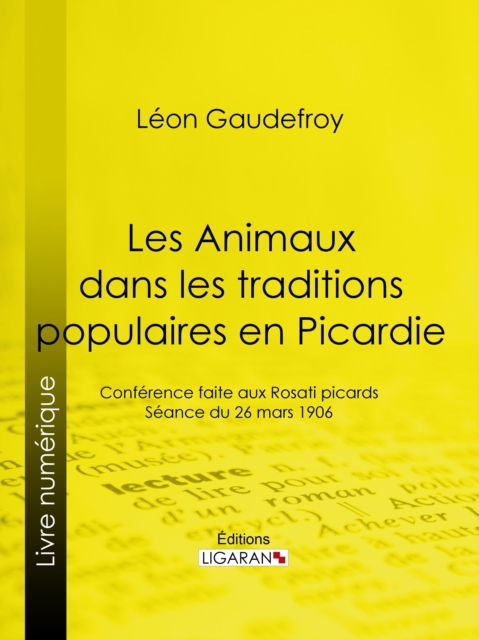
Les Animaux dans les traditions populaires en Picardie
Extrait: \"Jadis, dans nos campagnes, la croyance aux sorciers était presque générale, et la conférence sur les contre-sorts, faite ici par M. Ponchon, nous a montré combien le paysan d'autrefois était constamment préoccupé d'échapper au ténébreux empire de la sorcellerie. A l'heure actuelle, si la croyance à ces sorciers est généralement disparue de nos campagnes, elles ne sont pas moins infestées d'erreurs et de préjugés.\" À PROPOS DES ÉDITIONS LIGARAN: Les éditions LIGARAN proposent des versions numériques de grands classiques de la littérature ainsi que des livres rares, dans les domaines suivants: • Fiction: roman, poésie, théâtre, jeunesse, policier, libertin. • Non fiction: histoire, essais, biographies, pratiques.
eBook