
Catalogue Search | MBRL


Are you sure you want to remove the book from the shelf?

{{itemTitle}}
20,187
result(s) for
"Animals Social aspects."
Sort by:

Framing animals as epidemic villains : histories of non-human disease vectors
This book takes a historical and anthropological approach to understanding how non-human hosts and vectors of diseases are understood, at a time when emerging infectious diseases are one of the central concerns of global health. The volume critically examines the ways in which animals have come to be framed as 'epidemic villains' since the turn of the nineteenth century. Providing epistemological and social histories of non-human epidemic blame, as well as ethnographic perspectives on its recent manifestations, the essays explore this cornerstone of modern epidemiology and public health alongside its continuing importance in today's world. Covering diverse regions, the book argues that framing animals as spreaders and reservoirs of infectious diseases - from plague to rabies to Ebola - is an integral aspect not only to scientific breakthroughs but also to the ideological and biopolitical apparatus of modern medicine. As the first book to consider the impact of the image of non-human disease hosts and vectors on medicine and public health, it offers a major contribution to our understanding of human-animal interaction under the shadow of global epidemic threat.
Book


Animal, Vegetable, Mineral?
Does the natural world divide neatly into 'animal, vegetable, mineral'? Discoveries in the 18th century threw the question wide open; debates raged, and fed into wider religious and political battles concerning God's creation and the natural social order.
eBook


Artist Animal
Animals have always been compelling subjects for artists, but the rise of animal advocacy and posthumanist thought has prompted a reconsideration of the relationship between artist and animal. In this book, Steve Baker examines the work of contemporary artists who directly confront questions of animal life, treating animals not for their aesthetic qualities or as symbols of the human condition but rather as beings who actively share the world with humanity.
The concerns of the artists presented in this book-Sue Coe, Eduardo Kac, Lucy Kimbell, Catherine Chalmers, Olly and Suzi, Angela Singer, Catherine Bell, and others-range widely, from the ecological to the philosophical and from those engaging with the modification of animal bodies to those seeking to further the cause of animal rights. Drawing on extensive interviews he conducted with the artists under consideration, Baker explores the vital contribution that contemporary art can make to a broader conception of animal life, emphasizing the importance of creativity and trust in both the making and understanding of these artworks.
Throughout, Baker is attentive to issues of practice, form, and medium. He asks, for example, whether the animal itself could be said to be the medium in which these artists are working, and he highlights the tensions between creative practice and certain kinds of ethical demands or expectations. Featuring full-color, vivid examples of their work,Artist Animalsituates contemporary artists within the wider project of thinking beyond the human, asserting art's power to open up new ways of thinking about animals.
eBook


Beastly Natures
Although the animal may be, as Nietzsche argued, ahistorical, living completely in the present, it nonetheless plays a crucial role in human history. The fascination with animals that leads not only to a desire to observe and even live alongside them, but to capture or kill them, is found in all civilizations. The essays collected inBeastly Naturesshow how animals have been brought into human culture, literally helping to build our societies (as domesticated animals have done) or contributing, often in problematic ways, to our concept of the wild.
The book begins with a group of essays that approach the historical relevance of human-animal relations seen from the perspectives of various disciplines and suggest ways in which animals might be brought into formal studies of history. Differences in species and location can greatly affect the shape of human-animal interaction, and so the essays that follow address a wide spectrum of topics, including the demanding fate of the working horse, the complex image of the American alligator (at turns a dangerous predator and a tourist attraction), the zoo gardens of Victorian England, the iconography of the rhinoceros and the preference it reveals in society for myth over science, relations between humans and wolves in Europe, and what we can learn from society's enthusiasm for \"political\" animals, such as the pets of the American presidents and the Soviet Union's \"space dogs.\" Taken together, these essays suggest new ways of looking not only at animals but at human history.
Contributors
Mark V. Barrow Jr., Virginia Tech * Peter Edwards, Roehampton University * Kelly Enright, Rutgers University * Oliver Hochadel, Universitat Autònoma de Barcelona * Uwe Lübken, Rachel Carson Center, Munich * Garry Marvin, Roehampton University * Clay McShane, Northeastern University * Amy Nelson, Virginia Tech * Susan Pearson, Northwestern University * Helena Pycior, University of Wisconsin-Milwaukee * Harriet Ritvo, Massachusetts Institute of Technology * Nigel Rothfels, University of Wisconsin-Milwaukee * Joel A. Tarr, Carnegie Mellon University * Mary Weismantel, Northwestern University
eBook

Human and other animals : critical perspectives
\"This collection examines human-animal relations and the different ways in which they can be understood, exploring animal rights and animal welfare; whether and under what circumstances animals are regarded as social actors with agency; media representations of human-animal relations; and the relation between animals and national identity\"-- Provided by publisher.
Book
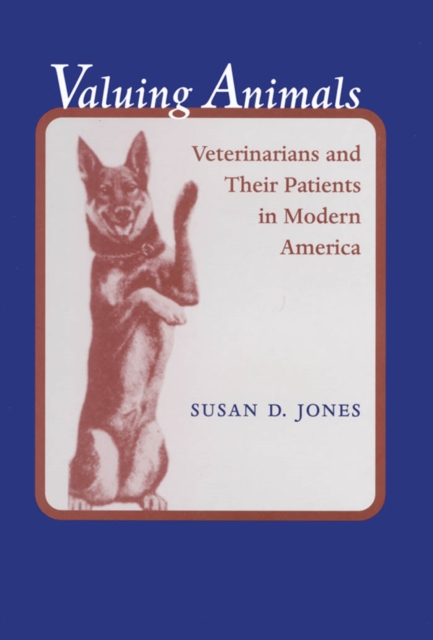
Valuing animals : veterinarians and their patients in modern America
Over the course of the twentieth century, the relationship between Americans and their domestic animals has changed dramatically. In the 1890s, pets were a luxury, horses were the primary mode of transport, and nearly half of all Americans lived or worked on farms. Today, the pet industry is a multibillion-dollar-a-year business, keeping horses has become an expensive hobby, and consumers buy milk and meat in pristine supermarkets. Veterinarians have been very much a part of these changes in human-animal relationships. Indeed, the development of their profession—from horse doctor to medical scientist—provides an important perspective on these significant transformations in America's social, cultural, and economic history.
In Valuing Animals, Susan D. Jones, trained as both veterinarian and historian, traces the rise of veterinary medicine and its impact on the often conflicting ways in which Americans have assessed the utility and worth of domesticated creatures. She first looks at how the eclipse of the horse by motorized vehicles in the early years of the century created a crisis for veterinary education, practice, and research. In response, veterinarians intensified their activities in making the livestock industry more sanitary and profitable. Beginning in the 1930s, veterinarians turned to the burgeoning number of house pets whose sentimental value to their owners translated into new market opportunities. Jones describes how vets overcame their initial doubts about the significance of this market and began devising new treatments and establishing appropriate standards of care, helping to create modern pet culture.
Americans today value domestic animals for reasons that typically combine exploitation and companionship. Both controversial and compelling, Valuing Animals uncovers the extent to which veterinary medicine has shaped—and been shaped by—this contradictory attitude.
eBook