
Catalogue Search | MBRL


Are you sure you want to remove the book from the shelf?

{{itemTitle}}
44
result(s) for
"Animaux Intelligence."
Sort by:

The internet of animals : discovering the collective intelligence of life on Earth
\"All we need to do is give animals a voice and our perception of the world could change forever. That's what author Martin Wikelski and his team of scientists believe, and this book shares their story for the first time. As they tag animals around the world with minuscule tracking devices, they link their movements to The International Space Station, which taps into the 'internet of animals': an astonishing network of information made up of thousands of animals communicating with each other and their environments. Called the International Cooperation for Animal Research Using Space, or ICARUS, this phenomenal project is poised to change our world. Down on the ground, Wikelski describes animals' sixth sense first-hand. Farm animals become restless when earthquakes are imminent. Animals on the African plains sense when poachers are on the move. Frigatebirds in South America depart before hurricanes arrive.\"-- Provided by publisher.
BOOK
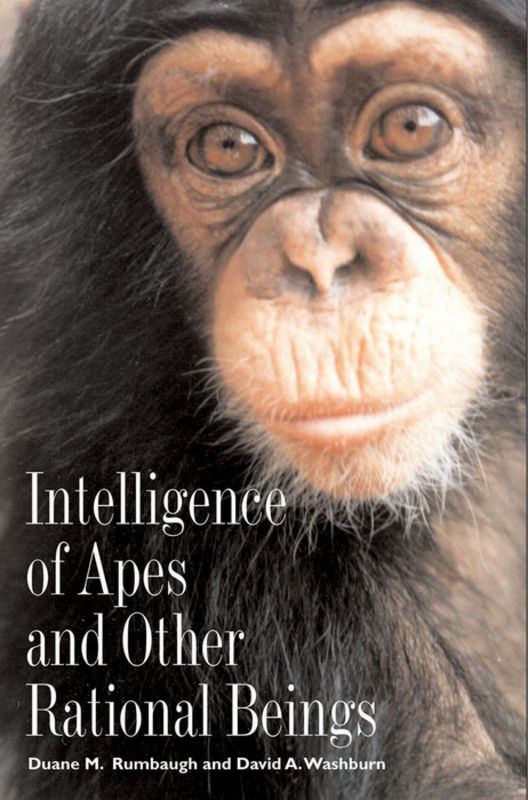
Intelligence of apes and other rational beings
What is animal intelligence? In what ways is it similar to human intelligence? Many behavioral scientists have realized that animals can be rational, can think in abstract symbols, can understand and react to human speech, and can learn through observation as well as conditioning many of the more complicated skills of life. Now Duane Rumbaugh and David Washburn probe the mysteries of the animal mind even further, identifying an advanced level of animal behavior-emergents-that reflects animals' natural and active inclination to make sense of the world. Rumbaugh and Washburn unify all behavior into a framework they call Rational Behaviorism and present it as a new way to understand learning, intelligence, and rational behavior in both animals and humans.Drawing on years of research on issues of complex learning and intelligence in primates (notably rhesus monkeys, chimpanzees, and bonobos), Rumbaugh and Washburn provide delightful examples of animal ingenuity and persistence, showing that animals are capable of very creative solutions to novel challenges. The authors analyze learning processes and research methods, discuss the meaningful differences across the primate order, and point the way to further advances, enlivening theoretical material about primates with stories about their behavior and achievements.
eBook

Bots and beasts : what makes machines, animals, and people smart? / Paul Thagard
An expert on mind considers how animals and smart machines measure up to human intelligence. Octopuses can open jars to get food, and chimpanzees can plan for the future. An IBM computer named Watson won on Jeopardy! and Alexa knows our favorite songs. But do animals and smart machines really have intelligence comparable to that of humans? In Bots and Beasts, Paul Thagard looks at how computers (\"bots\") and animals measure up to the minds of people, offering the first systematic comparison of intelligence across machines, animals, and humans. Thagard explains that human intelligence is more than IQ and encompasses such features as problem solving, decision making, and creativity. He uses a checklist of twenty characteristics of human intelligence to evaluate the smartest machines--including Watson, AlphaZero, virtual assistants, and self-driving cars--and the most intelligent animals--including octopuses, dogs, dolphins, bees, and chimpanzees. Neither a romantic enthusiast for nonhuman intelligence nor a skeptical killjoy, Thagard offers a clear assessment. He discusses hotly debated issues about animal intelligence concerning bacterial consciousness, fish pain, and dog jealousy. He evaluates the plausibility of achieving human-level artificial intelligence and considers ethical and policy issues. A full appreciation of human minds reveals that current bots and beasts fall far short of human capabilities. Amazon.com.
Book


The smartest animals in the world
\"Introduces readers to some of the world's smartest animals. It will explore the creatures' basic biology and appearance, their place in their ecosystems, and the ways in which their smarter natures affect their lives\"-- Provided by publisher.
CHILDBOOK

The Evolution of Thought
Research on the evolution of higher intelligence rarely combines data from fields as diverse as paleontology and psychology. In this volume we seek to do just that, synthesizing the approaches of hominoid cognition, psychology, language studies, ecology, evolution, paleoecology and systematics toward an understanding of great ape intelligence. Leading scholars from all these fields have been asked to evaluate the manner in which each of their topics of research inform our understanding of the evolution of intelligence in great apes and humans. The ideas thus assembled represent a comprehensive survey of the various causes and consequences of cognitive evolution in great apes. The Evolution of Thought will therefore be an essential reference for graduate students and researchers in evolutionary psychology, paleoanthropology and primatology.
eBook

Animal minds : what are they thinking?
\"This nonfiction book for middle-grade readers examines how animals think and the ways scientists study their cognitive abilities. Illustrated with photographs throughout.\"-- Provided by publisher.
Book
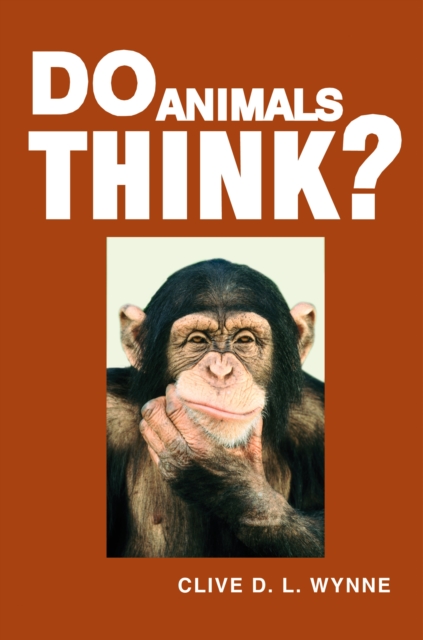
Do animals think?
Does your dog know when you've had a bad day? Can your cat tell that the coffee pot you left on might start a fire? Could a chimpanzee be trained to program your computer? In this provocative book, noted animal expert Clive Wynne debunks some commonly held notions about our furry friends. It may be romantic to ascribe human qualities to critters, he argues, but it's not very realistic. While animals are by no means dumb, they don't think the same way we do. Contrary to what many popular television shows would have us believe, animals have neither the \"theory-of-mind\" capabilities that humans have (that is, they are not conscious of what others are thinking) nor the capacity for higher-level reasoning. So, in Wynne's view, when Fido greets your arrival by nudging your leg, he's more apt to be asking for dinner than commiserating with your job stress. That's not to say that animals don't possess remarkable abilities--and Do Animals Think? explores countless examples: there's the honeybee, which not only remembers where it found food but communicates this information to its hivemates through an elaborate dance. And how about the sonar-guided bat, which locates flying insects in the dark of night and devours lunch on the wing? Engagingly written, Do Animals Think? takes aim at the work of such renowned animal rights advocates as Peter Singer and Jane Goodall for falsely humanizing animals. Far from impoverishing our view of the animal kingdom, however, it underscores how the world is richer for having such a diversity of minds--be they of the animal or human variety.
eBook

Innovative octopuses, half-brained birds, and more animals with magnificent minds
\"Real-life animal brainiacs and the scientists who study them come to life in this detailed look at how animal -- and human -- brains work and the incredible things they can do. Meet goldfish who drive their own special car in search of treats; brilliant octopus problem-solvers who can probe, taste, and even make decisions with their arms; and squirrels who use mnemonic devices to remember where they've hidden their nuts! Readers will explore brains large and small, smooth and wrinkly, through fascinating sidebars, plenty of real science vocabulary, and full-color illustrations and photos. They can even put their own brains to the test through DIY neuroscience activities, from honing memory skills to getting focused through meditation. This engaging book delivers lots of fascinating science and the opportunity to learn more through a \"further exploration\" section, source notes, and a bibliography\"-- Provided by publisher.
CHILDBOOK

Penser comme un rat
On a longtemps pensé découvrir les lois
de l’apprentissage en soumettant un rat à l’épreuve
du labyrinthe. Certes, si on le récompense, le rat
« apprend » le parcours. Mais à quelle question
le rat répond-il réellement ? Que signifie le labyrinthe
pour lui ? Comment interprète-t-il la récompense ?
Aujourd’hui, la réussite du processus
de l’habituation dans l’observation des primates
n’est plus considérée comme le seul résultat
du travail des humains. Elle tiendrait tout autant
à la volonté des singes de se laisser approcher
(la proximité des observateurs représenterait
une protection pour eux).
Pour certains, la prise en compte des dimensions
relationnelles constitue un artefact qu’il faut
éradiquer : l’animal répondrait en fait à une autre
question que celle qui lui est posée. Selon d’autres,
toute situation scientifique interrogeant les vivants
relèverait elle-même de l’artefact. Les animaux ne
« réagissent » pas à ce que nous leur soumettons :
ils interprètent une demande et leur réponse traduit
leur point de vue sur la situation. C’est à elle qu’il
faut s’intéresser.
Les scientifiques travaillant sur le bien-être animal
suivraient-ils cette voie prometteuse ? Quelles sont
les conditions permettant de tels changements ?
Telles sont les questions que ce livre leur adresse.
On y découvre que le fait d’interroger les animaux
sur ce qui les rend heureux pourrait inciter
les scientifiques à modifier leurs pratiques
et admettre que le point de vue de ceux qu’ils
étudient constitue en fait le véritable objet de leurs
recherches.
Psychologue, docteur en philosophie,
Vinciane Despret s’est d’abord consacrée à l’éthologie
des éthologues. Chercheur au département
de philosophie de l’Université de Liège, elle enseigne
actuellement à l’Université Libre de Bruxelles.
Elle a été commissaire scientifique de l’exposition
« Bêtes et hommes » à la Grande Halle de la Villette
en 2007.
eBook