
Catalogue Search | MBRL


Are you sure you want to remove the book from the shelf?

{{itemTitle}}
779
result(s) for
"Anniversaries, etc"
Sort by:

Transforming 1916 : meaning, memory and the fiftieth anniversary of the Easter Rising
The 50th anniversary of the Easter Rising has been held responsible for everything from the outbreak of conflict in Northern Ireland to the alienation of an entire generation in the Republic of Ireland. This book examines the myths behind the Rising.
Book

Founding Fathers
>Based largely upon the archival documents left behind by the lay and ecclesiastical leaders who organized the celebrations of Champlain and Laval, Ronald Rudin's study describes the complicated process of staging these spectacles.
eBook

What blest genius? : the jubilee that made Shakespeare
\"The remarkable, ridiculous, rain-soaked story of Shakespeare's Jubilee: the event that established William Shakespeare as the greatest writer of all time. In September 1769, three thousand people descended on Stratford-Upon-Avon to celebrate the artistic legacy of the town's most famous son, William Shakespeare. For three days, attendees paraded through garlanded streets, listened to songs and oratorios, and enjoyed masked balls. It was a unique cultural moment-- a coronation elevating Shakespeare to the throne of genius. It was also a disaster. The poorly planned Jubilee imposed an army of Londoners on a backwater town ill- equipped to host them; meanwhile, rain fell in sheets and the whole town seemed like it might wash away. Told from the dual perspectives of David Garrick, who masterminded the Jubilee, and James Boswell, who attended it, What Blest Genius? is rich with humor, gossip and theatrical intrigue. Recounting the absurd and chaotic glory of those three days in September, Andrew McConnell Stott illuminates the circumstances in which William Shakespeare became a transcendent global icon\"-- Provided by publisher.
Book
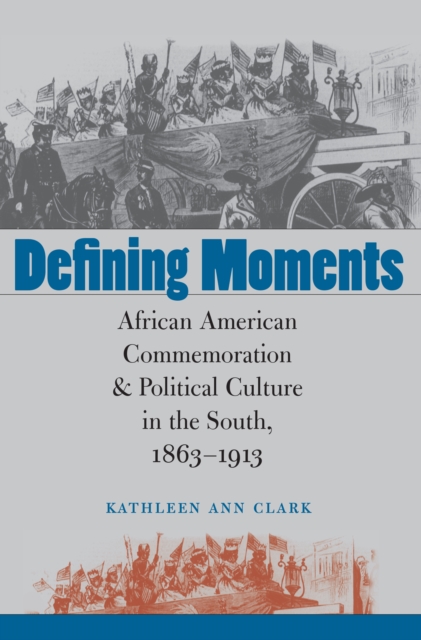
Defining moments : African American commemoration & political culture in the South, 1863-1913
The historical memory of the Civil War and Reconstruction has earned increasing attention from scholars. Only recently, however, have historians begun to explore African American efforts to interpret those events. With Defining Moments, Kathleen Clark shines new light on African American commemorative traditions in the South, where events such as Emancipation Day and Fourth of July ceremonies served as opportunities for African Americans to assert their own understandings of slavery, the Civil War, and Emancipation--efforts that were vital to the struggles to define, assert, and defend African American freedom and citizenship.Focusing on urban celebrations that drew crowds from surrounding rural areas, Clark finds that commemorations served as critical forums for African Americans to define themselves collectively. As they struggled to assert their freedom and citizenship, African Americans wrestled with issues such as the content and meaning of black history, class-inflected ideas of respectability and progress, and gendered notions of citizenship. Clark's examination of the people and events that shaped complex struggles over public self-representation in African American communities brings new understanding of southern black political culture in the decades following Emancipation and provides a more complete picture of historical memory in the South.
eBook
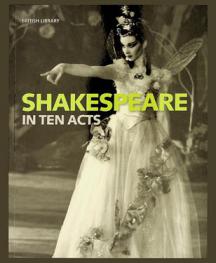
Shakespeare in ten acts
Four hundred years after Shakespeare's death, it is difficult to imagine a time when he was not considered a genius. But those 400 years have seen his plays banished and bowdlerized, faked and forged, traded and translated, re-mixed and re-cast. Shakespeare's story is not one of a steady rise to fame; it is a tale of set-backs and sea-changes that have made him the cultural icon he is today. This revealing new book accompanies an innovative exhibition at the British Library that will take readers on a journey through more than 400 years of performance. It will focus on ten moments in history that have changed the way we see Shakespeare, from the very first production of Hamlet to a digital-age deconstruction. Each performance holds up a mirror to the era in which it was performed. The first stage appearance by a woman in 1660 and a black actor playing Othello in 1825 were landmarks for society as well as for Shakespeare's reputation. The book will also explore productions as diverse as Peter Brook's legendary A Midsummer Night's Dream, Mark Rylance's 'Original Practices' Twelfth Night, and a Shakespeare forgery staged at Drury Lane in 1796, among many others. Over 100 illustrations include the only surviving playscript in Shakespeare's hand, an authentic Shakespeare signature, and rare printed editions including the First Folio. These - and other treasures from the British Library's manuscript and rare book collections - feature alongside film stills, costumes, paintings and production photographs. Publisher.
Book
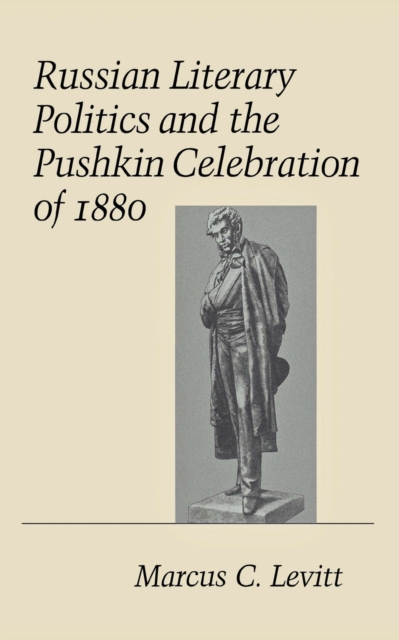
Russian literary politics and the Pushkin Celebration of 1880
In an event acknowledged to be a watershed in modern Russian cultural history, the elite of Russian intellectual life gathered in Moscow in 1880 to celebrate the dedication of a monument to the poet Alexander Pushkin,.
eBook


Custer on Canvas
The 1876 events known as Custer’s Last Stand, Battle of Little Big Horn, or Battle of Greasy Grass have been represented over 1000 times in various artistic media, from paintings to sculpture to fast food giveaways. Norman Denzin shows how these representations demonstrate the changing perceptions—often racist—of Native America by the majority culture, juxtaposed against very different readings shown in works composed by Native American artists. Consisting of autobiographical reminiscences, historical description, artistic representations, staged readings, and snippets of documents, this multilayered performance ethnography examines questions of memory, race, and violence against Native America, as symbolized by the changing interpretations of General Custer and his final battle.
eBook

Celebrating Shakespeare : commemoration and cultural memory
\"On the 400th anniversary of Shakespeare's death, this collection opens up the social practices of commemoration to new research and analysis. An international team of leading scholars explores a broad spectrum of celebrations, showing how key events - such as the Easter Rising in Ireland, the Second Vatican Council of 1964, and the Great Exhibition of 1851 - drew on Shakespeare to express political agendas. In the US, the 1864 commemoration counted on him to symbolize unity transcending the Civil War, while World War I pulled the 1916 anniversary celebration into the war effort, enlisting Shakespeare as patriotic poet. The essays also consider how the dream of Shakespeare as a rural poet took shape in gardens, how cartoons challenged the poet's elite status, and how statues of him mutated into advertisements for gin and Disney cartoons. Richly varied illustrations supplement these case studies of the diverse, complex and contradictory aims of memorializing Shakespeare\"-- Provided by publisher.
Book
Holocaust Remembrance between the National and the Transnational
Holocaust Remembrance Between the National and the Transnational provides a key study of the remembrance of the Jewish Catastrophe and the Nazi-era past in the world arena. It uses a range of primary documentation from the restitution conferences, speeches and presentations made at the Stockholm International Forum of 2000 (SIF 2000), a global event and an attempt to mark a defining moment in the inter-cultural construction of the political and institutional memory of the Holocaust in the USA, Europe and Israel. Containing oral history interviews with delegates to the conference and contemporary press reports, this book explores the inter-relationships between global and national Holocaust remembrances. The causes, consequences and ‘cosmopolitan' intellectual context for understanding the SIF 2000 are discussed in great detail. Larissa Allwork examines this seminal moment in efforts to globally promote the important, if ever controversial, topics of Holocaust remembrance, worldwide Genocide prevention and the commemoration of the Nazi past. Providing a balanced assessment of the Stockholm Project, this book is an important study for those interested in the remembrance of the Holocaust and the Third Reich, as well as the recent global direction in memory studies.
eBook