
Catalogue Search | MBRL


Are you sure you want to remove the book from the shelf?

{{itemTitle}}
549
result(s) for
"Anthologies Editing."
Sort by:


Keepers of the Code
Robert Lecker explores the ways in which these anthologies contributed to the formation of a Canadian literary canon, the extent to which this canon was tied to an ideal of English-Canadian nationalism, and the material conditions accounting for the anthologies' production.
eBook
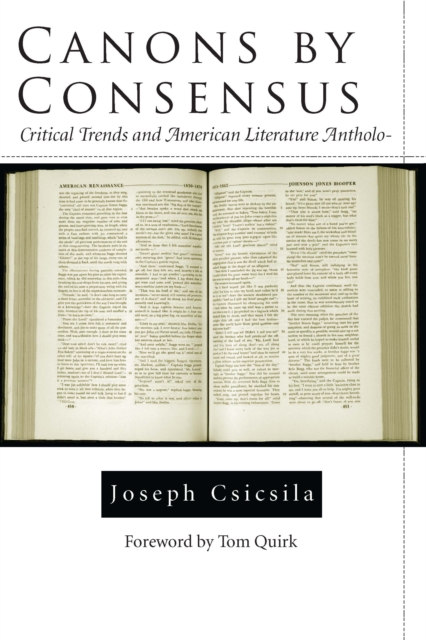
Canons by Consensus
The first systematic analysis of American literature
textbooks used by college instructors in the last
century Scholars have long noted the role that college
literary anthologies play in the rising and falling reputations
of American authors.
Canons by Consensus examines this classroom fixture in
detail to challenge and correct a number of assumptions about
the development of the literary canon throughout the 20th
century.
Joseph Csicsila analyzes more than 80 anthologies published
since 1919 and traces not only the critical fortunes of
individual authors, but also the treatment of entire genres and
groupings of authors by race, region, gender, and formal
approach. In doing so, he calls into question accusations of
deliberate or inadvertent sexism and racism. Selections by
anthology editors, Csicsila demonstrates, have always been
governed far more by prevailing trends in academic criticism
than by personal bias.
Academic anthologies are found to constitute a rich and
often overlooked resource for studying American literature, as
well as an irrefutable record of the academy’s changing
literary tastes throughout the last century.
eBook

The Anthology and the Rise of the Novel
The Anthology and the Rise of the Novel, first published in 2000, brings together two traditionally antagonistic fields, book history and narrative theory, to challenge established theories of 'the rise of the novel'. Leah Price shows that far from leveling class or gender distinctions, as has long been claimed, the novel has consistently located them within its own audience. Shedding new light on Richardson and Radcliffe, Scott and George Eliot, this book asks why the epistolary novel disappeared, how the book review emerged, why eighteenth-century abridgers designed their books for women while Victorian publishers marketed them to men, and how editors' reproduction of old texts has shaped authors' production of new ones. This innovative study will change the way we think not just about the history of reading, but about the genealogy of the canon wars, the future of intellectual property, and the role that anthologies play in our own classrooms.
eBook

Canons by consensus : critical trends and American literature anthologies
The first systematic analysis of American literature textbooks used by college instructors in the last century.
Scholars have long noted the role that college literary anthologies play in the rising and falling reputations of American authors. Canons by Consensus examines this classroom fixture in detail to challenge and correct a number of assumptions about the development of the literary canon throughout the 20th century.
Joseph Csicsila analyzes more than 80 anthologies published since 1919 and traces not only the critical fortunes of individual authors, but also the treatment of entire genres and groupings of authors by race, region, gender, and formal approach. In doing so, he calls into question accusations of deliberate or inadvertent sexism and racism. Selections by anthology editors, Csicsila demonstrates, have always been governed far more by prevailing trends in academic criticism than by personal bias.
Academic anthologies are found to constitute a rich and often overlooked resource for studying American literature, as well as an irrefutable record of the academy's changing literary tastes throughout the last century.
[This] is an innovative piece of scholarship—provocative by implication, lucid in presentation, steady in judgment. What the author has done is to methodically drill test bores through strata of representations of American literature. . . . No one in the future ought to be able to make overarching claims about the American literary canon without first checking here the facts of the cases in question.
—from the Foreword by Tom Quirk
Joseph Csicsila is Assistant Professor of English at Eastern Michigan University where he was recognized with the 2002 Ronald W. Collins Distinguished Faculty Award for Teaching. Tom Quirk is Professor of English at the University of Missouri-Columbia and the author of Nothing Abstract: Investigations in the American Literary Imagination.
eBook


Brazilian short prose in German
This article investigates the post-editing workflow and types of edits made in the context of a real-life literary translation project. The source text is a short narrative by Brazilian author Lima Barreto. The text was first machine-translated into German by DeepL and subsequently postedited by a literary translator, using a keylogger to capture edits and intermediate versions.
Journal Article

Confected Miscellanies in Early Modern England
The history of the miscellany is complicated, in part, by a confusion about the object of study. Not only is the term \"miscellany\" anachronistic, but also it is used to denote two related but distinct sorts of texts. Most of the print and manuscript collections labeled miscellanies are what we might call process miscellanies; that is, miscellaneous because of the processes of compilation. Comparatively neglected, however, are confected miscellanies, in which the apparent disorder is a deliberate effect created by the compiler. Brown's essay looks at the common tactics of three such confected miscellanies—George Gascoigne's A Hundred Sundry Flowers (1573), Francis Davison's A Poetical Rapsodie (1602), and Jonson's The Forest (1616)—and their descent from three different classical forms, the anthology, the rhapsody, and the silva. In this context, Brown asks how this conceptual difference can help us understand the purpose and aesthetic value of miscellanies for early modern authors, compilers, and readers.
Journal Article

From Great Books to World Literature: Anthologies as Institutional Supplements Around 1900 and Today
At the turn of the twentieth century, Great Books anthologies and essay collections began to create a coherent narrative of the world's literature, one that usually ended with the teleological arrival of its imagined reader: Euro-American man. This essay reads four such publishing projects—Charles Dudley Warner's Library of the World's Best Literature, Ancient and Modern (1896), Henry Cabot Lodge's The Best of the World's Classics (1909), John Macy's The Story of the World's Literature (1925), and Charles W. Eliot's The Harvard Classics (1909)—in order to argue that justifications of their selections constitute a theorization of the relationship between the one (text, editor, or imagined reader) and the many (possible texts, editorial boards, or national citizenry). In this way, these anthologies are meta-institutional texts, generating theories that can help us understand how contemporary world literature anthologies might reimagine their role as mediating between the representative and the universal.
Journal Article

Literary Canon Formation and Historiography: The ‘Rediscovery’ of Ming–Qing Women’s Poetry
‘No nation has produced more anthologies or collections of women’s poetry than late imperial China’, according to Kang-i Sun Chang. Indeed, the open-access database of Ming–Qing Women’s Writings at McGill University Library includes 5239 women writers and 431 poetry collections. Yet virtually no trace of this phenomenon, or of these women writers, can be found in transcultural literary histories and anthologies of world literature published in the West in the twentieth century and beyond. How is this possible? The reason is not simply the lack of translations of many of the poems, but rather it has to do with the lack of canonization of these women poets in Chinese literary history until the late twentieth century, when they were ‘rediscovered’. This article investigates this neglect with the aim of showing that there were several different reasons for it, related to poetics, genre hierarchies, anthology editing practices, etc., in the imperial era, and to aspects of Chinese literary historiography in the twentieth century. Two women ci poets, Liu Shi and Qiu Jin, are briefly introduced to show that the reasons for their exclusion, as well as their later inclusion in the national literary canon, also need to be addressed on an individual level.
Journal Article