
Catalogue Search | MBRL


Are you sure you want to remove the book from the shelf?

{{itemTitle}}
369
result(s) for
"Anthropologie politique."
Sort by:

Borders : a very short introduction
\"Compelling and accessible, this Very Short Introduction challenges common perceptions of borders as merely lines on maps or physical barriers snaking across the landscape. Instead, borders are shown to be powerful forces integral to the economic, social, political, and environmental processes that shape our lives. By highlighting their prominent role in global history and across a gamut of contemporary international events, Alexander Diener and Joshua Hagen demonstrate the impact borders have on a range of issues spanning economic development and inequality, inter- and intra-state conflict, migration, nationalism, international law, human rights, environmental sustainability, climate change, public health, and natural resource management and thereby provide a powerful counterpoint to the idea of an emerging borderless world. Even as some scholars and activists argue for open borders, unfettered movement, or the elimination of the territorial nation state, Diener and Hagen emphasize how and why borders have been, are currently, and will undoubtedly remain critical topics for the social sciences, domestic politics, and international affairs for the foreseeable future. This concise volume will appeal to a broad, interdisciplinary audience of scholars, practitioners, and students, including geographers, political scientists, anthropologists, sociologists, historians, experts in international relations and law, and anyone interested in a deeper understanding of current events. Whether taking the form of fenced national borders, gerrymandered electoral districts, bounded economic spaces, or private gated communities, demarcations of political and social spaces protect, structure, and shape our lives. This book offers readers an introduction to the diverse theoretical and philosophical perspectives on borders and their multifaceted roles shaping the twenty-first century\"-- Provided by publisher.
Book

Up, Down, and Sideways
Using a \"vertical slice\" approach, anthropologists critically analyze the relationship between undemocratic uses and abuses of power and the survival of the human species. The contributors scrutinize modern institutions in a variety of regions-from Russia and Mexico to South Korea and the U.S.Up, Down, and
Sidewaysis an ethnographic examination of such phenomena as debtculture, global financial crises, food insecurity, indigenous land and resource appropriation, the mismanagement of health care, andcorporate surrogacy within family life. With a preface by Laura Nader, this isessential reading for anyone seeking solid theories and concrete methods to inform activist scholarship.
eBook
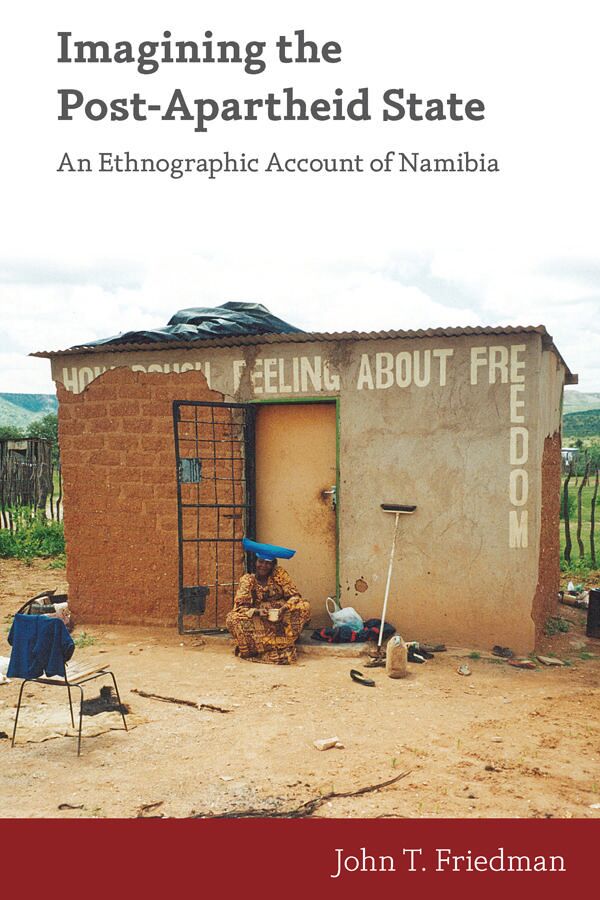
Imagining the Post-Apartheid State
In northwest Namibia, people's political imagination offers a powerful insight into the post-apartheid state. Based on extensive anthropological fieldwork, this book focuses on the former South African apartheid regime and the present democratic government; it compares the perceptions and practices of state and customary forms of judicial administration, reflects upon the historical trajectory of a chieftaincy dispute in relation to the rooting of state power and examines everyday forms of belonging in the independent Namibian State. By elucidating the State through a focus on the social, historical and cultural processes that help constitute it, this study helps chart new territory for anthropology, and it contributes an ethnographic perspective to a wider set of interdisciplinary debates on the State and state processes.
eBook
Magicians of Manumanua
This title is part of UC Press's Voices Revived program, which commemorates University of California Press's mission to seek out and cultivate the brightest minds and give them voice, reach, and impact. Drawing on a backlist dating to 1893, Voices Revived makes high-quality, peer-reviewed scholarship accessible once again using print-on-demand technology. This title was originally published in 1983.
eBook

Integral Europe
Over the past 15 years, the project of advanced European integration has followed a complex secular and cosmopolitan agenda. As that agenda has evolved, however, so have various hard-line populist movements with goals diametrically opposed to the ideals of a harmonious European Union. Spearheaded by figures such as Jean-Marie Le Pen, the controversial leader of France's National Front party, these radical movements have become increasingly influential and, because of their philosophical affinities with fascism and national socialism--politically worrisome.
InIntegral Europe,anthropologist Douglas Holmes posits that such movements are philosophically rooted in integralism, a sensibility that, in its most benign form, enables people to maintain their ethnic identity and solidarity within the context of an increasingly pluralistic society. Taken to irrational extremes by people like Le Pen, integralism is being used to inflame people's feelings of alienation and powerlessness, the by-products of impersonal, transnational \"fast-capitalism.\" The consequences are an invidious politics of exclusion that spawns cultural nationalism, racism, and social disorder.
The analysis moves from northern Italy to Strasbourg and Brussels, the two venues of the European Parliament, and finally to the East End of London. This multi-sited ethnography provides critical perspective on integralism as a form of intimate cultural practice and a violent idiom of estrangement. It combines a wide-ranging review of modern and historical scholarship with two years of field research that included personal interviews with right-wing activists, among them Le Pen and neo-Nazis in inner London. Fascinating, provocative, and sobering,Integral Europeoffers a rare inside look at one of modern Europe's most unsettling political trends.
eBook
Postsocialist Europe
Now that nearly twenty years have passed since the collapse of the Soviet bloc there is a need to understand what has taken place since that historic date and where we are at the moment. Bringing together authors with different historical, cultural, regional and theoretical backgrounds, this volume engages in debates that address new questions arising from recent developments, such as whether there is a need to reject or uphold the notion of post-socialism as both a necessary and valid concept ignoring changes and differences across both time and space. The authors’ firsthand ethnographies from their own countries belie such a simplistic notion, revealing, as they do, the cultural, social, and historical diversity of countries of Central and Southeastern Europe.
eBook

An Anthropological Trompe L'Oeil for a Common World
Our political age is characterized by forms of description as 'big' as the world itself: talk of 'public knowledge' and 'public goods,' 'the commons' or 'global justice' create an exigency for modes of governance that leave little room for smallness itself. Rather than question the politics of adjudication between the big and the small, this book inquires instead into the cultural epistemology fueling the aggrandizement and miniaturization of description itself. Incorporating analytical frameworks from science studies, ethnography, and political and economic theory, this book charts an itinerary for an internal anthropology of theorizing. It suggests that many of the effects that social theory uses today to produce insights are the legacy of baroque epistemological tricks. In particular, the book undertakes its own trompe l'oeil as it places description at perpendicular angles to emerging forms of global public knowledge. The aesthetic 'trap' of the trompe l'oeil aims to capture knowledge, for only when knowledge is captured can it be properly released.
eBook

How Societies Are Born
Like stars, societies are born, and this story deals with such a birth. It asks a fundamental and compelling question: How did societies first coalesce from the small foraging communities that had roamed in West Central Africa for many thousands of years?
Jan Vansina continues a career-long effort to reconstruct the history of African societies before European contact inHow Societies Are Born.In this complement to his previous studyPaths in the Rainforests,Vansina employs a provocative combination of archaeology and historical linguistics to turn his scholarly focus to governance, studying the creation of relatively large societies extending beyond the foraging groups that characterized west central Africa from the beginning of human habitation to around 500 BCE, and the institutions that bridged their constituent local communities and made large-scale cooperation possible.
The increasing reliance on cereal crops, iron tools, large herds of cattle, and overarching institutions such as corporate matrilineages and dispersed matriclans lead up to the developments treated in the second part of the book. From about 900 BCE until European contact, different societies chose different developmental paths. Interestingly, these proceeded well beyond environmental constraints and were characterized by \"major differences in the subjects which enthralled people,\" whether these were cattle, initiations and social position, or \"the splendors of sacralized leaders and the possibilities of participating in them.\"
eBook

Democracy in Modern Europe
As one of the most influential ideas in modern European history, democracy has fundamentally reshaped not only the landscape of governance, but also social and political thought throughout the world. Democracy in Modern Europe surveys the conceptual history of democracy in modern Europe, from the Industrial Revolutions of the nineteenth century through both world wars and the rise of welfare states to the present era of the European Union. Exploring individual countries as well as regional dynamics, this volume comprises a tightly organized, comprehensive, and thoroughly up-to-date exploration of a foundational issue in European political and intellectual history.
eBook
