
Catalogue Search | MBRL


Are you sure you want to remove the book from the shelf?

{{itemTitle}}
38
result(s) for
"Anti-imperialist movements Great Britain History 20th century."
Sort by:

Imperial sceptics : British critics of empire, 1850-1920
\"Imperial Sceptics provides a highly original analysis of the emergence of opposition to the British Empire from 1850-1920. Departing from existing accounts, which have focused upon the Boer War and the writings of John Hobson, Gregory Claeys proposes a new chronology for the contours of resistance to imperial expansion. Claeys locates the impetus for such opposition in the late 1850s with the British followers of Auguste Comte. Tracing critical strands of anti-imperial thought through to the First World War, Claeys then scrutinises the full spectrum of socialist writings from the early 1880s onwards, revealing a fundamental division over whether a new conception of 'socialist imperialism' could appeal to the electorate and satisfy economic demands. Based upon extensive archival research, and utilising rare printed sources, Imperial Sceptics will prove a major contribution to our understanding of nineteenth-century political thought, shedding new light on theories of nationalism, patriotism, the state and religion\"--Provided by publisher.
Book

The Trouble with Empire
While imperial blockbusters fly off the shelves, there is no comprehensive history dedicated to resistance in the 19th and 20th century British Empire. The Trouble with Empire is the first volume to fill this gap, offering a brief but thorough introduction to the nature and consequences of resistance to British imperialism. Historian Antoinette Burton's study spans the 19th and 20th centuries, when discontented subjects of empire made their unhappiness felt from Ireland to Canada to India to Africa to Australasia, in direct response to incursions of military might and imperial capitalism. The Trouble with Empire offers the first thoroughgoing account of what British imperialism looked like from below and of how tenuous its hold on alien populations was throughout its long, unstable life. By taking the long view, moving across a variety of geopolitical sites and spanning the whole of the period 1840-1955, Burton examines the commonalities between different forms of resistance and unveils the structural weaknesses of the British Empire. From the Indian Mutiny of 1857 to the Anglo-Zulu War to the Opium War, The Trouble with Empire reveals the often-overlooked indigenous agency throughout the British empire and illuminates the limits of imperial power, both official and unofficial.
eBook


Enoch Powell and the Making of Postcolonial Britain
Enoch Powell's explosive rhetoric against black immigration and anti-discrimination law transformed the terrain of British race politics and cast a long shadow over British society. Using extensive archival research, Camilla Schofield offers a radical reappraisal of Powell's political career and insists that his historical significance is inseparable from the political generation he sought to represent. Enoch Powell and the Making of Postcolonial Britain follows Powell's trajectory from an officer in the British Raj to the centre of British politics and, finally, to his turn to Ulster Unionism. She argues that Powell and the mass movement against 'New Commonwealth' immigration that he inspired shed light on Britain's war generation, popular understandings of the welfare state and the significance of memories of war and empire in the making of postcolonial Britain. Through Powell, Schofield illuminates the complex relationship between British social democracy, racism and the politics of imperial decline in Britain.
eBook
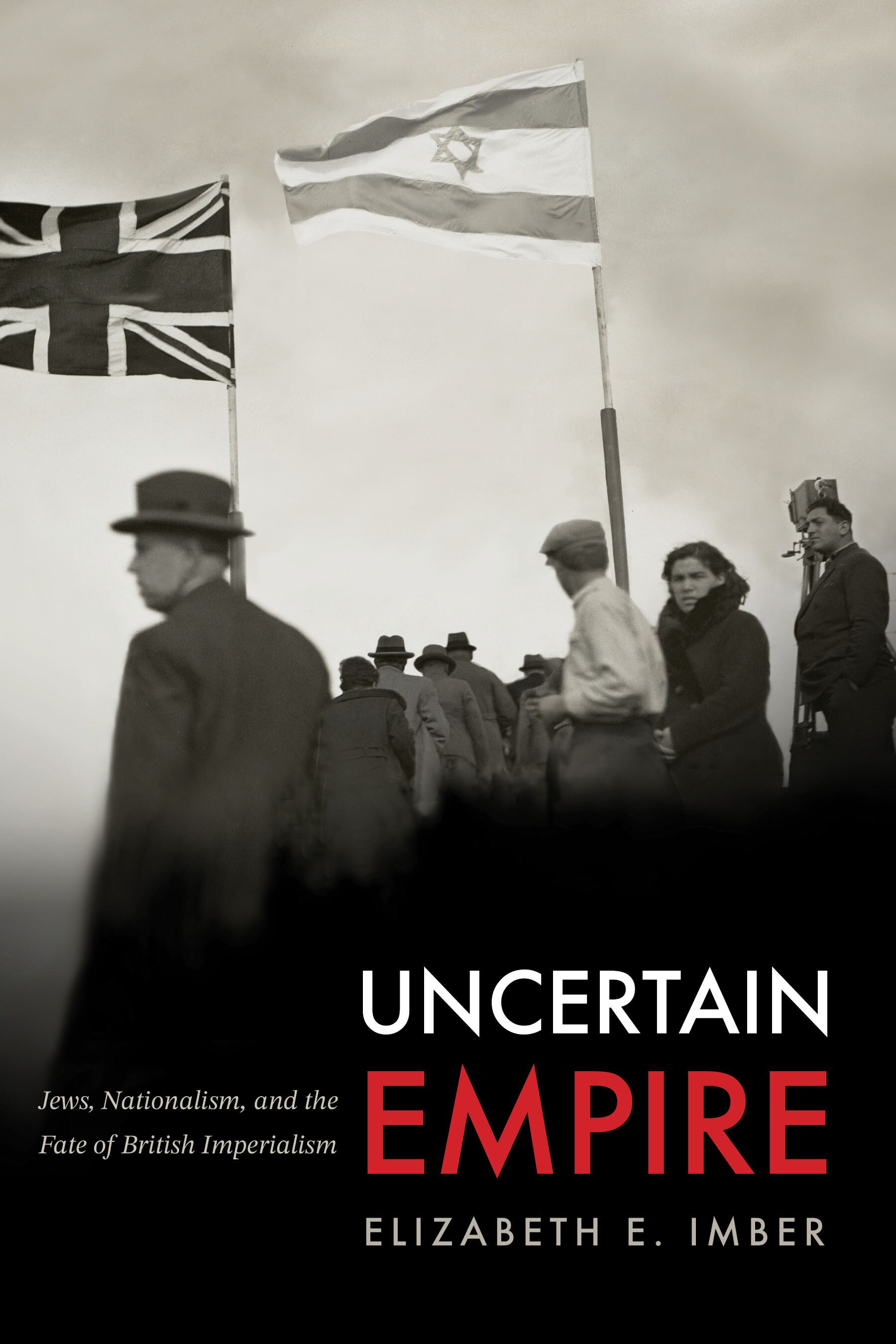
Uncertain Empire
Following the British conquest of Ottoman Palestine, Jews across the British Empire—from Jerusalem to Johannesburg, London to Calcutta—found themselves at the heart of global Jewish political discourse. As these intellectuals, politicians, activists, and communal elites navigated shifting political landscapes, some envisioned Palestine as a British dominion, leveraging imperial power for Jewish state-building, while others fostered ties with anticolonial movements, contemplating independent national aspirations. Uncertain Empire considers this intricate interplay between British imperialism, Zionism, and anticolonial movements from the 1917 British conquest of Palestine to the establishment of the state of Israel in 1948. Elizabeth Imber highlights diverse and sometimes conflicting visions of Jewish political futures, offering detailed case studies of key figures including Chaim Arlosoroff, Moshe Shertok, Helen Bentwich, Rachel Ezra, and Hermann Kallenbach. She explores a \"politics of uncertainty\" in which Jews engaged with both imperial stability and the rise of anticolonial mobilization, when many were likewise forced to reconsider Palestine as a viable refuge and political solution. Ultimately, this book provides a nuanced understanding of how the British Empire's fate became central to Zionist and broader Jewish political thought, revealing the complex intersections of empire, state power, and Jewish politics during a time marked by profound urgency and exigency.
eBook

From Empire To Orient
From Empire to Orient offers an alternative perspective on Britain's late imperial period by looking at the lives and the writings of the men who chose to defy the conventional social and political attitudes of the British ruling classes towards the Near East. Between the Greek revolt in 1830 and the fall of the Caliphate in 1924 a different kind of voice was heard that was both anti-Imperialist and pro-Islamic. Geoffrey Nash places David Urquhart’s passionate belief in the ideal of municipal government in Turkey, W.S. Blunt’s enthusiasm for the Egyptian reformers of the Azhar and Marmaduke Pickthall’s advocacy of the cause of the Young Turks into their political and historical context and into the context of their writings.
eBook

The Absent-Minded Imperialists
The British empire was a huge enterprise. To foreigners, it more or less defined Britain in the 19th and early 20th centuries. Its repercussions in the wider world are still with us today. It also had a great impact on Britain herself: for example, on her economy, security, population, and eating habits. One might expect this to have been reflected in her society and culture. Indeed, this has now become the conventional wisdom: that Britain was steeped in imperialism domestically, which affected (or infected) almost everything Britons thought, felt, and did. This book examines this assumption critically against the broader background of contemporary British society. It argues that the empire had a far lower profile in Britain than it did abroad. Although Britain was an imperial nation in this period, she was never a genuine imperial society. As well as showing how this was possible, the book also discusses the implications of this attitude for Britain and her empire, and for the relationship between culture and imperialism more generally, bringing his study up to date by including the case of the present-day United States.
eBook

May Days in Hong Kong
In this study of the anti-colonial riots which erupted in Hong Kong in May 1967, the authors of May Days in Hong Kong shed new light on their causes, their impact on future government policy and on Sino-British relations, and their legacy for Hong Kong so
eBook

Empire, the national, and the postcolonial, 1890-1920 : resistance in interaction
This book explores the political co-operations and textual connections which linked anti-colonial, nationalist, and modernist groups and individuals in the empire in the years 1890-1920. By developing the key motifs of lateral interaction and colonial interdiscursivity, this book builds a picture of the imperial world as an intricate network of surprising contacts and margin-to-margin interrelationships, and of modernism as a far more constellated cultural phenomenon than previously understood. Individual case studies consider Irish support for the Boers in 1899-1902, the path-breaking radical partnership of the Englishwoman Sister Nivedita and the Bengali extremist Aurobindo Ghose, Sol Plaatje's conflicted South African nationalism, and the cross-border, cosmopolitan involvements of W. B. Yeats, Rabindranath Tagore, and Leonard Woolf. Underlining Frantz Fanon's perception that ‘a colonized people is not alone’, the book significantly questions prevailing postcolonial paradigms of the self-defining nation, syncretism and mimicry, and dismantles still-dominant binary definitions of the colonial relationship.
eBook

Englishness and empire 1939-1965
Was the British empire given away in a fit of collective indifference as many have claimed? Englishness and Empire looks at connections between stories of nation and empire told in the media - the Second World War, the Coronation and Everest, colonial wars of the 1950s, immigration, Winston Churchill's funeral - and makes an important and origi.
eBook