
Catalogue Search | MBRL


Are you sure you want to remove the book from the shelf?

{{itemTitle}}
6
result(s) for
"Antiquities, Prehistoric -- Africa, East"
Sort by:

China and East Africa : ancient ties, contemporary flows
'China and East Africa' marks the culmination of a new round of archaeological and historical research on the relations between China and Africa, from the origins to the present. Africa and Asia have always been in constant contact, through land and seas. The contributors to this volume debate and present the results of their research on the very complex and intricate networks of connections that crisscrossed the Indian Ocean and surrounding lands linking Africa to East Asia.
Book
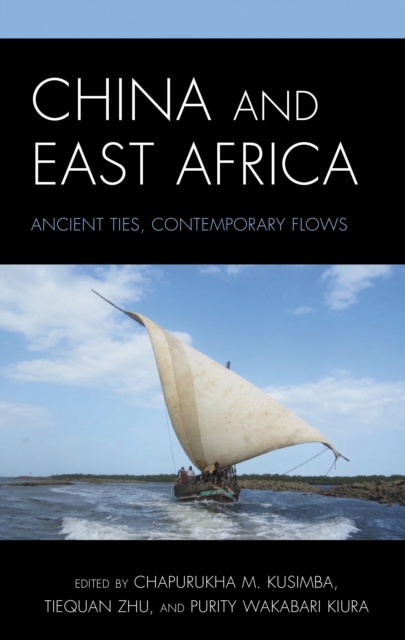
China and East Africa : ancient ties, contemporary flows
China and East Africa: Ancient Ties and Contemporary Flows marks the culmination of a new round of archaeological and historical research on the relations between China and Africa, from the origins to the present.Africa and Asia have always been in constant contact, through land and seas.
eBook

South-Eastern Mediterranean Peoples Between 130,000 and 10,000 Years Ago
The Upper Pleistocene era encompassed a period of dramatic cultural developments in the south-eastern Mediterranean basin. This book highlights and synthesizes the latest research and current scientific debate on the archaeology of this time period in North Africa and the Near East. Recent archaeological research in North Africa has meant this region now plays a decisive role in scientific debate. After decades of neglect, the archaeological record from North Africa has now been seen to parallel in significance that of the Near East. This book offers an opportunity to observe the Afro-Asian side of the Mediterranean basin as an uninterrupted land, as it was for its Upper Pleistocene inhabitants. Areas of focus include the Out-of-Africa movement of anatomically modern humans (Homo sapiens) into the Levant and the transition from the Middle Palaeolithic/Middle Stone Age to the Upper Palaeolithic/Later Stone Age, during which a change of lifestyle took place, based on plant cultivation and animal husbandry. These topics are of crucial interest to anyone studying human evolution, prehistoric archaeology, anthropology, and palaeo-environmental studies. This volume brings together data as well as perspectives from various scholars, often separated by their areas of interest and location. This volume is complementary to The Mediterranean from 50,000 to 25,000 BP: Turning Points and New Directions edited by M. Camps and C. Szmidt (Oxbow Books, 2009).
eBook

A revised chronology for pastoralism in southernmost Africa: new evidence of sheep at c. 2000 b.p. from Blombos Cave, South Africa
New excavation at Blombos Cave, in the southern Cape of South Africa, and new radiocarbon dates for its sequence further illuminate the chronology of pastoralism in southern Africa, and the relations between pottery-using and shepherding.
Journal Article
Diversity in mastic-mounted stone adzes and the use of mastic in precolonial South Africa: evidence from Steenbokfontein Cave
Composite tools and hafted tools were used world-wide over the last 35,000 years, and possibly earlier than that (Boëda et al. 1996; Holdaway 1996). Evidence for the use of composite tools in South Africa is provided by a small number of arrows from ethnohistorical and archaeological collections (Binneman 1994; Deacon & Deacon 1999: 158–9), a handful of mounted stone artefacts, and a significant number of mastic stained stone artefacts from archaeological sites (Deacon & Deacon 1999). On the basis of the limited sample of near intact mounted artefacts found in South Africa, it appears that small scrapers were side-mounted (at almost 90° to the axis of the handle) and fixed asymmetrically by surrounding resin (Deacon & Deacon 1980: 31–2). Adzes, on the other hand, were end-mounted (on one extreme, and along the same plane, of the handle) and held by a large ovoid lump of mastic (Hewitt 1921; Goodwin & Van Riet Lowe 1929: plate 42; Sampson 1974: figure 105). From their analysis of the available material two decades ago, Deacon & Deacon (1980: 37) concluded that the size and form of the insert was determined largely by the mode of hafting.
Journal Article
A history in paint and stone from Rose Cottage Cave, South Africa
In South Africa, as in so many regions, the world of dirt archaeology in shelter floors and of rock art on shelter walls, have also been rather separate as domains of study. In research at Rose Cottage Cave, bridges are being made to link both strands of evidence of the forager social strategies from which both derive.
Journal Article