
Catalogue Search | MBRL


Are you sure you want to remove the book from the shelf?

{{itemTitle}}
1,538
result(s) for
"Appalachian Region"
Sort by:

Burning bright : stories
Captures the eerie beauty, stark violence, and rugged character of Appalachia in a collection of stories that spans the Civil War to the present day.
Book

Combating Mountaintop Removal
Drawing on powerful personal testimonies of the hazards of mountaintop removal in southern West Virginia, Combating Mountaintop Removal critically examines the fierce conflicts over this violent and increasingly prevalent form of strip mining. Bryan T. McNeil documents the changing relationships among the coal industry, communities, environment, and economy from the perspective of local grassroots activist organizations and their broader networks. Focusing on Coal River Mountain Watch (CRMW), an organization composed of individuals who have personal ties to the coal industry in the region, the study reveals a turn away from once-strong traditional labor unions and the emergence of community-based activist organizations. By framing social and moral arguments in terms of the environment, these innovative hybrid movements take advantage of environmentalism's higher profile in contemporary politics. In investigating the local effects of globalization and global economics, McNeil tracks the profound reimagining of social and personal ideas such as identity, history, and landscape and considers their roles in organizing an agenda for progressive community activism.
eBook


Standing Our Ground
Standing Our Ground: Women, Environmental Justice, and the Fight to End Mountaintop Removal examines women's efforts to end mountaintop removal coal mining in West Virginia. Mountaintop removal coal mining, which involves demolishing the tops of hills and mountains to provide access to coal seams, is one of the most significant environmental threats in Appalachia, where it is most commonly practiced. The Appalachian women featured in Barry's book have firsthand experience with the negative impacts of Big Coal in West Virginia. Through their work in organizations such as the Coal River Mountain Watch and the Ohio Valley Environmental Coalition, they fight to save their mountain communities by promoting the development of alternative energy resources. Barry's engaging and original work reveals how women's tireless organizing efforts have made mountaintop removal a global political and environmental issue and laid the groundwork for a robust environmental justice movement in central Appalachia.
eBook


Center Places and Cherokee Towns
Examines how architecture and other aspects of the built
environment, such as hearths, burials, and earthen mounds, formed
center places within the Cherokee cultural landscape In
Center Places and Cherokee Towns , Christopher B. Rodning
opens a panoramic vista onto protohistoric Cherokee culture. He
posits that Cherokee households and towns were anchored within
their cultural and natural landscapes by built features that
acted as “center places.” Rodning investigates the
period from just before the first Spanish contact with
sixteenth-century Native American chiefdoms in La Florida through
the development of formal trade relations between Native American
societies and English and French colonial provinces in the
American South during the late 1600s and 1700s. Rodning focuses
particularly on the Coweeta Creek archaeological site in the
upper Little Tennessee Valley in southwestern North Carolina and
describes the ways in which elements of the built environment
were manifestations of Cherokee senses of place. Drawing on
archaeological data, delving into primary documentary sources
dating from the eighteenth century, and considering Cherokee
myths and legends remembered and recorded during the nineteenth
century, Rodning shows how the arrangement of public structures
and household dwellings in Cherokee towns both shaped and were
shaped by Cherokee culture. Center places at different scales
served as points of attachment between Cherokee individuals and
their communities as well as between their present and past.
Rodning explores the ways in which Cherokee architecture and the
built environment were sources of cultural stability in the
aftermath of European contact, and how the course of European
contact altered the landscape of Cherokee towns in the long run.
In this multi-faceted consideration of archaeology, ethnohistory,
and recorded oral tradition, Rodning adeptly demonstrates the
distinct ways that Cherokee identity was constructed through
architecture and other material forms.
Center Places and Cherokee Towns will have a broad
appeal to students and scholars of southeastern archaeology,
anthropology, Native American studies, prehistoric and
protohistoric Cherokee culture, landscape archaeology, and
ethnohistory.
eBook


Our Roots Run Deep as Ironweed
Motivated by a deeply rooted sense of place and community,
Appalachian women have long fought against the damaging effects of
industrialization. In this collection of interviews, sociologist
Shannon Elizabeth Bell presents the voices of twelve Central
Appalachian women, environmental justice activists fighting against
mountaintop removal mining and its devastating effects on public
health, regional ecology, and community well-being.
Each woman narrates her own personal story of injustice and
tells how that experience led her to activism. The interviews--many
of them illustrated by the women's \"photostories\"--describe
obstacles, losses, and tragedies. But they also tell of new
communities and personal transformations catalyzed through
activism. Bell supplements each narrative with careful notes that
aid the reader while amplifying the power and flow of the
activists' stories. Bell's analysis outlines the relationship
between Appalachian women's activism and the gendered
responsibilities they feel within their families and communities.
Ultimately, Bell argues that these women draw upon a broader
\"protector identity\" that both encompasses and extends the identity
of motherhood that has often been associated with grassroots
women's activism. As protectors, the women challenge dominant
Appalachian gender expectations and guard not only their families
but also their homeplaces, their communities, their heritage, and
the endangered mountains that surround them.
30% of the proceeds from the sale of this book will be donated
to organizations fighting for environmental justice in Central
Appalachia.
eBook

My curious and jocular heroes : tales and tale-spinners from Appalachia
\"With this book, Jones introduces to new generations four scholars of Appalachian folkways who made major contributions to the arts, culture, and values of the Appalachian people. Bascom Lamar Lunsford, born in North Carolina, collected ballads, songs, tunes, and stories--before there were tape recorders--by committing them all to memory and later recording his \"memory collection\" for Columbia University (1935) and the Library of Congress (1949). Josiah H. Combs, a Kentuckian who got a doctorate at the Sorbonne, taught languages, collected stories and songs, gave ballad recitals, was an authority on Kentucky mountain speech, and was a great raconteur. Cratis D. Williams, another Kentuckian, was the father of Appalachian studies based on his massive dissertation, The Southern Mountaineer in Fact and Fiction. He was a scholar and teacher, a singer of the old ballads, and teller of folk tales. He became Jones's treasured mentor. And the master storyteller Leonard W. Roberts, also born in Kentucky, was a pioneer collector and publisher of Old World folktales, riddles, ballads, and lyric songs, too. Beyond mere biography, this book introduces the reader to some of the lore preserved and performed by Lunsford, Combs, Williams, and Roberts throughout their lives. The end of each biographical chapter is filled with collected stories, songs, and jokes representing the breadth of each man's research and repertoire. With \"My Curious and Jocular Heroes,\" Jones provides not only the historical and cultural contexts of the lives of four of his personal heroes, but also brings together significant texts and music from Appalachian folklore in order to make a contribution to the field of Appalachian studies\"-- Provided by publisher.
Book
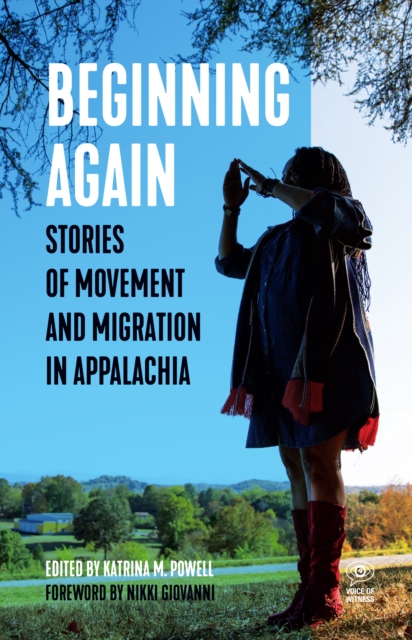
Beginning Again
Appalachia has been a place of movement and migration—for individuals, families, and entire communities—for centuries. Beginning Again brings together twelve narratives of refugees, migrants, and generations-long residents that explore complex journeys of resettlement. In their stories, Appalachia—despite how it's popularly portrayed—is not simply a region of poverty and strife populated only by white people. It is a diverse place where belonging and connection are created despite displacement, resource extraction, and inequality. Among the narratives included: Hear from Claudine Katete, a Rwandan asylum seeker raised in refugee camps who graduated college into the chaos of COVID-19. Follow Amal as she and her family fled war-ravaged Syria and navigated mice-infested housing and unresponsive case workers. Listen to Mekyah Davis, born and raised in Big Stone Gap, as he describes the \"slow burn\" of everyday racism and his efforts to organize Black Appalachian youth to stay in their communities. Taken together, their stories and more collected here present a nuanced look at life in contemporary Appalachia. Download the corresponding lesson plans on the Voice of Witness website. [https://voiceofwitness.org/resources/beginning-again-appalachia-curriculum/]
eBook