
Catalogue Search | MBRL


Are you sure you want to remove the book from the shelf?

{{itemTitle}}
82
result(s) for
"Apple computer Programming."
Sort by:

Swift in depth
It's fun to create your first toy iOS or Mac app in Swift. Writing secure, reliable, professional-grade software is a different animal altogether. The Swift language includes an amazing set of high-powered features, and it supports a wide range of programming styles and techniques. You just have to roll up your sleeves and learn Swift in depth. \"Swift in depth\" guides you concept by concept through the skills you need to build professional software for Apple platforms, such as iOS and Mac; also on the server with Linux. By following the numerous concrete examples, enlightening explanations, and engaging exercises, you'll finally grow powerful techniques like generics, efficent error handling, protocol-oriented programming, and advanced Swift patterns. Author Tjeerd in 't Veen reveals the high-value, difficult-to-discover Swift techniques he's learned through his own hard-won experience.
Book

Blind-sided by privacy? Digital contact tracing, the Apple/Google API and big tech’s newfound role as global health policy makers
Since the outbreak of COVID-19, governments have turned their attention to digital contact tracing. In many countries, public debate has focused on the risks this technology poses to privacy, with advocates and experts sounding alarm bells about surveillance and mission creep reminiscent of the post 9/11 era. Yet, when Apple and Google launched their contact tracing API in April 2020, some of the world’s leading privacy experts applauded this initiative for its privacy-preserving technical specifications. In an interesting twist, the tech giants came to be portrayed as greater champions of privacy than some democratic governments. This article proposes to view the Apple/Google API in terms of a broader phenomenon whereby tech corporations are encroaching into ever new spheres of social life. From this perspective, the (legitimate) advantage these actors have accrued in the sphere of the production of digital goods provides them with (illegitimate) access to the spheres of health and medicine, and more worrisome, to the sphere of politics. These sphere transgressions raise numerous risks that are not captured by the focus on privacy harms. Namely, a crowding out of essential spherical expertise, new dependencies on corporate actors for the delivery of essential, public goods, the shaping of (global) public policy by non-representative, private actors and ultimately, the accumulation of decision-making power across multiple spheres. While privacy is certainly an important value, its centrality in the debate on digital contact tracing may blind us to these broader societal harms and unwittingly pave the way for ever more sphere transgressions.
Journal Article
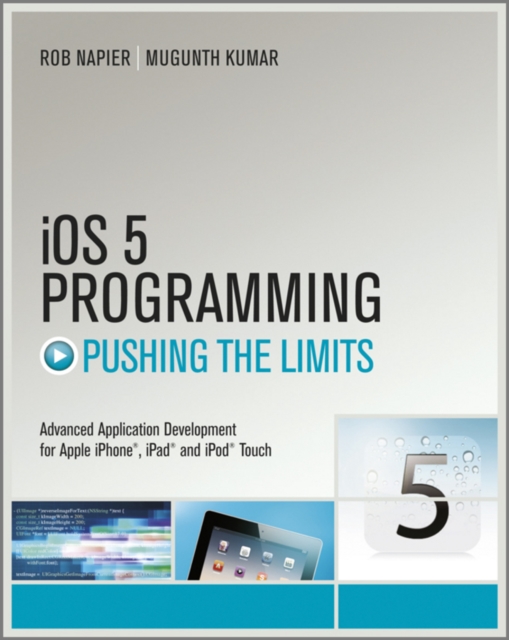
Pushing the limits with iOS 5 programming: advanced application development for Apple iPhone, iPad and iPod touch
Open the door to endless new app development possibilities Pushing the Limits with iOS 5 Programming is an expert guide for developers aiming to create unique applications for Apple′s iPad 2, iPhone, and the iPod Touch, which includes the latest version of the Apple iPhone SDK, iOS 5. This text goes beyond the basics to keep you ahead of the technology curve and spark your innovative nature to create seamless, functional, and fun apps. With a focus on advanced techniques for app development, you will learn to differentiate your apps from all the rest. With this must-have book, you′ll explore advanced coverage of a variety of development topics, such as developing with deep Objective-C, while you learn to create amazing applications for Apple′s iPad 2, iPhone, and iPod touch. Veteran mobile developers and authors guide you through maximizing your programs as they delve into topics not commonly found elsewhere. Provides a solid foundation in the patterns of iOS Shares tips for running on multiple platforms and best using security services Discusses topics such as controlling multitasking, advanced text layout and more Demonstrates how to think differently with blocks and functional programming Teaches table view, performance, and money-making optimization Eliminates common challenges with memory management and iOS information flow Pushing the Limits with iOS 5 Programming allows you to take on the future with confidence in your new, stand-out app design skills.
eBook

Measurement of Forest Inventory Parameters with Apple iPad Pro and Integrated LiDAR Technology
The estimation of single tree and complete stand information is one of the central tasks of forest inventory. In recent years, automatic algorithms have been successfully developed for the detection and measurement of trees with laser scanning technology. Nevertheless, most of the forest inventories are nowadays carried out with manual tree measurements using traditional instruments. This is due to the high investment costs for modern laser scanner equipment and, in particular, the time-consuming and incomplete nature of data acquisition with stationary terrestrial laser scanners. Traditionally, forest inventory data are collected through manual surveys with calipers or tapes. Practically, this is both labor and time-consuming. In 2020, Apple implemented a Light Detection and Ranging (LiDAR) sensor in the new Apple iPad Pro (4th Gen) and iPhone Pro 12. Since then, access to LiDAR-generated 3D point clouds has become possible with consumer-level devices. In this study, an Apple iPad Pro was tested to produce 3D point clouds, and its performance was compared with a personal laser scanning (PLS) approach to estimate individual tree parameters in different forest types and structures. Reference data were obtained by traditional measurements on 21 circular forest inventory sample plots with a 7 m radius. The tree mapping with the iPad showed a detection rate of 97.3% compared to 99.5% with the PLS scans for trees with a lower diameter at a breast height (dbh) threshold of 10 cm. The root mean square error (RMSE) of the best dbh measurement out of five different dbh modeling approaches was 3.13 cm with the iPad and 1.59 cm with PLS. The data acquisition time with the iPad was approximately 7.51 min per sample plot; this is twice as long as that with PLS but 2.5 times shorter than that with traditional forest inventory equipment. In conclusion, the proposed forest inventory with the iPad is generally feasible and achieves accurate and precise stem counts and dbh measurements with efficient labor effort compared to traditional approaches. Along with future technological developments, it is expected that other consumer-level handheld devices with integrated laser scanners will also be developed beyond the iPad, which will serve as an accurate and cost-efficient alternative solution to the approved but relatively expensive TLS and PLS systems. Such a development would be mandatory to broadly establish digital technology and fully automated routines in forest inventory practice. Finally, high-level progress is generally expected for the broader scientific community in forest ecosystem monitoring, as the collection of highly precise 3D point cloud data is no longer hindered by financial burdens.
Journal Article

Advanced iOS 4 Programming
With Advanced iOS 4 Programming, developers have the expert guidance they need to create amazing applications for Apple's iPhone, iPad, and iPod touch.
Inside, veteran mobile developer Dr. Maher Ali begins with a foundation introduction to Objective C and Cocoa Touch programming, and then guides readers through building apps with Apple's iPhone SDK 4 – including coverage of the major categories of new APIs and building apps for the new Apple iPad.
This book concentrates on illustrating GUI concepts programmatically, allowing readers to fully appreciate the complete picture of iOS 4 development without relying on Interface Builder. In addition, Interface Builder is covered in several chapters.
Advanced iOS 4 Programming delves into more advanced topics going beyond the basics of iOS 4 development, providing comprehensive coverage that will help you get your apps to the App Store quicker.
Key features include:
* Objective-C programming language and runtime
* Interface Builder
* Building advanced mobile user interfaces
* Collections
* Cocoa Touch
* Core Animation and Quartz 2D
* Model-view-controller (MVC) designs
* Developing for the iPad
* Grand Central Dispatch
* Parsing XML documents using SAX, DOM, and TouchXML
* Working with the Map Kit API
* Remote and Local Push Notification
* Blocks (closures) in Objective-C
* Building advanced location-based applications
* Developing database applications using the SQLite engine
* GameKit framework
eBook

Beginning iOS application development with HTML and JavaScript
This book covers the various aspects of developing web-based applications for iOS. Over the past four years, the iPhone and iPad have been amazingly successful. Because of this success, application developers are entering a world of sophisticated, multifunctional mobile applications. Now mobile web-based applications can bring together web apps, native apps, multimedia video and audio, and the mobile device itself. By using this book you will learn how to create a mobile application from beginning to end, utilizing open source frameworks to speed up development times, emulate the look and feel of built-in Apple applications, capture finger touch interactions, and optimize applications for Wi-Fi and wireless networks. The book introduces you to the web application platform for iOS. It also guides you through the process of building new applications from scratch as well as migrating existing web applications to this new mobile platform. By doing this, the book helps readers design a user interface that is optimized for iOS touch-screen displays and integrate their applications with iPhone services, including Phone, Mail, Google Maps, and GPS. This book is aimed at beginning and intermediate web developers who want to learn how to build new applications for iOS or migrate existing web apps to this platform. In general, you will find it helpful if you have a working knowledge of these technologies: HTML/XHTML CSS JavaScript Ajax.
eBook

Professional iOS network programming
Learn to develop iPhone and iPad applications for networked enterprise environments The iPhone and iPad have made a powerful impact on the business world. Developers creating iOS apps for the enterprise face unique challenges involving networking, system integration, security, and device management. This Wrox guide provides everything you need to know to write iOS apps that integrate with enterprise network resources, providing options for networking iOS devices to enterprise systems and to each other. -Offers a complete compendium of methods and techniques for networked communication between iOS applications and other platforms and devices -Includes instruction on incorporating synchronous and asynchronous HTTP requests, security, communication issues, and more -Covers payload handling, network security, GameKit and Bonjour communications, and low-level network communications Professional iOS Network Programming focuses on the networking aspects of iOS and its relationship to remote data sources, offering a truly unique approach.
eBook

IOS 6 Application Development for Dummies
Create incredible apps for the iPhone and iPad using the latest features of iOS 6 You could be the one who creates the next super app - one that is universal, works for both the iPhone and iPad, and is a top seller. It's a great goal, and the road starts here, with this energizing guide. Whether you're a budding programming hobbyist or a serious developer looking to hit it big, the information in this book is what you need. Learn how to join Apple's developer program, understand key differences between iPad and iPhone apps, download the latest SDK, create great user experiences, and build your very own app from the ground up. You'll gain the valuable hands-on experience you need to take your development skills to the next level by walking through the development process step-by-step and creating two applications. Shows programming hobbyists and programming pros how to develop a universal app for the iPhone and iPad in iOS 6 Explains the process of creating interfaces for each target device and how to merge your designs to create a killer universal app Walks you through the development of two applications, side by side Covers nib files, views, view controllers, interface objects, gesture recognizers, and much more iOS 6 Application Development For Dummies is your guide to bringing all your app ambitions to life!.
eBook

Comparison of the Usability of Apple M1 Processors for Various Machine Learning Tasks
In this paper, the authors have compared all of the currently available Apple MacBook Pro laptops, in terms of their usability for basic machine learning research applications (text-based, vision-based, tabular). The paper presents four tests/benchmarks, comparing four Apple Macbook Pro laptop versions: Intel based (i5) and three Apple based (M1, M1 Pro and M1 Max). A script in the Swift programming language was prepared, whose goal was to conduct the training and evaluation process for four machine learning (ML) models. It used the Create ML framework—Apple’s solution dedicated to ML model creation on macOS devices. The training and evaluation processes were performed three times. While running, the script performed measurements of their performance, including the time results. The results were compared with each other in tables, which allowed to compare and discuss the performance of individual devices and the benefits of the specificity of their hardware architectures.
Journal Article
Comparison of the Usability of Apple M2 and M1 Processors for Various Machine Learning Tasks
Thispaper compares the usability of various Apple MacBook Pro laptops were tested for basic machine learning research applications, including text-based, vision-based, and tabular data. Four tests/benchmarks were conducted using four different MacBook Pro models—M1, M1 Pro, M2, and M2 Pro. A script written in Swift was used to train and evaluate four machine learning models using the Create ML framework, and the process was repeated three times. The script also measured performance metrics, including time results. The results were presented in tables, allowing for a comparison of the performance of each device and the impact of their hardware architectures.
Journal Article