
Catalogue Search | MBRL


Are you sure you want to remove the book from the shelf?

{{itemTitle}}
502
result(s) for
"Apportionment (Election law) -- United States"
Sort by:


Rotten Boroughs, Political Thickets, and Legislative Donnybrooks
Every ten years, the Texas legislature redistricts itself and the state’s congressional districts in an attempt to ensure equality in representation. With a richly textured cultural fabric, Texas often experiences redistricting battles that are heated enough to gain national attention. Collecting a variety of voices, including legislators themselves, in addition to lawyers, community organizers, political historians, and political scientists, Rotten Boroughs, Political Thickets, and Legislative Donnybrooks delivers a multidimensional picture of how redistricting works in Texas today, and how the process evolved. In addition to editor Gary Keith’s historical narrative, which emphasizes the aftermath of the Warren Court’s redistricting decisions, longtime litigators David Richards and J. D. Pauerstein describe the contentious lines drawn from the 1970s into the 2000s. Former state legislator and congressman Craig Washington provides an insider’s view, while redistricting attorney and grassroots organizer Jose Garza describes the repercussions for Mexican Americans in Texas. Balancing these essays with a quantitative perspective, political scientists Seth McKee and Mark McKenzie analyze the voting data for the 2000 decade to describe the outcomes of redistricting. The result is a timely tour that provides up-to-date context, particularly on the role of the Voting Rights Act in the twenty-first century. From local community engagement to the halls of the Capitol, this is the definitive portrait of redistricting and its repercussions for all Texans.
eBook

Representation and inequality in late nineteenth-century America : the politics of apportionment
\"This book examines fierce conflicts over apportionment and gerrymandering in the late nineteenth-century Midwest\"-- Provided by publisher.
Book
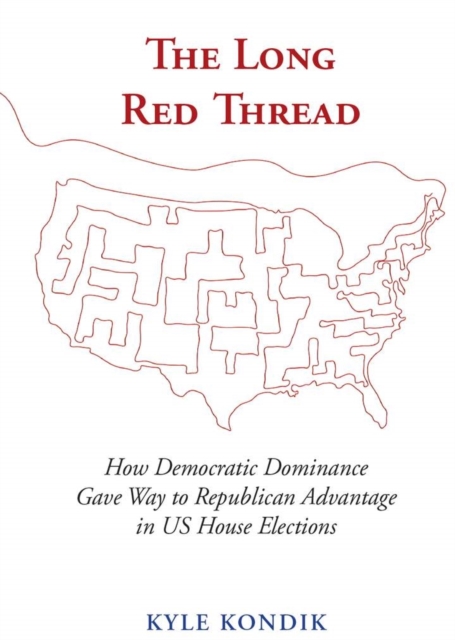
The Long Red Thread
An incisive study that shows how Republicans transformed the US House of Representatives into a consistent GOP stronghold—with or without a majority.
Long-term Democratic dominance in the US House of Representatives gave way to a Republican electoral advantage and frequently held majority following the GOP takeover in 1994. Republicans haven't always held the majority in recent decades, but nationalization, partisan realignment, and the gerrymandering of House seats have contributed to a political climate in which they've had an edge more often than not for nearly thirty years.
The Long Red Thread examines each House election cycle from 1964 to 2020, surveying academic and journalistic literature to identify key trends and takeaways from more than a half-century of US House election results in order to predict what Americans can expect to see in the future.
eBook

Resolving Gerrymandering
Table of Contents Congressional Districts Political Question One Person, One Vote State Legislative Districts Gerrymandering Manageable Standard for Resolving Gerrymandering Appendix A.Congressional Districting Following the 1800 Census: Population Disparities and Geographical Distortions Appendix B.
eBook
The political battle over congressional redistricting
John Engler, former Governor of Michigan, once claimed that redistricting is one of the purest actions a legislative body can take. Academicians and political leaders alike, however, have regularly debated the ideal way by to redistrict national and state legislatures. Rather than being the pure process that Governor Engler envisioned, redistricting has led to repeated court battles waged on such traditional democratic values as one person, one vote, and minority rights. Instead of being an opportunity to help ensure maximum representation for the citizens, the process has become a cat and mouse game in many states with citizen representation seemingly the farthest idea from anyone’s mind. From a purely political perspective, those in power in the state legislature at the time of redistricting largely act like they have unilateral authority to do as they please. In this volume, contributors discuss why such an assumption is concerning in the modern political environment.
eBook

Drawing the Lines
Radical redistricting plans, such as that pushed through by Texas governor Rick Perry in 2003, are frequently used for partisan purposes. Perry's plan sent twenty-one Republicans (and only eleven Democrats) to Congress in the 2004 elections. Such heavy-handed tactics strike many as contrary to basic democratic principles. InDrawing the Lines, Nicholas R. Seabrook uses a combination of political science methods and legal studies insights to investigate the effects of redistricting on U.S. House elections. He concludes that partisan gerrymandering poses far less of a threat to democratic accountability than conventional wisdom would suggest.
Building on a large data set of the demographics of redrawn districts and subsequent congressional elections, Seabrook looks less at the who and how of gerrymandering and considers more closely the practical effects of partisan redistricting plans. He finds that the redrawing of districts often results in no detrimental effect for district-level competition. Short-term benefits in terms of capturing seats are sometimes achieved but long-term results are uncertain. By focusing on the end results rather than on the motivations of political actors, Seabrook seeks to recast the political debate about the importance of partisanship. He supports institutionalizing metrics for competitiveness that would prove more threatening to all incumbents no matter their party affiliation.
eBook

The Supreme Court and election law : judging equality from Baker v. Carr to Bush v. Gore
In the first comprehensive study of election law since the Supreme Court decided Bush v. Gore , Richard L. Hasen rethinks the Court’s role in regulating elections. Drawing on the case files of the Warren, Burger, and Rehnquist courts, Hasen roots the Court’s intervention in political process cases to the landmark 1962 case, Baker v. Carr. The case opened the courts to a variety of election law disputes, to the point that the courts now control and direct major aspects of the American electoral process.
The Supreme Court does have a crucial role to play in protecting a socially constructed “core” of political equality principles, contends Hasen, but it should leave contested questions of political equality to the political process itself. Under this standard, many of the Court’s most important election law cases from Baker to Bush have been wrongly decided.
eBook
Representation and Inequality in Late Nineteenth-Century America
This book demonstrates that apportionment, although long overlooked by scholars, dominated state politics in late nineteenth-century America, setting the boundaries not only for legislative districts but for the nature of representative democracy. The book examines the fierce struggles over apportionment in the Midwest, where a distinctive constitutional and electoral context shaped their course with momentous consequences. As the major parties alternated in effectively disenfranchising their opponents through gerrymanders, growing tensions challenged established patterns of political behaviour and precipitated intense and even dangerous disputes. Unprecedented judicial intervention overturned gerrymanders in stunning decisions that electrified the public but intensified rather than resolved political conflict and uncertainty. Ultimately, America's political ideal of representative democracy was frustrated by its own political institutions, including the courts, because their decisions against gerrymandering in the 1890s helped parties and legislatures entrench the practice as a basic and profoundly undemocratic feature of American politics in the twentieth century.
eBook
Reapportionment and redistricting in the West
In Reapportionment and Redistricting in the West, Gary F. Moncrief brings together some of the best-known scholars in American state and electoral politics to explore the unique processes and problems of redistricting in the western United States. These political scientists examine the specific challenges facing western states in ensuring fair and balanced political representation. Western states tend to be geographically large and experiencing rapid population growth and the chapters in this enlightening volume discuss the changing demographics in western states, paying special attention to the rise in the Latino population and the effect this has had on reapportionment and redistricting. They describe the ways in which some of these states achieve redistricting through independent redistricting commissions—a process rarely found in other regions—and they provide policy prescriptions for the future.
eBook