
Catalogue Search | MBRL


Are you sure you want to remove the book from the shelf?

{{itemTitle}}
868
result(s) for
"Arab countries Politics and government."
Sort by:


Civil Society and Democratization in the Arab World
The transition paradigm has traditionally viewed civil society activism as an essential condition for the establishment of democracy. The democracy promotion strategies of Western policy-makers have, therefore, been based on strengthening civil society in authoritarian settings in order to support the development of social capital -to challenge undemocratic regimes.
This book questions the validity of the link between an active associational life and democratization. It examines civil society in the Arab world in order to illustrate how authoritarian constraints structure civil society dynamics in the region in ways that hinder transition to democracy. Building on innovative theoretical work and drawing on empirical data from extensive fieldwork in the region, this study demonstrates how the activism of civil society in five different Arab countries strengthens rather than weakens authoritarian practices and rule. Through an analysis of the specific legal and political constraints on associational life, and the impact of these on relations between different civic groups, and between associations and state authorities, the book demonstrates that the claim that civil society plays a positive role in processes of democratic transformation is highly questionable.
Offering a broad and alternative vision of the state of civil society in the region, this book will be an important contribution to studies on Middle Eastern politics, democratization and civil society activism.
Francesco Cavatorta is Senior Lecturer in International Relations and Middle East Politics at the School of Law and Government, Dublin City University. His research interests lie in processes of democratisation in the Arab world, the political role of Islamist movements and civil society activism. He has published his research in a number of journals and has previously authored a book on failed transition in Algeria.
Vincent Durac is a Lecturer in Middle East Politics and Politics of Development in the School of Politics and International Relations, University College Dublin. He is interested in political reform, the role of civil society and the impact of external actors on the Middle East He is also a visiting lecturer in Middle East Politics at Bethlehem University in Palestine.
Introduction 1. Civil Society in the Arab world 2. Associational Life under Authoritarian Constraints 3. Algeria 4. Morocco 5. Jordan 6. Yemen 7. Lebanon 8. The Dynamics of Civic Activism in the Arab World
\"Cavatorta and Durac have produced an interesting study that re-examines the assumed connection between an active civil society and democratization... their argument is worthy of consideration by scholars and students of Middle East and North African politics, Islamist socio-political movements, and comparative politics.\" - Christopher Anzalone, Institute of Islamic Studies, McGill University; Journal of Islamic Studies, vol 23, no 1, January 2012
eBook

Roots of the Arab Spring
In December 2010, the self-immolation of a Tunisian vegetable vendor set off a wave of protests that have been termed the \"Arab Spring.\" These protests upended the governments of Tunisia, Egypt, Libya, and Yemen while unsettling numerous other regimes throughout the Middle East and North Africa. Dafna Hochman Rand was a senior policy planner in the U.S. State Department as the uprisings unfolded. InRoots of the Arab Spring, she gives one of the first accounts of the systemic underlying forces that gave birth to the Arab Spring.
Drawing on three years of field research conducted before the protests, Rand shows how experts overlooked signs that political change was stirring in the region and overestimated the regimes' strategic capabilities to manage these changes. She argues that the Arab Spring was fifteen years in the making, gradually inflamed by growing popular demand-and expectation-for free expression, by top-down restrictions on citizens' political rights, and by the failure of the region's autocrats to follow through on liberalizing reforms they had promised more than a decade earlier.
An incisive account of events whose ramifications are still unfolding,Roots of the Arab Springcaptures the tectonic shifts in the region that led to the first major political upheaval of the twenty-first century.
eBook

Inside the Arab State
An in-depth, comprehensive, and theoretically-informed examination of Arab politics of the last decade. The Arab Spring revolts of 2011 and the rise of ISIS in 2014, demand an updated analysis of the topic.
Book

Nationalism and Liberal Thought in the Arab East
This book explores the complex relationship between nationalism and liberal thought in the Arab East during the first half of the twentieth century. Examining this formative period through reformist Islam, Arab secularism and Arab literature, the book situates major shifts in the political ideologies and practices of Arab liberals within a historical context.
Contributions from renowned scholars in the field show how rather than fundamentally contradicting each other, these two schools of thought are closely linked. Many key demands of liberalism - most notably constitutionalism, the rule of law, individual rights, and popular participation - have been central to the nationalist agenda, while other issues have proven more controversial: inter-confessional tolerance, secularism, and the goals of state-sponsored education. Although a strong nation-state was pivotal to the nationalist imagination during most of the twentieth century, a powerful critique of unchecked state power took shape as Arab countries experienced a half-century of authoritarian government. In analyzing these issues, the chapters demonstrate how the rise and fall of liberalism across the region was not determined solely by religion or culture, but by the ideas of influential intellectuals and politicians.
Advancing our understanding of political ideology and practice in the Arab East, this volume will be of great interest to students and scholars of political science, history and the Middle East.
Introduction Part I: Nationalism and Liberal Thought 1. The role of traditional religious scholars in Iraqi politics from the Young Turk period until 1920: the example of Yusuf al-Suwaydi Thomas Eich 2. Who is \"liberal\" in 1930s Iraq? Education as a contested terrain in a nascent public sphere Peter Wien 3. Liberal champions of pan-Arabism: Syria’s second Íizb al-Sha'b Fred H. Lawson 4. Nation, state, and democracy in the writings of Zaki al-Arsuzi Dalal Arsuzi-Elamir 5. Nationalism as a cause: Arab nationalism in the writings of Ghassan Kanafani Orit Bashkin Part II: Arab intellectuals and liberal thought 6. Modernity, romanticism, and religion: contradictions in the writings of Farah Antun Alexander Flores 7. Progress and liberal thought in al-Hil'al, al-Man'ar, and al-Muqta'aaf before World War I Thomas Philipp 8. Liberal democracy versus fascist totalitarianism in Egyptian intellectual discourse: the case of Salama Musa and 'al-Majalla al-JadÐda' Israel Gershoni 9. The \"failure\" of radical nationalism and the \"silence\" of liberal thought in the Arab world Christoph Schumann
Christoph Schumann is Professor of Politics and Contemporary History of the Middle East at the University of Erlangen-Nuremberg, Germany. His research focuses on political ideologies in the Middle East and Muslims in the West, and he has previously written on the topics of liberalism in the Mediterranean and radical nationalism in Syria and Lebanon.
eBook
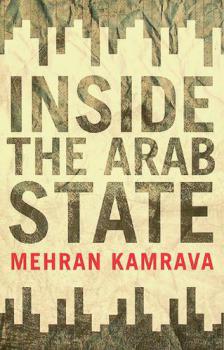
Inside the Arab state
Inside the Arab State offers a comprehensive examination of contemporary Arab politics before and after the 2011 uprisings. Mehran Kamrava examines a broad range of political, economic, and social variables that have shaped conceptions of power, the functions and institutions of the state, the rise and evolution of social movements, the eruption of civil war in some countries and fragile polities in others, and evolving civil-military relations before and after the 2011 uprisings. Beginning with an analysis of politics, and more specifically political institutions, in the Arab world from the 1950s onwards, the book traces the challenges faced by Arab states, and the wounds they inflicted on their societies and on themselves along the way. And at the crux of the book are the 2011 uprisings, states responses to them, and efforts by political leaders to carve out new forms of legitimacy, as well as the reasons for the emergence and rise of the Islamic State. -- Provided by publisher.
Book

The Rise and Fall of Arab Presidents for Life
Monarchical presidential regimes in the Arab world looked as though they would last indefinitely—until events in Tunisia and Egypt made clear their time was up. This is the first book to lay bare the dynamics of a governmental system that largely defined the Arab Middle East in the twentieth century, and the popular opposition they engendered.
eBook

Everyday Arab Identity
Whether through government propaganda or popular transnational satellite television channels, Arab citizens encounter a discourse that reinforces a sense of belonging to their own state and a broader Arab world on a daily basis. Looking through the lens of nationalism theory, this book examines how and why Arab identity continues to be reproduced in today's Middle East, and how that Arab identity interacts with strengthening ties to religion and the state.
Drawing on case studies of two ideologically different Arab regimes, Syria and Jordan, Christopher Phillips explores both the implications this everyday Arab identity will have on western policy towards the Middle East and its real life impact on international relations.
Offering an original perspective on this topical issue, this book will be of interest to academics and practitioners working on the Arab world and political affairs, as well as students of International Relations, Political Science and the Middle East, notably Syria and Jordan, and policymakers in the region.
eBook