Catalogue Search | MBRL


Are you sure you want to remove the book from the shelf?

{{itemTitle}}
80
result(s) for
"Arabian nights"
Sort by:
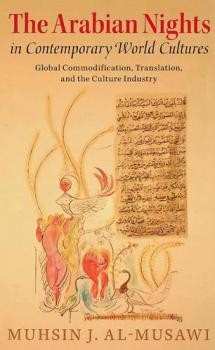
The Arabian Nights in contemporary world cultures : global commodification, translation, and the culture industry
\"This study of the Thousand and One Nights addresses the place of what is commonly called Arabian Nights in contemporary world cultures. It aims to study theoretical and philological undertakings, including poetics of prose and poetry, in conversation with social science. It explores and excavates the reasons for and effects of an enormous constellation of knowledge about and around the tales that has generated further projects to compile manuals, guides, companions, edited compilations, and encyclopedias. These constellations and projects also build on, or converse with, cinematic production, theater, painting, music,3 and other visual sites and spectacles\"-- Provided by publisher.
Book

The Arabic Source Text for Galland's Dormeur éveillé
For his adapted and enlarged French translation of the Arabic Alf laylah wa-laylah, Antoine Galland mainly exploited the incomplete fifteenth-century Arabic manuscript at his diposal and the tales narrated to him by the Syrian Maronite storyteller Ḥannā Diyāb. The Arabic source texts of the tales of Gānim b. Ayyūb at the beginning of vol. 8 and of The Sleeper Awakened at the beginning of vol. 9, until recently unknown to research, have now been identified by Ibrahim Akel. In extension of the present author's previous publications on The Sleeper Awakened, this contribution presents the Middle Arabic text of the version used for Galland's translation, introduced by a short discussion of the general context and of this version's specifics.
Journal Article


Wirt und Gast oder aus Scherz Ernst
The subject-matter of Meyerbeers second opera Wirt und Gast, or Aus Scherz Ernst (also called Alimelek), written in Munich in 1812, was taken from a tale in The Arabian Nights. The story of the man who would be sovereign, if only for one day, so frequently treated in the literature of all nations. The opera is an example of the Oriental or Turkish operas which were so popular in Germany during the second third of the eighteenth century. . The orchestra includes, besides the strings, d.
eBook


One Thousand and One Nights at the Transnational Crossroads
One Thousand and One Nights - also known in English as the Arabian Nights - is a compilation of folkloric tales, with anonymous author(s), dating as far back as the 14th or 15th century but assumed to be rooted much earlier, perhaps the 10th century in its Arabic version and even earlier in its lost Persian embodiment. This authorless work was introduced to the West first in the 18th and later in the 19th century by its French and English Orientalist translators by whom it was brought to life reborn in an alien environment with radically different perceptions and receptions. Since then, The Nights has become one of the most global and yet misunderstood works across various artistic versions besides literature. The narrative framework tells us tales that are widely varied and spread in various regions with their historical and cultural backgrounds, including Persia, Arabia, India, Egypt, China, and so on. On this account, this paper aims to highlight that the multiplicity and hybridity of voices, histories, and cultures position the work at a transnational crossroads. Without dismissing the Oriental aspects of the work, this paper emphasizes that the adaptation and appropriation of such an elusive work with a convoluted history cannot be discussed authoritatively (either through Western Oriental or Post-Colonial or Islamic perspectives) when there is no one author or manuscript or no one culture and nation as a reference point. Each translation or adaptation helps the work expand its transnational network, interconnect old and new, East and West together, bridge differences and continue to address the questions of cultural transformation.
Journal Article


Africanism
Anti-blackness has until recently been a taboo topic within Arab society. This began to change when Nader Kadhem, a prominent Arab and Muslim thinker, published the first in-depth investigation of anti-black racism in the Arab world in 2004. This translation of the new and revised edition of Kadhem's influential text brings the conversation to the English-speaking world.
Al-Istifraq or Africanism, a term that is analogous to Orientalism, refers to the discursive elements of perceiving, imagining, and representing black people as a subject of study in Arabic writings. Kadhem explores the narratives of Africanism in the Arab imaginary from the Middle Ages to the nineteenth century to show how racism toward black people is ingrained in the Arab world, offering a comprehensive account of the representations of blackness and black people in Arab cultural narratives – including the Quran, the hadith, and Arabic literature, geography, and history. The book examines the pejorative image of black people in Arab cultural discourse through three perspectives: the controversial anthropological concept that culture defines what it means to be human; the biblical narrative of Noah cursing his son Ham's descendants – understood to be darker-skinned – with servitude; and Greco-Roman physiognomy, philosophy, medicine, and geography. Describing the shifting standards of inclusion that have positioned Arab identity in opposition to blackness, Kadhem argues that in the cultural imaginary of the Arab world, black people are widely conflated with the Other.
Analyzing canonical Arabic texts through the lens of English, French, and German theory, Africanism traces the history of racism in Arab culture.
eBook