
Catalogue Search | MBRL


Are you sure you want to remove the book from the shelf?

{{itemTitle}}
7
result(s) for
"Arabic (including dialects)"
Sort by:

The Routledge Handbook of Arabic and Identity
The Routledge Handbook of Arabic and Identity offers a comprehensive and up-to-date account of studies that relate the Arabic language in its entirety to identity. This handbook offers new trajectories in understanding language and identity more generally and Arabic and identity in particular.
Split into three parts, covering ‘Identity and Variation’, ‘Identity and Politics’ and ‘Identity Globalisation and Diversity’, it is the first of its kind to offer such a perspective on identity, linking the social world to identity construction and including issues pertaining to our current political and social context, including Arabic in the diaspora, Arabic as a minority language, pidgin and creoles, Arabic in the global age, Arabic and new media, Arabic and political discourse.
Scholars and students will find essential theories and methods that relate language to identity in this handbook. It is particularly of interest to scholars and students whose work is related to the Arab world, political science, modern political thought, Islam and social sciences including: general linguistics, sociolinguistics, discourse analysis, anthropological linguistics, anthropology, political science, sociology, psychology, literature media studies and Islamic studies.
eBook

The Routledge Handbook of Arabic Sociolinguistics
The Routledge Handbook of Arabic Sociolinguistics comprises 22 chapters encompassing various aspects in the study of Arabic dialects within their sociolinguistic context.
This is a novel volume, which not only includes the traditional topics in variationist sociolinguistics, but also links the sociolinguistic enterprise to the history of Arabic and to applications of sociolinguistics beyond the theoretical treatment of variation. Newly formed trends, with an eye to future research, form the backbone of this volume.
With contributions from an international pool of researchers, this volume will be of interest to scholars and students of Arabic sociolinguistics, as well as to linguists interested in a concise, rounded view of the field.
eBook

Split topicalization as remnant movement: the case of Jordanian Arabic
This paper empirically and theoretically investigates the syntax of split topicalization in Jordanian Arabic, a previously undiscovered phenomenon. The results of a large-scale acceptability judgment task (n = 463) reveal that Jordanian Arabic displays split topicalization of various categorial types. Building on the labeling framework, the remnant movement analysis and the idea that there exists an IP-internal focus position below T and above the vP phase, I propose a unified analysis of all the categorial types of ST in Jordanian Arabic, where ST is reduced to remnant movement of a constituent (NP, VP, AP, etc.), from which a subconstituent has undergone focus movement to an IP-internal focus position. The analysis captures all cases of ST in Jordanian Arabic, such as splitting with ditransitives. It accounts for the fact that ST in JA is only grammatical with bridge-contour intonation: the intonation is read off the syntactic structure in which functional projections such as TopP and FocP are encoded. The analysis provides insights into the structure of the left periphery of the vP phase: it lends support to the view that this area could have a more elaborate structure than previously thought, parallel to that of the left periphery of the CP phase.
Journal Article
Poetry and translation as bridges: exploring Nizar Qabbani’s translation theory
“The poem is a bridge extending across time and encompassing all horizons,”1 writes the renowned Syrian poet Nizar Qabbani. It is through this bridge of poetry that he continues to traverse and speak to his Arab audience. As an homage to Qabbani—a master of metaphor in all his writings—this paper will compare Qabbani’s poetry in its original Arabic to that of his English translators, who have and continue to strive to bring his foreign readers from one world and language into his own poetic garden. By using examples of his approved English translations and the Skopos theory, I will argue in this paper that the bridge of translation cannot function in the same way as Qabbani’s bridge and that what prevents this bridge from succeeding is the deficiency of linguistic and cultural substances embedded in the text.
Journal Article
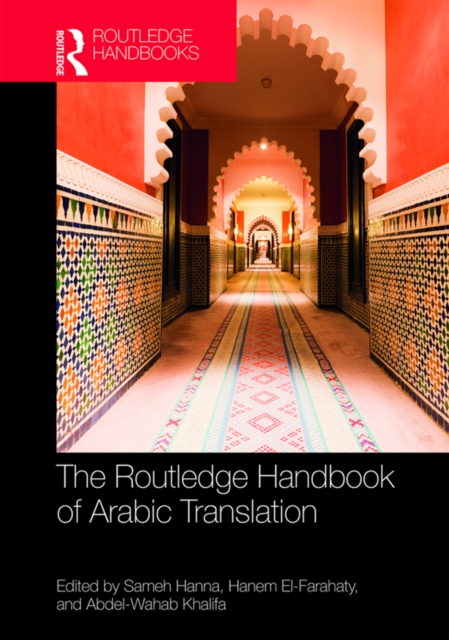
The Routledge Handbook of Arabic Translation
Translation-related activities from and into Arabic have significantly increased in the last few years, in both scope and scale. The launch of a number of national translation projects, policies and awards in a number of Arab countries, together with the increasing translation from Arabic in a wide range of subject areas outside the Arab World - especially in the aftermath of the Arab Spring - have complicated and diversified the dynamics of the translation industry involving Arabic.
The Routledge Handbook of Arabic Translation seeks to explicate Arabic translation practice, pedagogy and scholarship, with the aim of producing a state-of-the-art reference book that maps out these areas and meets the pedagogical and research needs of advanced undergraduate and postgraduate students, as well as active researchers.
eBook
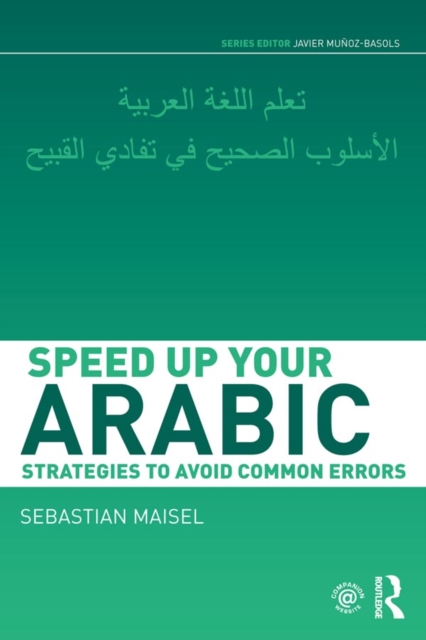
Speed up your Arabic
Pronunciation, spelling, the concept of roots and patterns and idomatic phrases are just some of the areas that cause confusion for students of Arabic. Learning how to avoid the common errors that arise repeatedly in these areas is an essential step in successful language learning.
Speed Up Your Arabic is a unique and innovative resource that identifies and explains the most commonly made errors, enabling students to learn from their mistakes and enhance their understanding of the Arabic language.
Each of the nine chapters focuses on a grammatical category where English speakers typically make mistakes in Arabic. Each chapter is divided into sections that classify the concepts and errors into subcategories. Full explanations are provided throughout with clear, comprehensive examples and exercises to help the learner gain an in-depth understanding of Arabic grammar and usage.
Key features:
Carefully selected grammar topics and examples based on the most commonly made errors
Comprehensive explanations of the most difficult grammar points help learners gain an in-depth understanding of Arabic grammar and usage.
Exercises throughout reinforce learning and link theory to practice
A complete answer key making it ideal for self-study
A glossary of grammatical terms, an Arabic-English glossary and a bibliography to aid learning
Useful drills and listening samples available for free download at http://www.routledge.com/books/details/9780415660556/
Suitable both for classroom use or self-study, Speed Up Your Arabic is the ideal resource for all intermediate learners of Arabic wishing to refine their language skills.
eBook
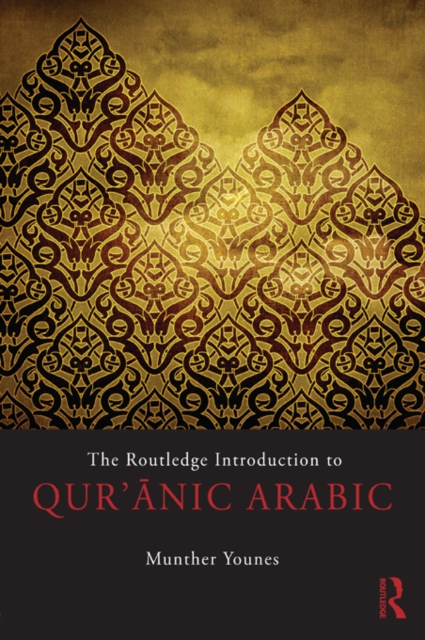
The Routledge Introduction to Qur'anic Arabic
The Routledge Introduction to Qur’ānic Arabic is an innovative, text-based, language course designed for students interested in acquiring a foundation in Qur’ānic and Classical Arabic.
Focused on enhancing comprehension and vocabulary acquisition, the book contains 40 lessons designed to be covered in about 40 hours of classroom instruction. Starting with the shorter sūras of the Qur’ān, such as al-Fatiha and those of the Juz’ ‘Amma, it utilizes their recurring vocabulary and grammatical structures to build a stable linguistic foundation for learners before moving on to more challenging and longer sūras such as Yāsīn, Maryam and Yūsuf.
Although the book is primarily designed for classroom use, the vocabulary and structures of the short sūras, the accompanying audio recordings, and the activities found throughout the book will also be helpful for independent learners. The only prerequisite is knowledge of the Arabic writing system.
The audio material, which is available on the Routledge website, helps learners improve their pronunciation of individual sounds and develop their skills to syllabify Arabic words and phrases correctly in order to approximate that of native speakers. Also available on the website are answer keys to exercises and transcriptions of the audio material.
Written by an experienced teacher, The Routledge Introduction to Qur’ānic Arabic is an essential guide for instructors, students and anyone interested in developing their knowledge of Qur’ānic Arabic.
Lesson 1: Chapters 1, 114, 113, 112. Lesson 2: Chapters 111, 110, 109, 108, 107. Lesson 3: Chapters 106, 105, 104, 103, 102. Lesson 4: Chapters 101, 100, 99. Lesson 5: Chapters 98, 97. Lesson 6: Chapters 96, 95, 94. Lesson 7: Chapters 93, 92. Lesson 8: Chapters 91, 90. Lesson 9: Chapter 89. Lesson 10: Chapter 88, 87. Lesson 11: Chapters 86, 85. Lesson 12: Chapter 84. Chapter 13: Chapter 83. Lesson 14: Chapter 82, 81. Lesson 15: Chapter 80. Lesson 16: Chapter 79. Lesson 17: Chapter 78. Lesson 18. Chapter 36 (Verses 1-19). Lesson 19: Chapter 36 (Verses 20-35). Chapter 20: Chapter 36 (Verses 36-50). Chapter 21: Chapter 36 (Verses 51-68). Lesson 22: Chapter 36 (Verses 69-83). Lesson 23: Chapter 19 (Verses 1-15). Lesson 24: Chapter 19 (Verses 16-28). Lesson 25: Chapter 19 (Verses 29-42). Lesson 26: Chapter 19 (Verses 43-55). Lesson 27: Chapter 19 (Verses 56-67). Lesson 28: Chapter 19 (Verses 68-80). Lesson 29: Chapter 19 (Verses 81-98). Lesson 30: Chapter 12 (Verses 1-12). Lesson 31: Chapter 12 (Verses 13-23). Lesson 32: Chapter 12 (Verses 24-32). Lesson 33: Chapter 12 (Verses 33-40). Lesson 34: Chapter 12 (Verses 41-50). Lesson 35: Chapter 12 (Verses 51-62). Lesson 36: Chapter 12 (Verses 63-70). Lesson 37: Chapter 12 (Verses 71-80). Lesson 38: Chapter 12 (Verses 81-90). Lesson 39: Chapter 12 (Verses 91-101). Lesson 40: Chapter 12 (Verses 102-111)
Munther Younes is Reis Senior Lecturer of Arabic Language and Linguistics and Director of the Arabic Program at Cornell University, USA.
\"Clear, accurate and easy to follow…an impressive text.\" Oliver Leaman, University of Kentucky, USA
\"An excellent introduction to Qur’anic Arabic.\" Harry Neale, University of California, Berkeley, USA
\"I think Mr. Younes is a genius in language instruction.\" Deborah Elder, independent Arabic learner for four years
eBook