
Catalogue Search | MBRL


Are you sure you want to remove the book from the shelf?

{{itemTitle}}
2,449
result(s) for
"Arabic language History"
Sort by:


Language conflict in Algeria
This is a book about the use of languages as a proxy for conflict. It traces the history of Algeria from colonization by the French in 1830 to the celebration of 50 years of independence in 2012, and examines the linguistic issues that have accompanied this turbulent period. The book begins with an examination of 'language conflict' and related concepts, and then applies them to both the French colonists' language policies and the Arabization campaigns which followed independence. This is followed by an analysis of the rivalry between the English and French languages in independent Algeria. The book concludes with a study of the language choices made by Algerian writers and the complex tensions which arose from these choices among intellectuals in the colonial and post-colonial periods.
eBook


The Power of Oratory in the Medieval Muslim World
Oratory and sermons had a fixed place in the religious and civic rituals of pre-modern Muslim societies and were indispensable for transmitting religious knowledge, legitimising or challenging rulers and inculcating the moral values associated with being part of the Muslim community. While there has been abundant scholarship on medieval Christian and Jewish preaching, Linda G. Jones's book is the first to consider the significance of the tradition of pulpit oratory in the medieval Islamic world. Traversing Iberia and North Africa from the twelfth to the fifteenth centuries, the book analyses the power of oratory, the ritual juridical and rhetorical features of pre-modern sermons and the social profiles of the preachers and orators who delivered them. The biographical and historical sources, which form the basis of this remarkable study, shed light on different regional practices and the juridical debates between individual preachers around correct performance.
eBook

Arabic : a linguistic introduction
\"This lively introduction to the linguistics of Arabic provides students with a concise overview of the language's structure and its various components: its phonology, morphology and syntax. Through exercises, discussion points and assignment built into every chapter, the book presents the Arabic language in vivid and engaging terms, encouraging students to grasp the complexity of its linguistic situation\"-- Provided by publisher.
Book

Doing justice to a wronged literature : essays on Arabic literature and rhetoric of the 12th-18th centuries in honour of Thomas Bauer
Doing Justice to a Wronged Literature is a Festschrift for the Arabist and Islamicist Thomas Bauer. It includes 17 essays by established academics on various themes and aspects of Arabic literature and rhetoric of the Ayyubid, Mamluk and Ottoman periods (12th-18th centuries). Notoriously neglected and maligned by earlier scholarship, Arabic literature and rhetoric of the 12th-18th centuries is an understudied area of Arabic studies that Thomas Bauer has over the last two decades succeeded in developing and promoting. A tribute to his pioneering work on this field, the contributions highlight the wealth, complexity and importance of Arabic literature and rhetoric of the said period by offering close readings of paradigmatic texts or examining specific topics and trends in larger corpora.
eBook
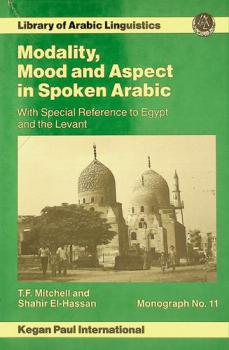
Modality, mood, and aspect in spoken Arabic : with special reference to Egypt and the Levant
This is the first full-length monograph derived from the Leeds University investigation into the structure of Educated Spoken Arabic which has so far been published. It would be difficult to underestimate the value of this corpus for the study of variation in modern Educated Spoken Arabic, since it is unique in its size, comprehensiveness and geographical representativeness, covering educated spoken usage in all the major population centres of the eastern Arab world, and drawing from a wide variety of contexts of use. The major contributions such studies can make to Arabic linguistics are two: synchronically, in showing just how much of the syntactic structure of modern Educated Spoken Arabic - however much morphological and lexical variation may divide one region from another - is in fact shared property; and, diachronically, if the degree of sharing of syntactic phenomena which cannot be plausibly derived from Classical Arabic turns out to be high (as from the present study it seems to be), is providing more evidence that ESA in fact represents a contemporary pan-Arab continuation of age-old shared spoken forms which were never identical with what we now call Classical Arabic, and which, through centuries of trade and constant contacts throughout the eastern Arab area, have continued to develop independently of it.
Book

Arabic in Context
This volume gathers fifteen interdisciplinary papers on the history of Arabic in celebration of the 400th anniversary of the chair of Arabic at Leiden, ranging from the epigraphy of pre-Islamic Arabia to the modern spoken dialects, and everything in between.
eBook


Scribal Traditions in Documentary Arabic
Scholars generally read Documentary Arabic according to the norms of Standard Arabic, the constructed ideal language of Abbasid literati. But this essay shows that the nonstandard features of Documentary Arabic were not spontaneous creations by the unlearned but rather scribal traditions carefully transmitted from one generation to the next. Umayyad Documentary Arabic was first and foremost the language used by state officials to display, in public, the authority of the Muslim state and, secondarily, the insider language that the small Arabic elite used to communicate on business and private matters. Given the nature of this elite, it is not surprising to find that this language was fairly uniform. Abbasid Documentary Arabic was the language used to display and administer the authority of the many loosely interacting and for the most part rival rulers but mainly became the language of choice that learned people used to communicate on business and private matters as well as in academic exchange. To mark provenance and affiliation, scribes most probably used not only whole words and formulas and distinctive scripts and layouts but also minor variants in orthography, form, and government. The Arabic of Fatimid Documentary Judeo-Arabic documents found in the Geniza is, this analysis demonstrates, nothing more than mainstream Fatimid Documentary Arabic, albeit continuously transliterated from Arabic into Hebrew characters. Geniza documentary materials must therefore be read as part of a continuous tradition of Arabic derived from state administration rather than as a Jewish sociolect or a variant of standard Arabic.
Journal Article