
Catalogue Search | MBRL


Are you sure you want to remove the book from the shelf?

{{itemTitle}}
748
result(s) for
"Arabic language Syntax."
Sort by:

The syntax of Arabic
\"Recent research on the syntax of Arabic has produced valuable literature on the major syntactic phenomena found in the language. This guide to Arabic syntax provides an overview of the major syntactic constructions in Arabic that have featured in recent linguistic debates, and discusses the analyses provided for them in the literature. A broad variety of topics are covered, including argument structure, negation, tense, agreement phenomena, and resumption. The discussion of each topic sums up the key research results and provides new points of departure for further research. The book also contrasts Standard Arabic with other Arabic varieties spoken in the Arab world. An engaging guide to Arabic syntax, this book will be invaluable to graduate students interested in Arabic grammar, as well as syntactic theorists and typologists\"--Provided by publisher.
Book

The Syntax of Arabic
Recent research on the syntax of Arabic has produced valuable literature on the major syntactic phenomena found in the language. This guide to Arabic syntax provides an overview of the major syntactic constructions in Arabic that have featured in recent linguistic debates, and discusses the analyses provided for them in the literature. A broad variety of topics are covered, including argument structure, negation, tense, agreement phenomena, and resumption. The discussion of each topic sums up the key research results and provides new points of departure for further research. The book also contrasts Standard Arabic with other Arabic varieties spoken in the Arab world. An engaging guide to Arabic syntax, this book will be invaluable to graduate students interested in Arabic grammar, as well as syntactic theorists and typologists.
eBook


Arabic Dislocation
Since the early years of generative grammar (Chomsky 1977, inter alia), the phenomenology of dislocation has proved to be a fertile area of research. This, however, has not been the case for Modern Standard Arabic (MSA), and hence this thorough monograph intends to fill this lacuna. Three aspects of this linguistic phenomenon stand out: the taxonomy of possible dislocated configurations, syntax and interpretation. Though the structure in itself has been extensively studied in various languages, including varieties of spoken Arabic, this monograph shows that MSA presents properties that set it apart from known varieties and cannot be captured by an extension or modification of existing analyses. Moreover, existing analyses are not fully satisfactory as there are open analytical questions regarding the interpretation and syntactic analysis of dislocation structures crosslinguistically. Particularly, the optimal path to follow concerning dislocation structures in MSA is to argue for the claim that contrast, as an information-structural notion, underlies the interpretation of dislocated elements, and these elements are best syntactically analyzed as being involved in a bisentential configuration, contra monoclausal approaches to dislocation. This monograph should be relevant to anyone with an interest in the Arabic language, and also to syntacticians and typologists with an interest in sentence structure.
eBook


Sentence Types and Word-Order Patterns in Written Arabic
Analyzing the medieval Arab grammarians' treatment of sentence types and word-order patterns in Arabic, this book sheds new light on the achievements of one of the major traditions in the history of linguistics, and assesses the contribution of modern scholarship to the discussion of the issues raised.
eBook
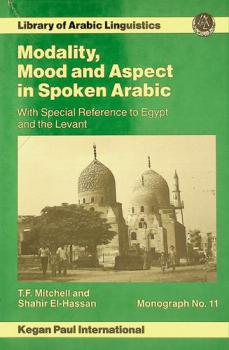
Modality, mood, and aspect in spoken Arabic : with special reference to Egypt and the Levant
This is the first full-length monograph derived from the Leeds University investigation into the structure of Educated Spoken Arabic which has so far been published. It would be difficult to underestimate the value of this corpus for the study of variation in modern Educated Spoken Arabic, since it is unique in its size, comprehensiveness and geographical representativeness, covering educated spoken usage in all the major population centres of the eastern Arab world, and drawing from a wide variety of contexts of use. The major contributions such studies can make to Arabic linguistics are two: synchronically, in showing just how much of the syntactic structure of modern Educated Spoken Arabic - however much morphological and lexical variation may divide one region from another - is in fact shared property; and, diachronically, if the degree of sharing of syntactic phenomena which cannot be plausibly derived from Classical Arabic turns out to be high (as from the present study it seems to be), is providing more evidence that ESA in fact represents a contemporary pan-Arab continuation of age-old shared spoken forms which were never identical with what we now call Classical Arabic, and which, through centuries of trade and constant contacts throughout the eastern Arab area, have continued to develop independently of it.
Book

Word Order, Agreement and Pronominalization in Standard and Palestinian Arabic
Grounded in the generative grammar framework of Minimalism, this text considers the related issues of word order and subject-verb agreement, which have occupied centre stage in the study of Arabic syntax since the eighth century.
eBook

Perspectives on Arabic Linguistics
This volume includes ten papers selected from the Eighth Annual Symposium on Arabic Linguistics, held at the University of Masschusetts, Amherst, 1994. Six of them deal with the syntax of Arabic two with phonology, and two with variation. The topics represented in the volume include binding in Arabic, the analysis of negation and negative polarity items, pronoun doubling in codeswitching, linguistic variation and language change, voice assimilation in Arabic dialects, among others.The volume includes contributions by the following: Mahasen Abu Mansour; Maher Bahloul; Raja Bahloul; Elabbas Benmamoun; Naomi Bolotin; Mushira Eid; Mark LeTourneau; Michael McOmber; Bernadette Plunkett; Keith Walters.
eBook

Perspectives on Arabic Linguistics
This is the third in a continuing series of papers presented at the annual meetings of the Arabic Linguistic Society whose primary purpose is to provide a forum for the study of Arabic within current approaches in linguistics. The volume includes a section on Arabic in relation to other languages, with papers ranging from the importance of Arabic to general linguistic theory, and guttural phonology to Arabic loanwords in Acehnese, verbless sentences in Arabic and Hebrew, and a contrastive study of middle and unaccusative constructions in Arabic and English. In the second section of the book, \"Grammatical perspectives on Arabic\", topics ranging from causatives in Moroccan Arabic and epenthesis in Makkan Arabic to a computer analysis of Modern Standard Arabic morphology are discussed. The third section, \"Socio- and psycholinguistic perspectives\", includes papers on women, men, and linguistic variation, code switching and linguistic accommodation, and agrammatism.
eBook