
Catalogue Search | MBRL


Are you sure you want to remove the book from the shelf?

{{itemTitle}}
142
result(s) for
"Arabic language Writing History."
Sort by:


Interpreting the Self
Autobiography is a literary genre which Western scholarship has
ascribed mostly to Europe and the West. Countering this assessment
and presenting many little-known texts, this comprehensive work
demonstrates the existence of a flourishing tradition in Arabic
autobiography. Interpreting the Self discusses nearly one
hundred Arabic autobiographical texts and presents thirteen
selections in translation. The authors of these autobiographies
represent an astonishing variety of geographical areas,
occupations, and religious affiliations. This pioneering study
explores the origins, historical development, and distinctive
characteristics of autobiography in the Arabic tradition, drawing
from texts written between the ninth and nineteenth centuries c.e.
This volume consists of two parts: a general study rethinking the
place of autobiography in the Arabic tradition, and the translated
texts. Part one demonstrates that there are far more Arabic
autobiographical texts than previously recognized by modern
scholars and shows that these texts represent an established
and-especially in the Middle Ages-well-known category of literary
production. The thirteen translated texts in part two are drawn
from the full one-thousand-year period covered by this survey and
represent a variety of styles. Each text is preceded by a brief
introduction guiding the reader to specific features in the text
and providing general background information about the author. The
volume also contains an annotated bibliography of 130 premodern
Arabic autobiographical texts. In addition to presenting much
little-known material, this volume revisits current understandings
of autobiographical writing and helps create an important
cross-cultural comparative framework for studying the genre.
eBook

Letters of light : Arabic script in calligraphy, print, and digital design
Arabic script remains one of the most widely employed writing systems in the world, for Arabic and non-Arabic languages alike. Focusing on naskh, the style most commonly used across the Middle East, Letters of Light traces the evolution of Arabic script from its earliest inscriptions to digital fonts, from calligraphy to print and beyond. J.R. Osborn narrates this storied past for historians of the Islamic and Arab worlds, for students of communication and technology, and for contemporary practitioners. The partnership of reed pen and paper during the tenth century inaugurated a golden age of Arabic writing; the shape and proportions of classical calligraphy known as al-khatt al-mansub were formalized, and variations emerged to suit different types of content. The rise of movable type quickly led to European experiments in printing Arabic texts. Ottoman Turkish printers, more sensitive than their European counterparts to the script's nuances, adopted movable type more cautiously. Debates about \"reforming\" Arabic script for print technology persisted into the twentieth century. Arabic script continues to evolve in the digital age. Programmers have adapted it to the international Unicode standard, greatly facilitating Arabic presence online and in word processing. Tech companies are investing resources to facilitate support of Arabic in their products. Professional designers are bringing about a renaissance in the Arabic script community as they reinterpret classical aesthetics and push new boundaries in digital form.-- Provided by publisher
Book

The Culture of Letter-Writing in Pre-Modern Islamic Society
This book presents a unique analysis of letter writing in the Middle Islamic period. This was an important aspect of intellectual life among the ruling classes in that period and it can tell us a great deal about the cultural history of the time. The author sets epistolography within a wider context, drawing on similarities between Islamic modes of letter writing and those of Western cultures. He ties in the crucial notion of the power of the pen in Islamic society with epistemological trends and relationships of dependency among the bureaucracy.
eBook
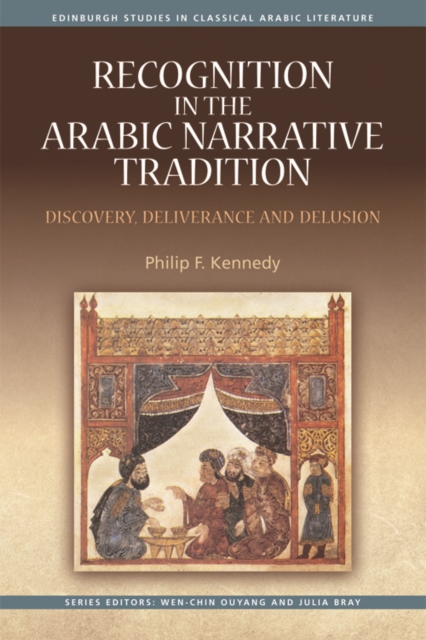
Recognition in the Arabic Narrative Tradition
According to Aristotle, a well-crafted recognition scene is one of the basic constituents of a successful narrative. It is the point when hidden facts and identities come to light-in the classic instance, a son discovers in horror that his wife is his mother and his children are his siblings. Aristotle coined the term 'anagnôrisis' for the concept. In this book Philip F. Kennedy shows how 'recognition' is key to an understanding of how one reads values and meaning into, or out of, a story. He analyses texts and motifs fundamental to the Arabic literary tradition in five case studies: the Qur'an; the biography of Muhammad; Joseph in classical and medieval re-tellings; the 'deliverance from adversity' genre and picaresque narratives.
eBook

(Re)Writing the Middle East
[...]the American \"model\" for writing studies does not integrate seamlessly into local cultures and communities.4 Even terms like \"English as a Second or Foreign Language\" or \"bilingualism\" are problematized in this context where multilingual speakers negotiate varied linguistic backgrounds with competing nationalist and religious ideologies and postcolonial perceptions about the \"prestige\" of speaking a foreign language.5 For instance, at the American University of Beirut, a French-language educated Catholic student and an Arabic-language educated Shia Muslim student come not only at English, but also at a shared Standard Arabic (Fus'ha), with significantly different language attitudes because of their different religious and communal backgrounds. Aided by these textbooks, students begin to consider the multiple digital, social, cultural, political, and ideological components that make up their own linguistic and rhetorical practices while also keying into the intersections and divergences between those and others in the region and in the world. On an institutional level, writing research in the region involves questions about the very nature of writing and writing instruction. In relation to Writing Across the Curriculum and Writing in the Disciplines in particular, these efforts begin with developing methods to convince faculty across the disciplines to take responsibility for and apply consistent writing practice and pedagogy in their classrooms.6 At the level of writing centers, Zimmerman underscores the momentum of this growing body of research and the efforts made to create and maintain institutional and discursive relationships between writing centers, writing programs, and the university (138).
Journal Article

Power in the Portrayal
Power in the Portrayalunveils a fresh and vital perspective on power relations in eleventh- and twelfth-century Muslim Spain as reflected in historical and literary texts of the period. Employing the methods of the new historical literary study in looking at a range of texts, Ross Brann reveals the paradoxical relations between the Andalusi Muslim and Jewish elites in an era when long periods of tolerance and respect were punctuated by outbreaks of tension and hostility.
The examined Arabic texts reveal a fragmented perception of the Jew in eleventh-century al-Andalus. They depict seemingly contradictory figures at whose poles are an intelligent, skilled, and noble Jew deserving of homage and a vile, stupid, and fiendish enemy of God and Islam. For their part, the Hebrew and Judeo-Arabic texts display a deep-seated reluctance to portray Muslims in any light at all. Brann cogently demonstrates that these representations of Jews and Muslims--each of which is concerned with issues of sovereignty and the exercise of power--reflect the shifting, fluctuating, and ambivalent relations between elite members of two of the ethno-religious communities of al-Andalus.
Brann's accessible prose is enriched by his splendid translations; the original texts are also included. This book is the first to study the construction of social meaning in Andalusi Arabic, Judeo-Arabic, and Hebrew literary texts and historical chronicles. The novel approach illuminates nuances of respect, disinterest, contempt, and hatred reflected in the relationship between Muslims and Jews in medieval Spain.
eBook

Writing in Arabic in Gujarat and the Hijaz: Some Reflections from the Early Modern Period
As a region with a long coastline by the Arabian Sea in northwestern India, Gujarat has historically been connected to the maritime rhythms of the Indian Ocean and inter-regional developments in north India and the Deccan. These connections—commercial, but also political, cultural, and intellectual—remain central to the history of Gujarat as an independent sultanate in the fifteenth century and during the time of Mughal control from the late sixteenth century.1 The circulation of Muslim scholars and intellectuals between the urban centers of Gujarat and cities of the Hijaz, Hadramawt, and Egypt, shaped the intellectual enterprise of several prominent scholars in Gujarat (and more broadly South Asia) who wrote in Arabic—from al-Damamini (d. 1424) and ‘Ali Muttaqi (d. 1567) to Shah Wajih al-Din ‘Alawi (d. 1590) and ‘Abd al-Qadir al-‘Aydarus (d.1628). While these scholars’ works have received attention from modern scholars to varying degrees, this essay emphasizes the importance of foregrounding the early modern oceanic context in order to recover the transregional social and scholarly ties central to the lives and oeuvre of these intellectuals. Recovering transregional oceanic connections in turn calls for greater engagement with scholarly writings produced in Arabic, a language that has remained peripheral to South Asian historiography.
Journal Article
A Case of Multiple Identities: Uncanny Histories of the Arabic Typewriter
Little is known today about the Arabic typewriter. American typewriters revolutionized clerical labor and became literary icons, but the Arabic typewriter is largely absent from scholarship and popular culture. Only one story about it recurs, namely that of its origins. It was reportedly invented multiple times: in 1890s Beirut by, among others, a portrait painter named Salim Haddad; in 1900s Vienna by Theodor Herzl, founding father of political Zionism; and in 1940s Cairo by Wadie Said, father of the pioneering postcolonial theorist Edward Said. Bringing three competing accounts of the machine's invention together, I find that in each the Arabic typewriter was turned to very different purposes. Consistently, however, it was co-opted into intensifying struggles over territory and language. Repeatedly, it exceeded its representations, unsettling the narratives into which it was written and provoking a sense of strangeness, even unease. And across the accounts, diverse names and places reappear: New York, Palestine, Sherlock Holmes. Taking seriously the doublings and coincidences that connect the typewriter's origin-stories, I ask finally whether they might alert us to the possibility of another mode of cultural history—one that is itself uncanny and estranged.
Journal Article