Catalogue Search | MBRL


Are you sure you want to remove the book from the shelf?

{{itemTitle}}
10
result(s) for
"Arabic literature Iraq 21st century Translations into English"
Sort by:

The Book of Collateral Damage
Sinan Antoon returns to the Iraq war in a poetic and provocative tribute to reclaiming memoryWidely-celebrated author Sinan Antoon's fourth and most sophisticated novel follows Nameer, a young Iraqi scholar earning his doctorate at Harvard, who is hired by filmmakers to help document the devastation of the 2003 invasion of Iraq. During the excursion, Nameer ventures to al-Mutanabbi street in Baghdad, famed for its bookshops, and encounters Wadood, an eccentric bookseller who is trying to catalogue everything destroyed by war, from objects, buildings, books and manuscripts, flora and fauna, to humans. Entrusted with the catalogue and obsessed with Wadood's project, Nameer finds life in New York movingly intertwined with fragments from his homeland's past and its present-destroyed letters, verses, epigraphs, and anecdotes-in this stylistically ambitious panorama of the wreckage of war and the power of memory.
eBook

Poems from Guantanamo
Since 2002, at least 775 men have been held in the U.S. detention center at Guantánamo Bay, Cuba. According to Department of Defense data, fewer than half of them are accused of committing any hostile act against the United States or its allies. In hundreds of cases, even the circumstances of their initial detainment are questionable. This collection gives voice to the men held at Guantánamo. Available only because of the tireless efforts of pro bono attorneys who submitted each line to Pentagon scrutiny, Poems from Guantánamo brings together twenty-two poems by seventeen detainees, most still at Guantánamo, in legal limbo. If, in the words of Audre Lorde, poetry “forms the quality of light within which we predicate our hopes and dreams toward survival and change,” these verses—some originally written in toothpaste, others scratched onto foam drinking cups with pebbles and furtively handed to attorneys—are the most basic form of the art. Death Poem by Jumah al Dossari Take my blood. Take my death shroud and The remnants of my body. Take photographs of my corpse at the grave, lonely. Send them to the world, To the judges and To the people of conscience, Send them to the principled men and the fair-minded. And let them bear the guilty burden before the world, Of this innocent soul. Let them bear the burden before their children and before history, Of this wasted, sinless soul, Of this soul which has suffered at the hands of the "protectors or peace." Jumah al Dossari is a thirty-three-year old Bahraini who has been held at Guantanamo Bay for more than five years. He has been in solitary confinement since the end of 2003 and, according to the U.S. military, has tried to kill himself twelve times while in custody.
eBook

Escaping the vortex
Invading and conquering Iraq shook the lives of its people. Many novels can be written about what has happened after the occupation, including the life of Ibaa Al Salem, the hero of Escaping The Vortex. She represents some of the Iraqi pains and losses; forced to leave your own land, home and family to start a new life in a new country. Escaping The Vortex is the story of repeating departures and an ongoing tragedy. It also represents some of the pains of exiled Iraqis. It is a love story that may be viewed as a real outlook for what may happen to young people forced to leave their homes, and start a new life in countries opposite to their culture and values. The insistence of Iraqi people to live and their refusal to be suppressed are also incidents within Escaping The Vortex.
Book


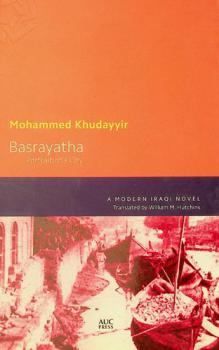
Basrayatha : portrait of a city
\"Basrayatha is a literary tribute by author Mohammed Khudayyir to the city of his birth, Basra, on the Shatt al-Arab waterway in southern Iraq. Just as a city's inhabitants differ from outsiders through their knowledge of its streets as well as its stories, so Khudayyir distinguishes between the real city of Basra and Basrayatha, the imagined city he has created through stories, experiences, and folklore.\" \"By turns a memoir, a travelogue, a love letter, and a meditation, Basrayatha summons up images of a city long gone. In loving detail, Khudayyir recounts his discovery of his city as a child, as well as past communal banquets, the public baths, the delights of the Muslim day of rest, the city's flea markets and those who frequent them, a country bumpkin's big day in the city. Hollywood films at the local cinema, daily life during the Iran-Iraq War, and the canals and rivers around Basra. Above all, however, the book illuminates the role of the storyteller in creating the cities we inhabit. Evoking the literary modernism of authors like Calvino and Borges, and tinged with nostalgia for a city now disappeared, Basrayatha is a tribute to the power of memory and imagination.\"--Jacket.
BOOK