
Catalogue Search | MBRL


Are you sure you want to remove the book from the shelf?

{{itemTitle}}
20
result(s) for
"Arabic poetry 750-1258 History and criticism."
Sort by:


Arabic literary salons in the Islamic Middle Ages : poetry, public performance, and the presentation of the past
Arabic literary salons emerged in ninth-century Iraq and, by the tenth, were flourishing in Baghdad and other urban centers. In an age before broadcast media and classroom education, salons were the primary source of entertainment and escape for middle- and upper-rank members of society, serving also as a space and means for educating the young. Although salons relied on a culture of oral performance from memory, scholars of Arabic literature have focused almost exclusively on the written dimensions of the tradition. That emphasis, argues Samer Ali, has neglected the interplay of oral and written, as well as of religious and secular knowledge in salon society, and the surprising ways in which these seemingly discrete categories blurred in the lived experience of participants. Looking at the period from 500 to 1250, and using methods from European medieval studies, folklore, and cultural anthropology, Ali interprets Arabic manuscripts in order to answer fundamental questions about literary salons as a social institution. He identifies salons not only as sites for socializing and educating, but as loci for performing literature and oral history; for creating and transmitting cultural identity; and for continually reinterpreting the past. A fascinating recovery of a key element of humanistic culture, Ali’s work will encourage a recasting of our understanding of verbal art, cultural memory, and daily life in medieval Arab culture.
eBook


Abundance from the Desert
Abundance from the Desertprovides a comprehensive introduction to classical Arabic poetry, one of the richest of poetic traditions. Covering the period roughly of 500â€\"1250 c.e., it features original translations and illuminating discussions of a number of major classical Arabic poems from a variety of genres. The poems are presented chronologically, each situated within a specific historical and literary context. Together, the selected poems suggest the range and depth of classical Arabic poetic expression; read in sequence, they suggest the gradual evolution of a tradition. Moving beyond a mere chronicle, Farrin outlines a new approach to appreciating classical Arabic poetry based on an awareness of concentric symmetry, in which the poem's unity is viewed not as a linear progression but as an elaborate symmetrical plot. In doing so, the author presents these works in a broader, comparative light, revealing connections with other literatures. The reader is invited to examine these classical Arabic works not as isolated phenomena-notwithstanding their uniqueness and their association with a discrete tradition-but rather as part of a great multicultural heritage.This pioneering book marks an important step forward in the study of Arabic poetry. At the same time, it opens the door to this rich tradition for the general reader.
eBook


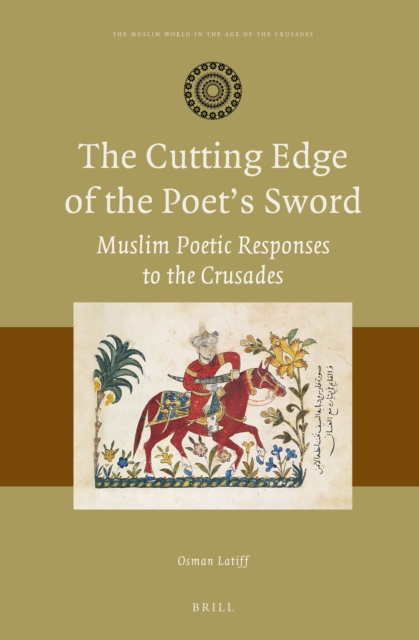
The Cutting Edge of the Poet's Sword
In this comprehensive analysis of Arabic poetry during the period of the crusades (sixth/twelfth-seventh/thirteenth centuries), Osman Latiff provides an insightful examination of the poets who inspired Muslims to unite in the jihad against the Franks. The Cutting Edge of the Poet's Sword not only contributes to our understanding of literary history, it also illuminates a broad spectrum of religiosity and the role of political propaganda in the anti-Frankish Muslim struggle. Latiff shows how poets, often used by the ruling elite to promote their rule, emphasised the centrality of Islam's holy sites to inspire the Muslim response to the occupation and later reconquest of Jerusalem, and expressed some surprising views of Frankish Christians.
eBook


Selections From the Art of Party Crashing
Selove provides a humorous selection of anecdotes from al-Baghdadi’s The Art of Party-Crashing, a book about enjoying food, flirtation and everyday life in Medieval Iraq. The passages are full of ribald jokes, roguish tricksters, and joyful outpourings of spontaneous eloquence.
eBook