
Catalogue Search | MBRL


Are you sure you want to remove the book from the shelf?

{{itemTitle}}
183
result(s) for
"Arabs Genealogy"
Sort by:

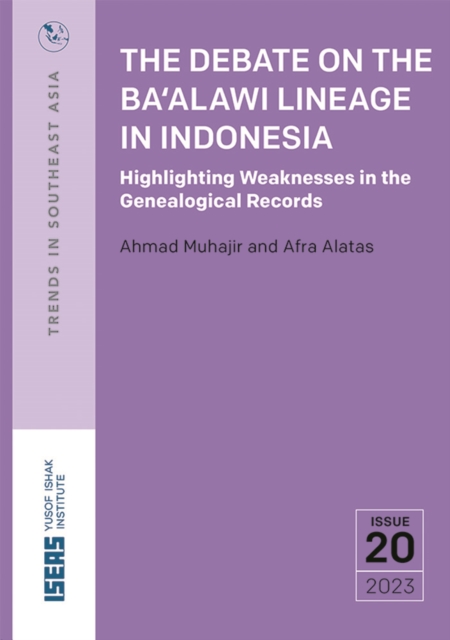
The debate on the Ba'Alawi lineage in Indonesia : highlighting weaknesses in the genealogical records
A scholar from Nahdlatul Ulama by the name of Imaduddin Utsman has recently challenged the long-accepted claim that the Ba'Alawi—Muslims of Hadhrami descent also known in Indonesia as habaib—are descendants of Prophet Muhammad. The challenge arose out of his critical examination of available records on the Prophet's lineage from the fifth century to the tenth century of Islam.
eBook
Debate on the Ba'Alawi Lineage in Indonesia
A scholar from Nahdlatul Ulama by the name of Imaduddin Utsman has recently challenged the long-accepted claim that the Ba'Alawi-Muslims of Hadhrami descent also known in Indonesia as habaib-are descendants of Prophet Muhammad. The challenge arose out of his critical examination of available records on the Prophet's lineage from the fifth century to the tenth century of Islam.
eBook

Founder mutations and rare disease in the Arab world
Founder mutations are disease-causing variants that occur frequently in geographically or culturally isolated groups whose shared ancestor(s) carried the pathogenic variant. While some disease alleles may vanish from the genetic pool due to natural selection, variants with weaker effects may survive for a long time, thereby enhancing the prevalence of some rare diseases. These are predominantly autosomal recessive diseases but can also be autosomal dominant traits with late-onset or mild phenotypes. Cultural practices, such as endogamy and consanguinity, in these isolated groups lead to higher prevalence of such rare diseases compared to the rest of the population and worldwide. In this Perspective, we define population isolates and the underlying genetic mechanisms for accumulating founder mutations. We also discuss the current and potential scientific, clinical and public-health implications of studying founder mutations in population isolates around the world, with a particular focus on the Arab population.
Journal Article

Entwined African and Asian genetic roots of medieval peoples of the Swahili coast
The urban peoples of the Swahili coast traded across eastern Africa and the Indian Ocean and were among the first practitioners of Islam among sub-Saharan people
1
,
2
. The extent to which these early interactions between Africans and non-Africans were accompanied by genetic exchange remains unknown. Here we report ancient DNA data for 80 individuals from 6 medieval and early modern (
ad
1250–1800) coastal towns and an inland town after
ad
1650. More than half of the DNA of many of the individuals from coastal towns originates from primarily female ancestors from Africa, with a large proportion—and occasionally more than half—of the DNA coming from Asian ancestors. The Asian ancestry includes components associated with Persia and India, with 80–90% of the Asian DNA originating from Persian men. Peoples of African and Asian origins began to mix by about
ad
1000, coinciding with the large-scale adoption of Islam. Before about
ad
1500, the Southwest Asian ancestry was mainly Persian-related, consistent with the narrative of the Kilwa Chronicle, the oldest history told by people of the Swahili coast
3
. After this time, the sources of DNA became increasingly Arabian, consistent with evidence of growing interactions with southern Arabia
4
. Subsequent interactions with Asian and African people further changed the ancestry of present-day people of the Swahili coast in relation to the medieval individuals whose DNA we sequenced.
Analysis of ancient human DNA from the Swahili coast reveals that predominantly African female ancestors and Asian male ancestors formed families after around
ad
1000 and lived in elite communities in coastal stone towns.
Journal Article

This Noble House
This Noble House explores the preoccupation with biblical genealogy that emerged among Jews in the Islamic Near East between the eleventh and fourteenth centuries. Arnold Franklin looks to Jewish society's fascination with Davidic ancestry, examining the profusion of claims to the lineage that had already begun to appear by the year 1000, the attempts to chart the validity of such claims through elaborate genealogical lists, and the range of meanings that came to be ascribed to the House of David in this period. Jews and Muslims shared the perception that the Davidic line and the noble family of the Prophet Muhammad were counterparts to one another, but captivation with Davidic lineage was just one facet of a much broader Jewish concern with biblical ancestry.Based on documentary material from the Cairo Geniza, the book argues that this \"genealogical turn\" should be understood as a consequence of Jewish society's dynamic encounter with its Arab-Islamic milieu and constituted a selective adaptation to the importance of ancestry in the dominant cultural environment. While Jewish society surely had genealogical materials and preoccupations of its own upon which to draw, the Arab-Islamic regard for tracing the lineage of Muhammad provided the impetus for deploying those traditions in new and unprecedented ways.On the one hand, the increased focus on ancestry is an instance of medieval Jews reflexively and unselfconsciously making use of the cultural forms of their Muslim neighbors; on the other, it is an expression of cultural competitiveness or even resistance, an implicit response to the claim of Arab genealogical superiority that uses the very methods of the Arab \"science of genealogy.\" To be sure, Franklin notes, Jews were only one of several non-Arab minority groups to take up genealogy in this way. At the broadest level, then, This Noble House illuminates a strategy that various minority populations utilized as they sought legitimacy within the medieval Arab-Islamic world.
eBook

Imagining modernity: the language and genealogy of modernity in nineteenth-century Arabic
This article employs the methodology of conceptual history to contest two of the most common theoretical approaches dominating our understanding of modernity in the field of Middle Eastern studies. The first approach relies on the assumption of incompatibility between modernity and Islam and captures Arab modernity using concepts such as 'adoption'. The second understands Arab modernity through concepts such as 'imitation', contending that it is a legacy of Western imperialism. This article challenges both theories by examining the genealogy of tamaddun (civilization, being civilized), a pivotal concept used in nineteenth-century Arabic to imagine modernity. The genealogy of tamaddun elucidates that medieval paradigms derived from the concept of madina (polity) were rediscovered, reimagined, and reused in the context of the rise of the nation-state and the challenge of Western imperialism. The article suggests understanding Arab modernity and its critique from within, rather than outside of, the temporality of the historical condition.
Journal Article

Climatic Determinism and Race: A Comparative Analysis of Ibn H̱aldūn’s and I. Kant’s Racialist Anthoropologies
This paper attempts to examine and compare Ibn H̱aldūn’s and I. Kant’s racialist theories. The paper shows how the theories of Avicenna, Ṣāʿid al-Andalusī and Ibn H̱aldūn contended that the interplay of climatic determinism and humoral constitution of humans produced human phenotypic and behavioural differences. The study shows a conceptual overlap between the European racial theories as found in Comte de Buffon and I. Kant and the ideas found in Arabic texts. Their fundamental differences lie in the treatment of ethnic groups. While Ibn H̱aldūn positioned the Mediterranean and Middle Eastern regions as the civilisational centre, European racial geography is Eurocentric. Kant placed Europeans at the pinnacle of human excellence. This conceptual shift largely reflects a changed historic and political context. Thus, the article illustrates how power generates a racial discourse that legitimises the existing relations between the masters and slaves, between the colonisers and the colonised.
Journal Article