
Catalogue Search | MBRL


Are you sure you want to remove the book from the shelf?

{{itemTitle}}
9
result(s) for
"Aramaic language-Texts"
Sort by:


Textbook of Aramaic Ostraca from Idumea, Volume 2
Since 1991, some 2,000 Aramaic ostraca deriving from the south of Israel have appeared on the antiquities market and are now scattered in 9 museums and libraries and 21 private collections. Of these, the majority are still not formally published, and in this second volume in the series, Bezalel Porten continues the publication of this important corpus of 4th century B.C.E. economic texts. With the expert epigraphic assistance of Ada Yardeni and hand-copies by her as well, Porten here provides the second volume of texts, organized by “dossier” based on the primary personage cited in the text. Color photographs (where available), ceramic descriptions, hand-copies, transcription, translation, and commentary are provided for each text, along with tables of seven grain dossiers. This publication will become the primary resource for information on these texts, which provide insight into the economic, social, and religious lives of Idumeans in the late Persian and early Hellenistic periods.
eBook


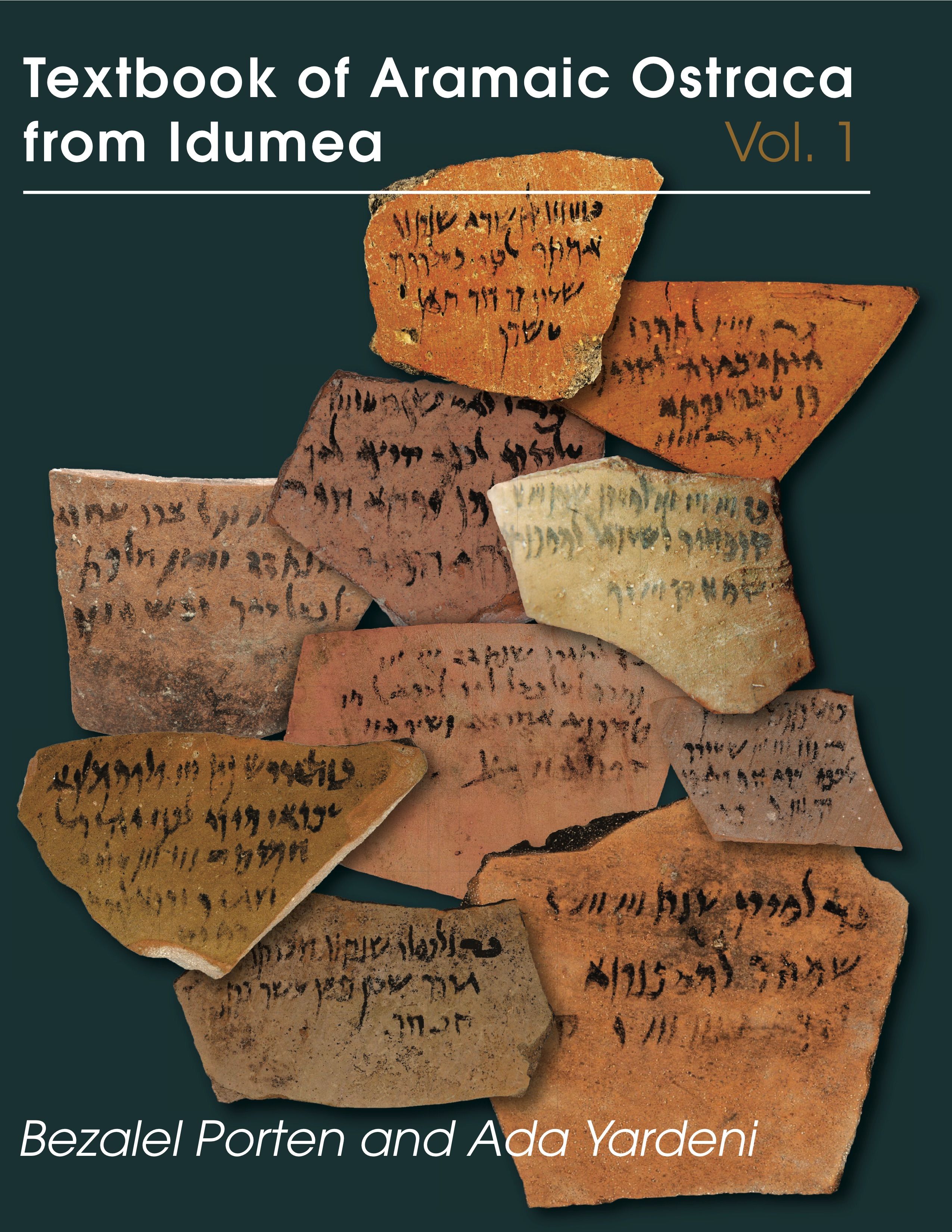
Textbook of Aramaic Ostraca from Idumea, Volume 1
Some 340 Aramaic ostraca of the Persian and Hellenistic periods have been excavated at 32 sites in Israel, from Yokneam in the north to Eilat in the south, with Arad and Beersheba being the main contributory sites. By far, however, the largest cache of texts is what has come to be known as “the Idumean ostraca”. These did not come from formal excavations but began to appear on the antiquities market in 1991. Since then, some 2,000 ostraca have reached 9 museums and libraries and 21 private collections. Of these, the majority are still not formally published, and in this volume (and those to follow), Bezalel Porten undertakes to provide a comprehensive edition of all these texts, in many cases as an editio princeps. Porten, with the expert epigraphic assistance of Ada Yardeni and hand-copies by her as well, here provides the first volume of texts, organized by “dossier” based on the primary personage cited in the text. Color photographs (where available), ceramic descriptions, hand-copies, transcription, translation, and commentary are provided for each text, along with figures and tables, and introductions and summaries of each dossier. An included CD contains a catalogue of all the texts and three color key-word-in-context concordances, for words, personal names, and months for the entire corpus. This publication will become the primary resource for information on these texts.
eBook
Textbook of Aramaic Ostraca from Idumea, volume 1
Some 340 Aramaic ostraca of the Persian and Hellenistic periods
have been excavated at 32 sites in Israel, from Yokneam in the
north to Eilat in the south, with Arad and Beersheba being the main
contributory sites. By far, however, the largest cache of texts is
what has come to be known as \"the Idumean ostraca\". These did not
come from formal excavations but began to appear on the antiquities
market in 1991. Since then, some 2,000 ostraca have reached 9
museums and libraries and 21 private collections. Of these, the
majority are still not formally published, and in this volume (and
those to follow), Bezalel Porten undertakes to provide a
comprehensive edition of all these texts, in many cases as an
editio princeps . Porten, with the expert epigraphic
assistance of Ada Yardeni and hand-copies by her as well, here
provides the first volume of texts, organized by \"dossier\" based on
the primary personage cited in the text. Color photographs (where
available), ceramic descriptions, hand-copies, transcription,
translation, and commentary are provided for each text, along with
figures and tables, and introductions and summaries of each
dossier. An included CD contains a catalogue of all the texts and
three color key-word-in-context concordances, for words, personal
names, and months for the entire corpus. This publication will
become the primary resource for information on these texts.
eBook

Everyday writing in the graeco-roman east
Most of the everyday writing from the ancient world—that is, informal writing not intended for a long life or wide public distribution—has perished. Reinterpreting the silences and blanks of the historical record, leading papyrologist Roger S. Bagnall convincingly argues that ordinary people—from Britain to Egypt to Afghanistan—used writing in their daily lives far more extensively than has been recognized. Marshalling new and little-known evidence, including remarkable graffiti recently discovered in Smyrna, Bagnall presents a fascinating analysis of writing in different segments of society. His book offers a new picture of literacy in the ancient world in which Aramaic rivals Greek and Latin as a great international language, and in which many other local languages develop means of written expression alongside these metropolitan tongues.
eBook
