
Catalogue Search | MBRL


Are you sure you want to remove the book from the shelf?

{{itemTitle}}
980
result(s) for
"Archaeological chemistry."
Sort by:

Archaeological chemistry
\"The use of chemistry in archaeology can help archaeologists answer questions about the nature and origin of the many organic and inorganic finds recovered through excavation, providing valuable information about the social history of humankind. This textbook tackles the fundamental issues in chemical studies of archaeological materials.
Book

Revealing a 5,000-y-old beer recipe in China
The pottery vessels from the Mijiaya site reveal, to our knowledge, the first direct evidence of in situ beer making in China, based on the analyses of starch, phytolith, and chemical residues. Our data reveal a surprising beer recipe in which broomcorn millet (Panicum miliaceum), barley (Hordeum vulgare), Job’s tears (Coix lacrymajobi), and tubers were fermented together. The results indicate that people in China established advanced beer-brewing technology by using specialized tools and creating favorable fermentation conditions around 5,000 y ago. Our findings imply that early beer making may have motivated the initial translocation of barley from the Western Eurasia into the Central Plain of China before the crop became a part of agricultural subsistence in the region 3,000 y later.
Journal Article


Seeing Beneath the Soil
Scientific soil prospecting methods can give dramatic pictures of buried archaeological sites, and sometimes information on what occurred within them, before any earth has ben removed. Dr Clark, who was one of the earliest to work in this field, has written the first general survey of an increasingly important area of practical archaeology. The emphasis is on the principles and practical application of the well established techniques of resistivity, magnetometry and magnetic susceptibility, with shorter sections on emerging and less common techniques such as ground-penetrating radar, electromagnetic methods and phosphate survey. This paperback edition updates and enhances the earlier book, adding new material such as the large-scale evaluation exercises now required as a precondition of planning consent for major developments.
eBook

Deep palaeoproteomic profiling of archaeological human brains
Palaeoproteomics leverages the persistence, diversity, and biological import of ancient proteins to explore the past, and answer fundamental questions about phylogeny, environment, diet, and disease. These insights are largely gleaned from hard tissues like bone and teeth, as well-established protocols exist for extracting ancient proteins from mineralised tissues. No such method, however, exists for the soft tissues, which are underexplored in palaeoproteomics given permission for destructive analysis routinely depends on a proven methodology. Considering less than one-tenth of all human proteins are expressed in bone, compared to three-quarters in the internal organs, the amount of biological information presently inaccessible is substantial. We address this omission with an optimised LC-FAIMS-MS/MS workflow yielding the largest, most diverse palaeoproteome yet described. Using archaeological human brains, we test ten protocols with varied chemistries and find that urea lysis effectively disrupts preserved membrane regions to expose low-abundant, intracellular analytes. Further, we show that ion mobility spectrometry improves unique protein identification by as much as 40%, and represents a means of “cleaning” dirty archaeological samples. Our methodology will be useful for improving protein recovery from a range of ancient tissues and depositional environments.
Journal Article

Compositional Analysis of Cultic Clay Objects from the Iron Age Southern Levant
Compositional analysis conducted on pottery and other ceramic items can shed light on their place of production and in certain cases, on technological aspects of the production sequence. The methods used, petrography and chemical analysis, can also be employed on cultic terracotta such as figurines, cult stands, models, or other clay objects. Several studies of such analyses of items from various periods in the Southern Levant have been published, mostly from temple contexts. This paper focuses particularly on two groups of items: clay models from the favissa at Yavneh and pillar figurines and other (mostly horse) figurines from Jerusalem and Tell en-Nasbeh in Iron Age Judah. These two groups are both roughly dated to the time span between the 9th and 7th centuries BCE. While the former group is of objects representing a temple context in Philistia, the latter is likely related to a domestic cult in Judah. The analysis of these objects is also examined against the background of a robust compositional analysis of regular pottery from the sites. The compositional analysis can indicate whether these objects were locally produced or imported from various regions (thus possibly brought by pilgrims), as well as whether they were “mass-produced” in a single workshop. The results can shed light on aspects of religious and cultic conducts in these occasions as well as compare domestic and temple-related cultic behaviors.
Journal Article

Fermented beverages of pre- and proto-historic China
Chemical analyses of ancient organics absorbed into pottery jars from the early Neolithic village of Jiahu in Henan province in China have revealed that a mixed fermented beverage of rice, honey, and fruit (hawthorn fruit and or grape) was being produced as early as the seventh millennium before Christ (B.C.). This prehistoric drink paved the way for unique cereal beverages of the proto-historic second millennium B.C., remarkably preserved as liquids inside sealed bronze vessels of the Shang and Western Zhou Dynasties. These findings provide direct evidence for fermented beverages in ancient Chinese culture, which were of considerable social, religious, and medical significance, and help elucidate their earliest descriptions in the Shang Dynasty oracle inscriptions.
Journal Article
Isotope systematics of subfossil, historical, and modern Nautilus macromphalus from New Caledonia
Cephalopod carbonate geochemistry underpins studies ranging from Phanerozoic, global-scale change to outcrop-scale paleoecological reconstructions. Interpreting these data hinges on assumed similarity to model organisms, such as Nautilus , and generalization from other molluscan biomineralization processes. Aquarium rearing and capture of wild Nautilus suggest shell carbonate precipitates quickly (35 μm/day) in oxygen isotope equilibrium with seawater. Other components of Nautilus shell chemistry are less well-studied but have potential to serve as proxies for paleobiology and paleoceanography. To calibrate the geochemical response of cephalopod δ 15 N org , δ 13 C org , δ 13 C carb , δ 18 O carb , and δ 44/40 Ca carb to modern anthropogenic environmental change, we analyzed modern, historical, and subfossil Nautilus macromphalus from New Caledonia. Samples span initial human habitation, colonialization, and industrial p CO 2 increase. This sampling strategy is advantageous because it avoids the shock response that can affect geochemical change in aquarium experiments. Given the range of living depths and more complex ecology of Nautilus , however, some anthropogenic signals, such as ocean acidification, may not have propagated to their living depths. Our data suggest some environmental changes are more easily preserved than others given variability in cephalopod average living depth. Calculation of the percent respired carbon incorporated into the shell using δ 13 C org , δ 13 C carb , and Suess-effect corrected δ 13 C DIC suggests an increase in the last 130 years that may have been caused by increasing carbon dioxide concentration or decreasing oxygen concentration at the depths these individuals inhabited. This pattern is consistent with increasing atmospheric CO 2 and/or eutrophication offshore of New Caledonia. We find that δ 44/40 Ca remains stable across the last 130 years. The subfossil shell from a cenote may exhibit early δ 44/40 Ca diagenesis. Questions remain about the proportion of dietary vs ambient seawater calcium incorporation into the Nautilus shell. Values of δ 15 N do not indicate trophic level change in the last 130 years, and the subfossil shell may show diagenetic alteration of δ 15 N toward lower values. Future work using historical collections of Sepia and Spirula may provide additional calibration of fossil cephalopod geochemistry.
Journal Article
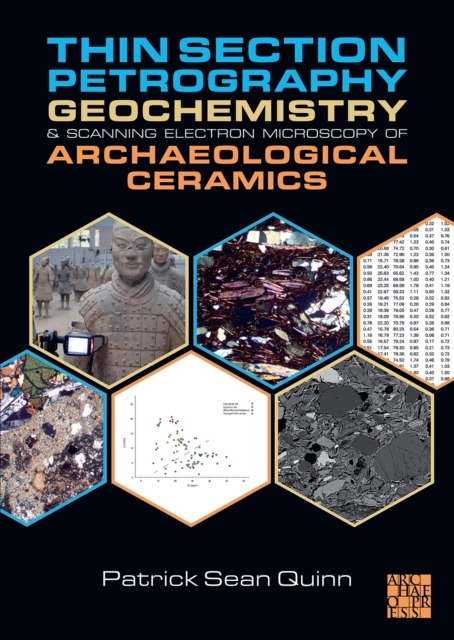
Thin Section Petrography, Geochemistry and Scanning Electron Microscopy of Archaeological Ceramics
Thin section petrography, geochemistry, scanning electron microscopy and X-ray diffraction are key scientific methods used to investigate the raw materials, origins and production technology of archaeological pottery, ceramic building materials, ancient refractories and plaster. Using over 400 colour figures of a diverse range of artefact types and archaeological periods from 50 countries worldwide, this book outlines the mineralogical, chemical and microstructural composition of ancient ceramics and provides comprehensive guidelines for their scientific study within archaeology. The core of the book is dedicated to the versatile approach of ceramic petrography. This is complimented by a detailed account of the principles of bulk instrumental geochemistry, as well as the SEM microanalysis and XRD characterisation of ceramics. The book is intended as a reference manual for research as well as a course text for specialist training on scientific ceramic analysis.
eBook

Detecting Recent Research Trends and Applications of Some Molecular Archaeometric Analysis Techniques: A Review
This review, through the collection and comparative analysis of the most recent literature, aims to analyze the new trends in archaeometric analysis and some selected laboratory techniques aimed at determining the provenance, the physical–chemical characteristics, and the state of decay of archaeological finds of different types (ancient manuscripts, paintings, frescoes, and ceramics). In particular, the methodologies and analytical techniques relating to Raman spectroscopy, X-ray fluorescence, laser ablation, IR spectroscopy, LIBS, and Thz spectroscopy were compared and tabulated, with the aim of determining the appropriateness of each technique applied to various archaeological items. This will provide guidelines for the right conservation and restoration strategies. The work was also based on the construction of comparative tables of the consulted scientific literature and on the analysis of the research trends by using the Google Trends app.
Journal Article