
Catalogue Search | MBRL


Are you sure you want to remove the book from the shelf?

{{itemTitle}}
4,140
result(s) for
"Archaeological methodology"
Sort by:


New Archaeobotanic Data for the Study of the Origins of Agriculture in China
In the past 10 years, flotation techniques have been introduced and implemented in Chinese archaeology. As a result, a tremendous quantity of plant remains have been recovered from archaeological sites located all over China. These plant remains include crops that might have been domesticated in China—such as rice, foxtail millet, broomcorn millet, and soybean—as well as crops that were introduced into China from other parts of world—such as wheat and barley. The new archaeobotanic data provide direct archaeological evidence for the study of the origins and development of agriculture in China. This paper attempts a synthesis of these new archaeobotanic data while presenting some new ideas about the origins and development of ancient agriculture in China, including the rice agriculture tradition that originated around the middle and lower Yangtze River areas; the dry-land agriculture tradition, with millets as major crops, centered in North China; and the ancient tropical agriculture tradition located in the tropical parts of China, where the major crops seem to be roots and tubers, such as taro.
Journal Article


Microarchaeological Approaches to the Identification and Interpretation of Combustion Features in Prehistoric Archaeological Sites
Combustion features inform archaeologists about the prehistoric use of space, subsistence behaviors, and tempo of site visitation. Their study in the field is difficult because burned sediments are susceptible to reworking and diagenesis. Microarchaeological analyses, including micromorphology, are essential for documenting the composition, preservation, and function of hearths and other burned residues. These investigations focus on the description of fuels, depositional fabrics and structures, and mineralogy. As evidenced by a literature review, microarchaeological analyses have much to offer Paleolithic archaeologists, while applications of the techniques to Late Pleistocene and Early Holocene sites and in ethnographic or experimental contexts are presently rare.
Journal Article
Methods in World History: A Critical Approach
\"Interest in world history has never been greater—both among historians and the reading public. Globalization has coaxed historians out of their fixation on all things national, which has characterized historical research since the nineteenth century. But with this new global field of research has come new methodological problems. It is high time that these problems were tackled, if only to develop methods to ensure that world-historical research strives for the same high quality and standards as any other field of historical study. This book addresses all these problems in detail, with a particular emphasis on solutions. The contributors discuss how the progress made in the sciences, which offer unique access to new types of source material, can best be used by the historians of global processes. These are sources that demand an awareness of both their advantages and their drawbacks. The same is true of the secondary sources, which are the basis of most world-historical overviews and syntheses. Primary and secondary sources alike require shrewd handling in a way not seen before. Similarly, the calculations and comparisons essential to world history must be harmonized, and historians have to acknowledge that the information they are working from is often of variable quality and detail. Linguistic and cultural differences must also be analysed systematically whenever historians seek the recurring traits in human history, much as they must be alert to the strong ideological interests that all too often distort scholarly results. Solutions to these and the other methodological problems are hammered out in this book. Whether researchers, students, or interested readers, anyone keen to sharpen their critical thinking about world history will find there is much to take away from this book.
Intresset för världshistoria är större än på länge – både bland den läsande allmänheten och bland historiker. Globaliseringen har bidragit till att historikerna kommit ut ur den fixering vid det nationella som kännetecknat deras forskning ända sedan 1800-‐talet. Men med den nya globala arenan för forskning följer också nya metodproblem. Det är hög tid att de världshistoriskt orienterade forskarna tar sig an de här problemen och utvecklar metoder, så att de kan arbeta med lika höga kvalitetskrav som annan historieforskning. I den här boken adresseras utförligt en serie sådana problem, och författarna ger förslag på hur de ska lösas. Här diskuteras hur den naturvetenskapliga forskningens framsteg kan utnyttjas för den som vill studera övergripande globala processer med vår tids unikt stora tillgång till helt nya typer av källmaterial. Det kräver en medvetenhet hos historikerna både om de här källornas förtjänster och om deras fällor. Detsamma gäller användningen sekundärlitteratur, som en stor del av de världshistoriska översikterna och synteserna baseras på. Här krävs källkritisk skärpa av ett nytt slag. Här krävs också att de ekonomiska och andra beräkningar och jämförelser som måste till inom världshistorisk forskning harmonieras och att forskarna tar höjd för att den information de bygger på ofta är av olika kvalitet och upplösning. Språkliga och kulturella skillnader måste också analyseras systematiskt när forskarna söker de återkommande dragen i den mänskliga historien. Dessutom måste världshistorikerna ständigt vara uppmärksamma på de starka ideologiska intressen som allt för ofta tenderar att förvrida de vetenskapliga resultaten. Detta och en hel del andra metodproblem diskuteras i den här boken, där det finns mycket att hämta både för forskaren och för studenten, liksom för den historieintresserade läsare som vill skärpa sitt kritiska förhållningssätt till världshistorisk forskning.\"
eBook
Thinking Through Networks: A Review of Formal Network Methods in Archaeology
This review aims to expose the potential of formal network methods for archaeology by tracing the origins of the academic traditions, network models, and techniques that have been most influential to archaeologists. A brief discussion of graph theoretic applications in archaeology reveals how graph visualization and analysis was used since the 1960s in a very similar way to later network analysis applications, but did not seem to have influenced the more widespread adoption of network techniques over the past decade. These recent archaeological applications have been strongly influenced by two academic traditions, social network analysis and sociophysics. The most influential and promising techniques and models adopted from these traditions are critically discussed. This review reveals some general trends which are considered to be the result of two critical issues that will need to be addressed in future archaeological network analysis: (1) a general unawareness of the historicity and diversity of formal network methods both within and outside the archaeological discipline has resulted in a very limited methodological scope; (2) the adoption or development of network methods has very rarely been driven by specific archaeological research questions and is dominated by a few popular models and techniques, which has in some cases resulted in a routinized explanatory process. This review illustrates, however, the great potential of formal network methods for archaeology and argues that, if this potential is to be applied in a critical way, a broad multidisciplinary scope is necessary and specific archaeological research contexts should dominate applications.
Journal Article
Networks in Archaeology: Phenomena, Abstraction, Representation
The application of method and theory from network science to archaeology has dramatically increased over the last decade. In this article, we document this growth over time, discuss several of the important concepts that are used in the application of network approaches to archaeology, and introduce the other articles in this special issue on networks in archaeology. We argue that the suitability and contribution of network science techniques within particular archaeological research contexts can be usefully explored by scrutinizing the past phenomena under study, how these are abstracted into concepts, and how these in turn are represented as network data. For this reason, each of the articles in this special issue is discussed in terms of the phenomena that they seek to address, the abstraction in terms of concepts that they use to study connectivity, and the representations of network data that they employ in their analyses. The approaches currently being used are diverse and interdisciplinary, which we think are evidence of a healthy exploratory stage in the application of network science in archaeology. To facilitate further innovation, application, and collaboration, we also provide a glossary of terms that are currently being used in network science and especially those in the applications to archaeological case studies.
Journal Article

The early chronology of broomcorn millet (Panicum miliaceum) in Europe
The majority of the early crops grown in Europe had their origins in south-west Asia, and were part of a package of domestic plants and animals that were introduced by the first farmers. Broomcorn millet, however, offers a very different narrative, being domesticated first in China, but present in Eastern Europe apparently as early as the sixth millennium BC. Might this be evidence of long-distance contact between east and west, long before there is any other evidence for such connections? Or is the existing chronology faulty in some way? To resolve that question, 10 grains of broomcorn millet were directly dated by AMS, taking advantage of the increasing ability to date smaller and smaller samples. These showed that the millet grains were significantly younger than the contexts in which they had been found, and that the hypothesis of an early transmission of the crop from east to west could not be sustained. The importance of direct dating of crop remains such as these is underlined.
Journal Article

Archaeological Ethnography: A Multitemporal Meeting Ground for Archaeology and Anthropology
Archaeology and anthropology, despite their commonalities, have had a rather asymmetrical relationship, and the periodic attempts at closer collaboration resulted in mutual frustration. As both disciplines have recently undergone significant changes, however, with anthropology embracing more fully materiality and historicity, and archaeology engaging in contemporary research, often involving ethnography, the time is ripe for a new rapprochement. Archaeological ethnography, an emerging transdisciplinary field, offers such an opportunity. Archaeological ethnography is defined here as a transcultural space for multiple encounters, conversations, and interventions, involving researchers from various disciplines and diverse publics, and centered around materiality and temporality. It is multitemporal rather than presentist, and although many of its concerns to date are about clashes over heritage, this article argues that its potential is far greater because it can dislodge the certainties of conventional archaeology and question its ontological principles, such as those founded on modernist, linear, and successive temporality.
Journal Article
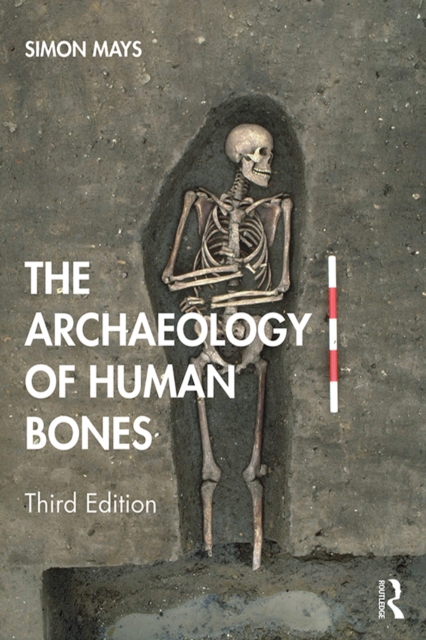
The Archaeology of Human Bones
The Archaeology of Human Bones provides an up to date account of the analysis of human skeletal remains from archaeological sites, introducing students to the anatomy of bones and teeth and the nature of the burial record.
Drawing from studies around the world, this book illustrates how the scientific study of human remains can shed light upon important archaeological and historical questions. This new edition reflects the latest developments in scientific techniques and their application to burial archaeology. Current scientific methods are explained, alongside a critical consideration of their strengths and weaknesses. The book has also been thoroughly revised to reflect changes in the ways in which scientific studies of human remains have influenced our understanding of the past, and has been updated to reflect developments in ethical debates that surround the treatment of human remains. There is now a separate chapter devoted to archaeological fieldwork on burial grounds, and the chapters on DNA and ethics have been completely rewritten.
This edition of The Archaeology of Human Bones provides not only a more up to date but also a more comprehensive overview of this crucial area of archaeology. Written in a clear style with technical jargon kept to a minimum, it continues to be a key work for archaeology students.
eBook