
Catalogue Search | MBRL


Are you sure you want to remove the book from the shelf?

{{itemTitle}}
371
result(s) for
"Archaeologists Biography."
Sort by:


Cultural Negotiations
This meticulously researched reference work documents the role of women who contributed to the development of Americanist archaeology from 1865 to 1940. Between the Civil War and World War II, many women went into anthropology and archaeology, fields that, at the beginning of this period, welcomed and made room for amateurs of both genders. But over time, the increasingly professional structure of these fields diminished or even obscured the contributions of women due to their lack of access to prestigious academic employment and publishing opportunities. As a result, a woman archaeologist during this period often published her research under her husband's name or as a junior author with her husband.
InCultural Negotiationsarchaeologist David L. Browman has scoured the archaeological literature and archival records of several institutions to bring the stories of more than two hundred women in Americanist archaeology to light through detailed biographies that discuss their contributions and publications. This work highlights how the social and cultural construction of archaeology as a field marginalized women and will serve as an invaluable reference to those researchers who continue to uncover the history of women in the sciences.
eBook

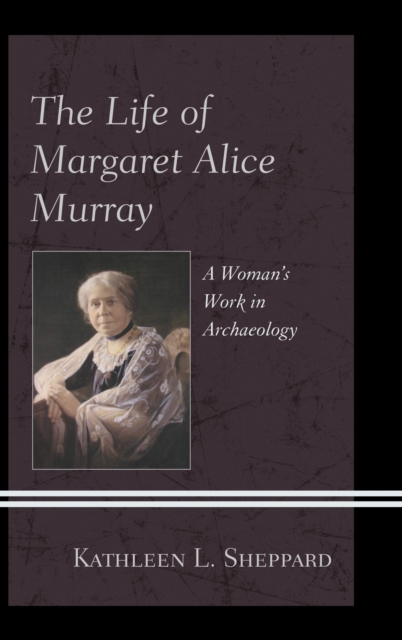
The life of Margaret Alice Murray
The Life of Margaret Alice Murray: A Woman’s Work in Archaeology is the first book-length biography of Margaret Alice Murray (1863–1963), one of the first women to practice archeology. Despite Murray’s numerous professional successes, her career has received little attention because she has been overshadowed by her mentor, Sir Flinders Petrie. This oversight has obscured the significance of her career including her fieldwork, the students she trained, her administration of the pioneering Egyptology Department at University College London (UCL), and her published works. Rather than focusing on Murray’s involvement in Petrie’s archaeological program, Kathleen L. Sheppard treats Murray as a practicing scientist with theories, ideas, and accomplishments of her own. This book analyzes the life and career of Margaret Alice Murray as a teacher, excavator, scholar, and popularizer of Egyptology, archaeology, anthropology, linguistics, and more. Sheppard also analyzes areas outside of Murray’s archaeology career, including her involvement in the suffrage movement, her work in folklore and witchcraft studies, and her life after her official retirement from UCL.
eBook


A White-Bearded Plainsman
W. Raymond Wood played a leading role in the early days of Great Plains archaeology. In A White-Bearded Plainsman , he tells how his own career emerged, as the discipline of Plains archaeology developed during the post-World War II era. Readers will learn of the childhood influences that lead Wood to pursue the path of archaeologist, and of the events and people that shaped his professional life. In addition to telling Wood’s personal story, the book provides an intellectual history of the discipline of mid-continental archaeology over the last half century. It will thus be valuable to students and scholars in the field, as it describes how the paradigms in Plains and midwestern prehistory have changed over time. To understand the discipline, one must understand the cultural and intellectual underpinnings that shaped it. Wood’s book helps map for a new generation of archaeologists from whence they’ve come, and his role in the developments along the way.
eBook

Archaeology : cool women who dig
Provides information about the field of archaeology and profiles some women who are succeeding in the profession.
Book

Being and Becoming Indigenous Archaeologists
What does being an archaeologist mean to Indigenous persons? How and why do some become archaeologists? What has led them down a path to what some in their communities have labeled a colonialist venture? What were are the challenges they have faced, and the motivations that have allowed them to succeed? How have they managed to balance traditional values and worldview with Western modes of inquiry? And how are their contributions broadening the scope of archaeology? Indigenous archaeologists have the often awkward role of trying to serves as spokespeople both for their home community and for the scientific community of archaeologists. This volume tells the stories-in their own words-- of 37 indigenous archaeologists from six continents, how they became archaeologists, and how their dual role affects their relationships with their community and their professional colleagues. Sponsored by the World Archaeological Congress
eBook


Breaking ground
This book presents twelve fascinating women whose contributions to the development and progress of Old World archaeology—in an area ranging from Italy to Mesopotamia—have been immeasurable. Each essay in this collection examines the life of a pioneer archaeologist in the early days of the discipline, tracing her path from education in the classics to travel and exploration and eventual international recognition in the field of archaeology. The lives of these women may serve as models both for those interested in gender studies and the history of archaeology because in fact, they broke ground both as women and as archaeologists. The interest inherent in these biographies will reach well beyond defined disciplines and subdisciplines, for the life of each of these exciting and accomplished individuals is an adventure story in itself.
eBook