
Catalogue Search | MBRL


Are you sure you want to remove the book from the shelf?

{{itemTitle}}
11
result(s) for
"Archaeology -- Moral and ethical aspects -- United States"
Sort by:


Plundered skulls and stolen spirits : inside the fight to reclaim native America's culture
A leading anthropologist \"explores the fraught project of repatriating Native American sacred objects in this moving and thoughtful work\" ( Publishers Weekly).
Who own the objects that connect us to history? And who has the right to decide, particularly when the objects are sacred or, in the case of skeletal remains, human? As senior curator of anthropology at the Denver Museum of Nature & Science, Chip Colwell has navigated questions like these firsthand. In Plundered Skulls and Stolen Spirits, he examines how to weigh the religious freedom of Native Americans against the academic freedom of scientists—and whether the emptying of museum shelves elevates human rights or destroys a common heritage.
Today, hundreds of tribes use the Native American Graves Protection and Repatriation Act to recover their looted heritage from museums across the country. Colwell shares a personal account of this process, following the trail of four objects as they were created, collected, and ultimately returned to their sources: a sculpture that is a living god, the scalp of a massacre victim, a ceremonial blanket, and a skeleton from a tribe considered by some to be extinct.
These stories reveal a dramatic process that involves not merely obeying the law, but negotiating the blurry lines between identity and morality, spirituality and politics. Repatriation, Colwell argues, is a difficult but vitally important way for museums and tribes to heal the wounds of the past while creating a respectful approach to caring for these rich artifacts of history.
eBook


Reforming the world
Reforming the World offers a sophisticated account of how and why, in the late nineteenth and early twentieth centuries, American missionaries and moral reformers undertook work abroad at an unprecedented rate and scale. Looking at various organizations such as the Young Men's Christian Association and the Student Volunteer Movement for Foreign Missions, Ian Tyrrell describes the influence that the export of American values had back home, and explores the methods and networks used by reformers to fashion a global and nonterritorial empire. He follows the transnational American response to internal pressures, the European colonies, and dynamic changes in global society.
eBook

Getting Somalia Wrong?
Somalia is a failed state, representing a threat to itself, its neighbours and the wider world. In recent years, it has become notorious for the piracy off its coast and the rise of Islamic extremism, opening it up as a new 'southern front' in the war on terror. At least that is how it is inevitably portrayed by politicians and in the media.
Mary Harper presents the first comprehensive account of the chaos into which the country has descended and the United States' renewed involvement there. In doing so, Harper argues that viewing Somalia through the prism of al-Qaeda risks further destabilizing the country and the entire Horn of Africa, while also showing that though the country may be a failed state, it is far from being a failed society. In reality, alternative forms of business, justice, education and local politics have survived and even flourished.
Provocative in its analysis, Harper shows that until the international community starts to 'get it right' the consequences will be devastating, not just for Somalia, but for the world.
eBook

Class of '31
Class of '31 is a beautifully written memoir from a German Jew determined to learn the fate of his former classmates during the Third Reich. Jessel returned to Germany in 1945 as an American soldier hoping to understand how his friends survived World War II.
eBook

The Crimes of Empire
Imperial Nations advance their own interests by exploiting other societies. To those on the receiving end this is obvious, while inside the empire, a powerful ideological system of justification tends to hide all but the worst excess. Carl Boggs argues that that the US began life two centuries ago as a nascent colonialist regime plundering and conquering the Native Tribes. The Indian wars were followed by perpetual militarism and warfare fuelled by a deep sense of national exceptionalism. The Crimes Of Empire examines several trends in this process, and illustrates the new depths plumbed since 9/11. Violation of international agreements, treaties and laws and the use of prohibited weapons, support for death squads and torture are just some of the practices that Boggs highlights as he shows how technical superiority and media control prolong the American nightmare.
eBook

Fighting for Peace
Fighting for Peacebrings to light an important yet neglected aspect of opposition to the Iraq War-the role of veterans and their families. Drawing on extensive participant observation and interviews, Lisa Leitz demonstrates how the harrowing war experiences of veterans and their families motivated a significant number of them to engage in peace activism.
Married to a Navy pilot herself, Leitz documents how military peace activists created a movement that allowed them to merge two seemingly contradictory sides of their lives: an intimate relation to the military and antiwar activism. Members of the movement strategically deployed their combined military-peace activist identities to attract media attention, assert their authority about the military and war, and challenge dominant pro-war sentiment. By emphasizing the human costs of war, activists hoped to mobilize American citizens and leaders who were detached from the wars in Iraq and Afghanistan, bring the wars to an end, and build up programs to take care of returning veterans and their families.
The stories inFighting for Peaceultimately reveal that America's all-volunteer force is contributing to a civilian-military divide that leaves civilians with little connection to the sacrifices of the military. Increasingly, Leitz shows, veterans and their families are being left to not only fight America's wars but also to fight against them.
eBook
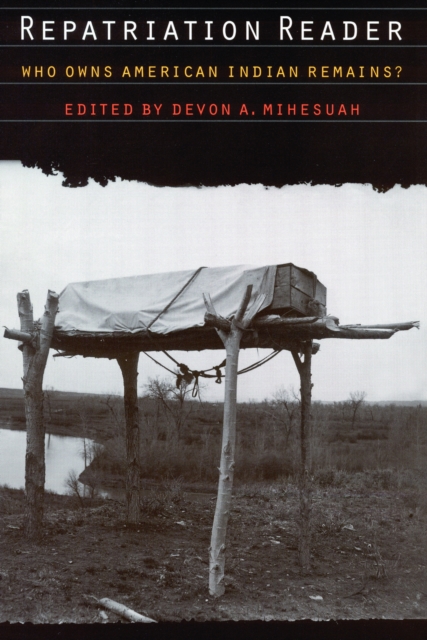
Repatriation reader : who owns American Indian remains?
In the past decade the repatriation of Native American skeletal remains and funerary objects has become a lightning rod for radically opposing views about cultural patrimony and the relationship between Native communities and archaeologists. In this unprecedented volume, Native Americans and non-Native Americans within and beyond the academic community offer their views on repatriation and the ethical, political, legal, cultural, scholarly, and economic dimensions of this hotly debated issue. While historians and archaeologists debate continuing non-Native interests and obligations, Native American scholars speak to the key cultural issues embedded in their ancestral pasts. A variety of sometimes explosive case studies are considered, ranging from Kennewick Man to the repatriation of Zuni Ahayu:da. Also featured is a detailed discussion of the background, meaning, and applicability of the Native American Graves Protection and Repatriation Act, as well as the text of the act itself.
eBook

Misfortunes of War
This monograph, part of a larger study of ways to reduce collateral damage undertaken for the U.S. Air Force, analyzes media and public reactions to civilian casualty incidents, whether these incidents affect media reporting or public support for military operations, and, if so, how. It analyzes case studies of incidents of civilian deaths in the February 1991 bombing of the Al Firdos bunker in the Gulf War, the April and May 1999 attacks on the Djakovica convoy and Chinese embassy during the war in Kosovo, the June 2002 attack involving an Afghan wedding party during operations in Afghanistan, and the March 2003 incident involving a large explosion in a crowded Baghdad marketplace to describe and explain how the U.S. and foreign media and publics have responded. For each case study, the study team examined press, public, and leadership responses to these incidents and found the following. First, while avoiding civilian casualties is important to the American public, it has realistic expectations about the actual possibilities for avoiding casualties. Second, the press reports heavily on civilian casualty incidents. Third, adversaries understand the publicÂ's sensitivities to civilian deaths and have sought to exploit them. Fourth, during armed conflict, the belief that the United States and its allies are trying to avoid casualties most affects support for U.S. military operations, both at home and abroad. Fifth, while strong majorities of Americans typically give U.S. military and political leaders the benefit of the doubt when civilian casualty incidents occur, this does not necessarily extend to foreign audiences. Sixth, when civilian casualty incidents occur, it is at least as important to get the story right as to get the story out. Finally, attention to and concern about civilian casualties both at home and abroad have increased in recent years and may continue to do so.
eBook