
Catalogue Search | MBRL


Are you sure you want to remove the book from the shelf?

{{itemTitle}}
381
result(s) for
"Architects Fiction."
Sort by:

Builder mouse
Edgar the mouse is frustrated when his architectural and artistic creations, made from tasty leftovers, are gobbled up by other mice, until he finds the perfect solution.
Book

Cosmotechnologies of Community and Collaboration in Vandana Singh’s Speculative Architectures
Yuk Hui, referring both to climate change and its accompanying social upheavals, writes that ‘to confront the crisis that is before us’, humans will have to rethink the idea of technological universality and how it constructs our relationship to each other and to the natural world. For architects, this means considering how much architecture today is constrained by a singular technological paradigm, and how architects can think the many technologies of architecture differently. This essay considers architectural cosmotechnology through discourses in global speculative fiction (SF), fictions proceeding from different ways of understanding and being in the world, to explore the future implications of these fictions for architecture and other technological practices in contrast to the hegemony of global modernism – what I have called cosmotechnologies of community and collaboration. The short fiction of SF author Vandana Singh supplies an image of architecture that proceeds from different images of and concerns about the future, and is an exemplary practice in cosmotechnology. She reframes existing technologies and invents new technologies in a mode of practice that centres the experience of diverse cultures in technologies of community and collaboration where architecture becomes central to new ways of being in the world.
Journal Article

The wilderness : a novel
With his memories slowly eroding from Alzheimer's, sixty-five-year-old Jake Jameson struggles to preserve his sense of identity by building stories about his feelings and the events of his life, unaware that even his clearest recollections may not be true.
Book

Biophilic architecture in artificial environments: insights from sci-fi cinema
Space tourism is rapidly advancing in both feasibility and popularity, yet architects still lack established frameworks for designing in outer space. Science fiction films increasingly depict expansive space megastructures with biophilic elements that are not only visually captivating but also serve as conceptual experiments for potential future habitats beyond Earth. This research employs a two-phase mixed-methods approach: first, a visual analysis of scenes from the film
Passengers
, using Kellert’s biophilic design framework to identify and quantify design elements and attributes; second, a comparative analysis of three recent biophilic design frameworks. The paper introduces the Biophilic Architecture Integration Model (BAIM), a tailored framework for designing in extreme environments, such as outer space, offering guidance for future architectural projects in artificial and challenging settings. By exploring how cinematic portrayals of space settlements shape our perceptions of life beyond Earth, the study highlights the significance of these representations in influencing our understanding of nature in futuristic contexts. Ultimately, the paper calls for expanding biophilic design beyond Earth-based architecture, advocating for its incorporation into speculative designs in cinema and artificial environments.
Journal Article

The water thief
When a heart attack kills his father, young architect Nick abandons his comfortable London life to volunteer abroad for a year - a last chance to prove himself, and atone for old sins. But in a remote village on the edge of the Sahara, dangerous currents soon engulf him: a simmering family conflict, hidden violence and fanaticism, his host's lonely wife hiding secrets of her own. Their attraction threatens both their worlds, blurring the line between right and wrong. And when a deadly drought descends it brings an irrevocable choice. With all their hopes at stake, should he take matters into his own hands? Or let fate run its course? His decision has life-changing consequences for them all.
Book

Atomville: Architects, Planners, and How to Survive the Bomb
In the post-Hiroshima era, atomic cities—designed to survive a nuclear attack—remain in the science fiction realm. Yet Hungarian émigré Paul Laszlo, a successful architect in Southern California suburbia, had a utopian vision for a futuristic, paradoxically luxurious atomic city he called \"Atomville,\" never built but nonetheless seriously proposed. Laszlo was one of the very few architects known to venture into atomic survival on this scale. This article focuses on why the architectural profession for the most part ignored the issues raised by the atomic bomb, and on Laszlo's role as an outlier. It also deals with the genesis of Atomville and its place among the many unrealized ideas put forward in the 1940s and 1950s for urban survival, including underground buildings, urban dispersal, linear cities, and cluster cities.
Journal Article

The girl before : a novel
\"A psychological thriller that spins one woman's seemingly good fortune, and another woman's mysterious fate, through a kaleidoscope of duplicity, death, and deception\"-- Provided by publisher.
Book

‘Endless forms, vistas and hues’: why architects should read science fiction
Most of an architect's life is concerned with that which has not yet taken place, both foreseeing the near future and expressing an intention of how this future world should be remade. However small the intervention, all design proposals are utopian works. With this in mind, this article is a celebration of the utopian potential of reading science fiction (SF); to make the familiar strange, to reveal fears about the future, to confront us with ourselves, and to shape the world we inhabit. It is an unabashed call from an architect and avid SF reader, for architects to raid the bookshelves for the most lurid cover and glaring font and lose themselves in the exuberant worlds of science fiction.
Journal Article
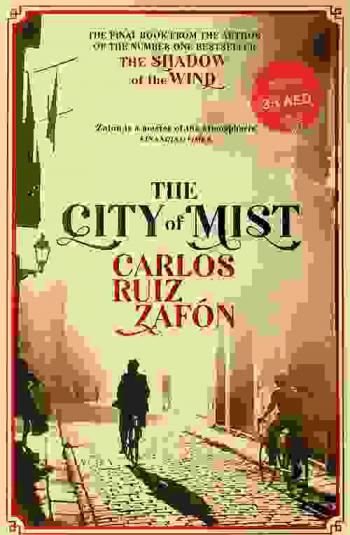
The city of mist
Comprising eleven stories, most never before published in English, The City of Mist is Ruiz Zafon's tribute to the countless thousands of readers who joined him on the extraordinary journey through the mysterious gothic world of his beloved Cemetery of Forgotten Books quartet. A boy decides to become a writer when he discovers that his creative gifts capture the attentions of an aloof young beauty who has stolen his heart. A labyrinth maker flees Constantinople to a plague ridden Barcelona, with plans for building a library impervious to the destruction of time. A strange gentleman tempts Cervantes to write a book like no other, each page of which could prolong the life of the woman he loves. And a brilliant Catalan architect named Antoni Gaudì reluctantly agrees to cross the ocean to New York, a voyage that will determine the fate of an unfinished masterpiece.

Review of Architecture in Cinema
This paper reviews the book Architecture in Cinema, which explores the multilayered relationship between architecture and cinema from both generic and historical perspectives, offering a critical framework for rethinking the role of architecture within cinematic narratives.
Journal Article