
Catalogue Search | MBRL


Are you sure you want to remove the book from the shelf?

{{itemTitle}}
18
result(s) for
"Architects Germany 20th century."
Sort by:

Walter Gropius
\"As founder of the Bauhaus school, Walter Gropius (1883-1969) is one of the icons of 20th-century architecture. While his early buildings in Pomerania were still strongly marked by his teacher Peter Behrens, after an expressionistic phase focused on handicraft, he ultimately arrived at geometric abstraction. During the entire period he collaborated with other architects, founding the collective known as \"The Architects Collaborative\" in the US. This comprehensive monograph documents all 74 of the known buildings by Gropius that were realized, including many early works which he never publicized; but it also critically examines his unbuilt projects. The book is illustrated with new photographs by the author, historical figures, and with as-new plans drawn by the author\"-- Provided by publisher.
Book

Form as Revolt
The German writer and art critic Carl Einstein (1885-1940) has long been acknowledged as an important figure in the history of modern art, and yet he is often sidelined as an enigma. InForm as RevoltSebastian Zeidler recovers Einstein's multifaceted career, offering the first comprehensive intellectual biography of Einstein in English.
Einstein first emerged as a writer of experimental prose through his involvement with the anarchist journalDie Aktion. After a few limited forays into art criticism, he burst onto the art scene in 1915 with his bookNegro Sculpture, at once a formalist intervention into the contemporary theory and practice of European sculpture and a manifesto for the sophistication of African art. Einstein would go on to publish seminal texts on the cubist paintings of Georges Braque and Pablo Picasso. His contributions to the surrealist magazineDocuments(which Einstein cofounded with Georges Bataille), including writings on Picasso and Paul Klee, remain unsurpassed in their depth and complexity. In a series of close visual analyses-illustrated with major works by Braque, Picasso, and Klee-Zeidler retrieves the theoretical resources that Einstein brought to bear on their art.Form as Revoltshows us that to rediscover Einstein's art criticism is to see the work of great modernist artists anew through the eyes of one of the most gifted left-wing formalists of the twentieth century.
eBook

Rudolf Schwarz and the monumental order of things
The product of a continuous European architectural and intellectual practice that bridged the Second World War, the work of Rudolf Schwarz (1897-1961) allows a deeper understanding of post-war German architecture. This book examines nine of his religious and secular buildings sited in the Rhineland, which are presented through new survey drawings and photographs. These are accompanied by Schwarz's project descriptions and his lecture 'Architecture of Our Times' from 1958, which contextualizes his approach. Essays by Wolfgang Pehnt and an interview with Schwarz's wife, the architect Maria Schwarz, provide further insight into this complex oeuvre.
Book

New Form, New Material and Color Scheme, the Exposed Concrete Phenomenon—The Centennial Hall in Wrocław
The aim of the article is to present the remarkable changes in architecture that took place in the 20th century. They can easily be called a revolution regarding the architectural form and the color scheme. Progress was being made through the development of reinforced concrete production methods. In the German Empire (Deutsches Kaiserreich), this material quickly found applications in more and more interesting solutions in architectural structures. In Wrocław (formerly Breslau), then located in the eastern German Empire, exceptional architectural works were realized before and after the First World War using new technology. In 1913, an unusual building was erected—the Centennial Hall, designed by Max Berg (inscribed on the UNESCO World Heritage List in 2006). Berg’s work was inspired by the works of both Hans Poelzig and Bruno Taut. On the one hand, it was a delight with the new material (the Upper Silesian Tower at the exhibition in Poznań, designed by H. Poelzig) and, on the other hand, with the colorful architecture of light and glass by B. Taut (a glass pavilion at the Werkbund exhibition in Cologne). Max Berg left the concrete in an almost “pure” form, not hiding the texture of the formwork under the plaster layer. However, stratigraphic studies of paint coatings and archival inquiries reveal a new face of this building. The research was carried out as part of the CMP (Conservation Management Plan—prepared by the authors of the article, among others) grant from The Getty Foundation Keeping It Modern program. According to the source materials, the architect intended to leave the exposed concrete outside of the building, while the interior was to be decorated with painting, stained glass, and sculpture. The stratigraphic tests showed that the external walls were covered with a translucent yellowish color coating. Thus, the Centennial Hall shows a different face of reinforced concrete architecture.
Journal Article


Open Architecture
The International Building Exhibition 1984/87 in Berlin constitutes one of the most remarkable examples to discuss \"open architecture\".Almost 10,000 dwellings were constructed or restored in the Kreuzberg districts adjacent to the Berlin Wall, inhabited about halfway by immigrants.
eBook


Art and the German Bourgeoisie
In this new study of art in fin-de-siècle Hamburg, Carolyn Kay examines the career of the city's art gallery director, Alfred Lichtwark, one of Imperial Germany's most influential museum directors and a renowned cultural critic. A champion of modern art, Lichtwark stirred controversy among the city's bourgeoisie by commissioning contemporary German paintings for the Kunsthalle by secession artists and supporting the formation of an independent art movement in Hamburg influenced by French impressionism. Drawing on an extensive amount of archival research, and combining both historical and art historical approaches, Kay examines Lichtwark's cultural politics, their effect on the Hamburg bourgeoisie, and the subsequent changes to the cultural scene in Hamburg.
Kay focuses her study on two modern art scandals in Hamburg and shows that Lichtwark faced strong public resistance in the 1890s, winning significant support from the city's bourgeoisie only after 1900. Lichtwark's struggle to gain acceptance for impressionism highlights conflicts within the city's middle class as to what constituted acceptable styles and subjects of German art, with opposition groups demanding a traditional and 'pure' German culture. The author also considers who within the Hamburg bourgeoisie supported Lichtwark, and why. Kay's local study of the debate over cultural modernism in Imperial Germany makes a significant contribution both to the study of modernism and to the history of German culture.
eBook
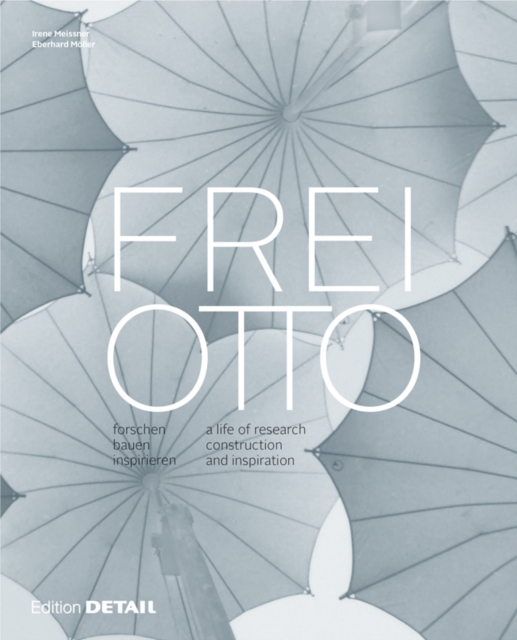
Frei Otto: forschen, bauen, inspirieren = a life of research, construction and inspiration
A depiction of his most important works New forms of lightweight and adaptable construction Insight into interdisciplinary research projects Frei Otto's work as a source of inspiration for architects and engineers worldwide No other architect provided as many ideas and inspiration to construction in the second half of the 20th century as Frei Otto. Lord Norman Foster described this great pioneer of lightweight construction simply as \"an inspiration\". Frei Otto explored the foundations of resource and energy-efficient building well before these issues received the attention of the wider public. By including users in construction planning and taking into account local and climatic conditions, he opened new avenues for the building industry. To celebrate his 90th birthday, the publication provides insights on the key aspects of his work. At its heart was the search for natural designs and an exploration of form-finding and self-development processes. As such he created a whole universe of ideas using membrane, net and convertible roofs with umbrellas, grid shells, and pneumatic structures. The book introduces his key works and highlights how his ideas were adopted and continued throughout the world.
eBook

Max Pechstein
Max Pechstein (1881–1955) is one of the most prominent German artists of the twentieth century, not least because of his crucial role in the breakthrough of German Expressionism. This long overdue biography combines the portrayal of an outstanding artistic personality with the story of an individual German who struggled through the political upheavals of his time. Pechstein's work is presented in the cultural context of museum politics and art associations, art dealers and critics, market forces and cultural trends.
eBook