
Catalogue Search | MBRL


Are you sure you want to remove the book from the shelf?

{{itemTitle}}
1,748
result(s) for
"Architectural acoustics"
Sort by:

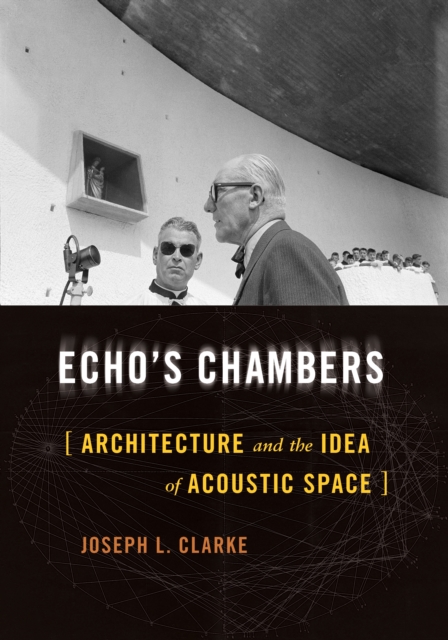
Echo's Chambers
A room's acoustic character seems at once the most technical and
the most mystical of concerns. Since the early Enlightenment,
European architects have systematically endeavored to represent and
control the propagation of sound in large interior spaces. Their
work has been informed by the science of sound but has also been
entangled with debates on style, visualization techniques,
performance practices, and the expansion of the listening public.
Echo's Chambers explores how architectural experimentation
from the seventeenth through the mid-twentieth centuries laid the
groundwork for concepts of acoustic space that are widely embraced
in contemporary culture. It focuses on the role of echo and
reverberation in the architecture of Pierre Patte, Claude-Nicolas
Ledoux, Carl Ferdinand Langhans, and Le Corbusier, as well as the
influential acoustic ideas of Athanasius Kircher, Richard Wagner,
and Marshall McLuhan. Drawing on interdisciplinary theories of
media and auditory culture, Joseph L. Clarke reveals how
architecture has impacted the ways we continue to listen to, talk
about, and creatively manipulate sound in the physical environment.
eBook


The Historical Building and Room Acoustics of the Stockholm Public Library (1925–28, 1931–32)
The Stockholm Public Library was realized in two distinct phases of construction in the 1920s and early 1930s, and remains a well-known work in twentieth-century architecture, with a heritage status today. While previous studies have focused on the library’s architectural design, particularly its lighting, acoustics were also an important aspect of the building’s design and construction. This study marks the first detailed investigation of the library’s architectural acoustics, with a suite of standard measurements performed to assess and characterize the library’s historical room and building acoustics. Reverberation time measurements in the library’s reading rooms yielded results of about 1.5–2 s for frequencies associated with speech. A significantly longer reverberation time of 5–6 s was measured in the library’s central rotunda, confirming a prominent acoustic issue in the library, where appropriate heritage discussions are needed in the future as the library undergoes a major renovation in the coming years. A comparison of the measured airborne and impact sound insulation of the 1920s and 1930s reading room ceilings also yielded interesting results. While the materials in library’s two construction periods are notably different, the airborne sound insulation performance of the 1920s and 1930s floors or ceilings was comparable and in line with contemporary standards. Impact sound insulation results from the 1920s and 1930s floors, however, differed significantly, with the latter displaying a relatively poor performance. Flanking transmission effects related to historical construction details and deviations from archival plans were investigated and discussed. This work emphasizes the practical and academic importance of conducting on-site measurements, and the close mutual development of modern architecture, construction, and architectural acoustics.
Journal Article

Auditive Räume des alten Ägypten
In Auditive Räume des alten Ägypten Erika Meyer-Dietrich explores the sonic aspects of culture in the 18th Dynasty (1550-1290 BCE). She shows how, through sound sequences and the creation or omission of sounds, auditive spaces are given social and religious significance.
eBook

Worship sound spaces : architecture, acoustics and anthropology
\"Worship Sound Spaces unites specialists from architecture, acoustic engineering and the social sciences to encourage closer analysis of the sound environments within places of worship. Gathering a wide range of case studies set in Europe, Asia, North America, the Middle East, and Africa, the book presents investigations into Muslim, Christian and Hindu spaces. These diverse cultural contexts demonstrate the composite nature of designing and experiencing places of worship. Beginning with a historical overview of the three primary indicators in acoustic design of religious buildings, reverberation, intelligibility and clarity, the second part of this edited collection offers a series of field studies devoted to perception, before moving onto recent examples of restoration of the sound ambiances of former religious buildings. Written for academics and students interested in architecture, cultural heritage, acoustics, sensory studies and sound\"-- Provided by publisher.
Book

Auditorium Acoustics and Architectural Design
Modern concert halls and opera houses are now very specialized buildings with special acoustical characteristics. With new contemporary case-studies, this updated book explores these characteristics as an important resource for architects, engineers and auditorium technicians.
Supported by over 40 detailed case studies and architectural drawings of 75 auditoria at a scale of 1:500, the survey of each auditorium type is completed with a discussion of current best practice to achieve optimum acoustics.
Michael Barron is a senior lecturer at the University of Bath Department of Architecture and Civil Engineering and partner of Fleming & Barron acoustic consultants. He has been involved over many years in acoustic consultancy and research, of which a key project was an Acoustic Survey of British Auditoria. In 2006 he received the Rayleigh medal, the premier award of the (British) Institute of Acoustics.
1. Introduction 2. Sound and Rooms 3. Acoustics for the Symphony Concert Hall 4. The Development of the Concert Hall 5. British Concert Halls and Conclusions for Concert Hall Acoustics 6. Chamber Music and Recital Halls 7. Acoustics for Speech 8. Theatre Acoustics 9. Acoustics for Opera 10. Acoustics for Multi-Purpose Use 11. Multi-Purpose Halls in Britain 12. The Art and Science of Acoustics Appendix A: Sound Reflection and Reverberation Calculation Appendix B: Objective Measures for Music Auditoria Appendix C: Further Objective Results in Concert Halls Appendix D: Objective Measures for Speech Auditoria
eBook


Architectures of sound : acoustic concepts and parameters for architectural design
Architekten sind es gewohnt, visuell zu entwerfen. Um ihre Entwurfsgrundlagen zu erweitern, stellt dieses Buch die Zusammenhänge zwischen Klang, Raum, Hören und Architektur dar. Dafür nutzt der Autor zeitgenössische wie historische Bauten und Projekte, aber auch fiktionale, philosophische und theoretische Ansätze: schliesslich soll der Klang nicht nur als Quelle, sondern auch als Instrument des architektonischen Raums definiert werden. Durch die Einführung in eine Metatheorie des „kritischen Hörens\" können die Entwerfenden ihre Projekte bereits in der Entwurfsphase akustisch prüfen und auditiv gestalten.
Architects are used to designing visually. In order to expand their basic design tools, this book explores the interactions between sound, space, hearing, and architecture. To this end, the author uses contemporary and historic buildings and projects, but also fictional, philosophical, and theoretical approaches – the idea is not only to define sound as a source, but also as an instrument of architectural space. By introducing a metatheory of \"critical hearing\", designers are able to acoustically test their projects and contribute to their design with auditive input, already at the design stage.
eBook