
Catalogue Search | MBRL


Are you sure you want to remove the book from the shelf?

{{itemTitle}}
10
result(s) for
"Architecture, Classical Turkey."
Sort by:
Art and Identity in Thirteenth-Century Byzantium
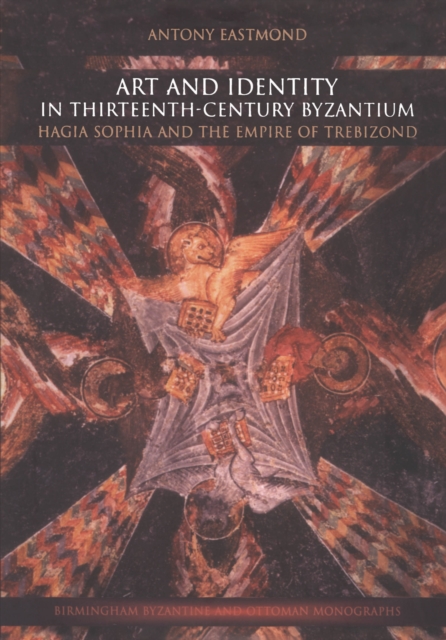
The church of Hagia Sophia in Trebizond, built by the emperor Manuel I Grand Komnenos (1238-63) in the aftermath of the fall of Constantinople to the Fourth Crusade, is the finest surviving Byzantine imperial monument of its period. Art and Identity in Thirteenth-Century Byzantium is the first investigation of the church in more than thirty years, and is extensively illustrated in colour and black-and-white, with many images that have never previously been published. Antony Eastmond examines the architectural, sculptural and painted decorations of the church, placing them in the context of contemporary developments elsewhere in the Byzantine world, in Seljuq Anatolia and among the Caucasian neighbours of Trebizond. Knowledge of this area has been transformed in the last twenty years, following the collapse of the Soviet Union. The new evidence that has emerged enables a radically different interpretation of the church to be reached, and raises questions of cultural interchange on the borders of the Christian and Muslim worlds of eastern Anatolia, the Caucasus and Persia. This study uses the church and its decoration to examine questions of Byzantine identity and imperial ideology in the thirteenth century. This is central to any understanding of the period, as the fall of Constantinople in 1204 divided the Byzantine empire and forced the successor states in Nicaea, Epiros and Trebizond to redefine their concepts of empire in exile. Art is here exploited as significant historical evidence for the nature of imperial power in a contested empire. It is suggested that imperial identity was determined as much by craftsmen and expectations of imperial power as by the emperor's decree; and that this was a credible alternative Byzantine identity to that developed in the empire of Nicaea.
Contents: Preface; Introduction: the Byzantine empires in the 13th century; Hagia Sophia and its contexts; Architecture and the construction of identity; Trebizond as imperial capital: ceremonial and processions; Adam, exile and 'Byzantine' culture; Ornamental sculpture and cultural orientation: Trebizond, the Seljuqs, and the Caucasus; Wall paintings and politics: rebuilding empire?; Art, the liturgy and modernity; Manuel I Grand Komnenos: the embodiment of empire; Conclusion; Appendix of rulers; Bibliography; Index.
Antony Eastmond is Reader in the History of Byzantine Art at the Courtauld Institute of Art, University of London, UK
eBook
Antiochia in der Spätantike
This public lecture is staged annually in memory of the ecclesiastic historian Hans Lietzmann (1875–1942), Adolf von Harnacks's successor as director of the Academy project The Greek Christian Authors of the First Centuries (GDS). The invited speaker is an internationally renowned scholar from the field of archeology, classical studies, history of religion, and patristics. The lectures address central topics of the history of ancient religion that are of relevance to the present day.
eBook
Constantine of Rhodes, on Constantinople and the Church of the Holy Apostles
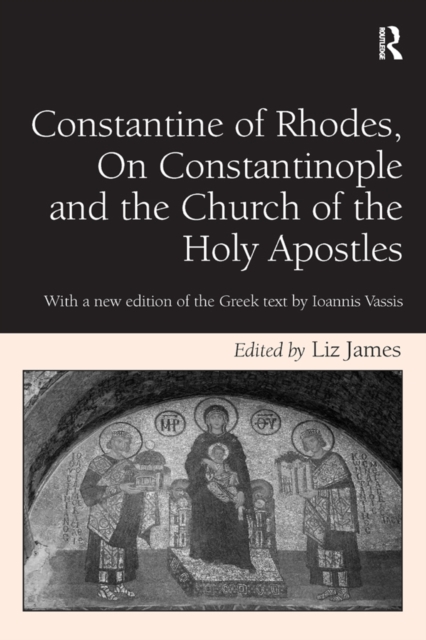
Constantine of Rhodes's tenth-century poem is an account of public monuments in Constantinople and of the Church of the Holy Apostles. In the opening section of the work, Constantine describes columns and sculptures within the city, seven of which he calls 'wonders'. In the second part of the poem, he portrays the Church of the Holy Apostles, offering an account of its architecture and internal decoration, notably the mosaics, seven of which are also depicted as 'wonders'. On one level, the poem offers an account of what was visible, a sense of city topography and, in the case of the Apostoleion, a vital description of a now-lost building. But it cannot be read as a straightforward description. Rather, Constantine's work offers insights into Byzantine perceptions of works of art. The monuments Constantine decided to portray and the ways in which he chose to describe them say as much, if not more, about the social and cultural milieu in which he operated as about the actual physical appearance of the monuments themselves. Further, the poem itself, as it survives in one fifteenth-century manuscript, raises questions: is it, in its current form, a single poem or is it made up of a compilation of Constantine's writings?
eBook

The Theatre of Diokaisareia
On the southern fringes of the Taurus mountains, in the modern town of Uzuncaburc, lie the ruins of the Hellenistic temple of Zeus-Olbios and of the ancient city of Diocaesarea. The impressive architectural remains reflect the turbulent history of the ancient site. In the Hellenistic period the extra-urban sanctuary was the centre of power of an extensive temple state, while in the early Roman Empire a city was established around the temple that blossomed until the 7th century AD. In 2001-2006 a record of all surface finds and a detailed documentation of buildings were made by an international team of archaeologists, architectural experts and historians. The series of monographs presents individual groups of material and building complexes, so offering an important contribution on the history of settlement in ancient Asia Minor and the development of ancient architecture. The series will probably consist of five volumes: Volume I: Norbert Kramer, The Ceramic Survey (2012) Volume II: Marcello Spanu, The Theatre (2011) Volume III: Johannes Linnemann, The Necropoleis (2013) The next volume planned is Volume IV: Detlev Wannagat, The Sanctuary of Zeus-Olbios.
eBook
Antiochia in der Spätantike
Diese öffentliche Vorlesung wird jährlich veranstaltet im Andenken an den Kirchenhistoriker Hans Lietzmann (1875-1942), den Nachfolger Adolf von Harnacks als Leiter des Akademienunternehmens Die Griechischen Christlichen Schriftsteller der ersten Jahrhunderte (GCS). Es wird dazu jeweils ein international bedeutender Referent aus dem Bereich der Altertumswissenschaften eingeladen. Die Vorträge behandeln zentrale Themen der antiken Religionsgeschichte mit einer Bedeutung für die Gegenwart.
eBook
Diokaisareia in Kilikien
The theatre of Diokaisareia (Cilicia, Asia Minor) has been partially excavated in 1993 by a team of Turkish archaeologists, when a large part of the cavea and part of the scaena have been brought to light. On this occasion many elements of the architectural decoration were uncovered and a significant fragment of the dedicatory inscription was rediscovered. This text allows to date the building during the principate of Marcus Aurelius and Lucius Verus, making this theatre the only dated monument so far in Roman Cilicia. Now the remains have been studied within the German research project directed by Detlev Wannagat. The purpose of the volume is to make a complete survey of the main architectural features of the theatre. Starting from the collation of travellers' notes and photographs, in breadth and detail Marcello Spanu analyses and illustrates all available data. The study provides a detailed survey of the ancient structures and a thorough catalogue of all the preserved architectural elements, accompanied by an accurate graphic and photographic documentation. Starting from these data, the author proposes the reconstruction of the monument, taking into account its main features and its situation within the ancient city's topographic layout. The book offers new light on the researches on Cilicia and on Asia Minor, proposing new hypothesis on architecture of ancient theatres and on architectural decoration history.
eBook

Samothracian Connections
This volume of sixteen papers is dedicated to James R. McCredie in celebration of his outstanding contribution to the excavation and study of the sanctuary of the Great Gods on the Greek island of Samothrace. The papers focus mainly on the art and archaeology of Samothrace, while two contributions discuss Alexandria in Egypt and Florina in Macedonia, two areas that were closely connected with Samothrace in antiquity. The volume covers the latest research on the architecture, sculpture, pottery, epigraphy and cult of the sanctuary of the Great Gods on Samothrace, and contains many original architectural drawings and photos of previously unpublished material.
eBook

Asia Minor
This chapter contains sections titled:
Introduction
Ionian Migration
Temples: An Exemplary Form of Greek Art and Architecture
Ionian, Phrygian, and Lydian Sculpture and Art
The Classical Period
The Hellenization of Dynastic Lycia
Alexander the Great and the Hellenistic Kingdoms
Sagalassos: From Rural Settlement to Hellenized Greek City
Further Reading
Book Chapter

Before the flood
The hurried evacuation of still-pristine ancient Roman treasures from Zuegma, a city in southeastern Turkey, to make room for a hydroelectric dam, is discussed. Although as much as half of the city's still-buried remains could remain above water, a full understanding of the society will forever be lost.
Magazine Article