
Catalogue Search | MBRL


Are you sure you want to remove the book from the shelf?

{{itemTitle}}
1,283
result(s) for
"Architecture, Gothic."
Sort by:

Late Gothic architecture : its evolution, extinction, and reception
In this book, Robert Bork offers a sweeping reassessment of late Gothic architecture and its fate in the Renaissance. In a chronologically organized narrative covering the whole of western and central Europe, he demonstrates that the Gothic design tradition remained inherently vital throughout the fourteenth and fifteenth centuries, creating spectacular monuments in a wide variety of national and regional styles. Bork argues that the displacement of this Gothic tradition from its long-standing position of artistic leadership in the years around 1500 reflected the impact of three main external forces: the rise of a rival architectural culture that championed the use of classical forms with a new theoretical sophistication; the appropriation of that architectural language by patrons who wished to associate themselves with papal and imperial Rome; and the chaos of the Reformation, which disrupted the circumstances of church construction on which the Gothic tradition had formerly depended. Bork further argues that art historians have much to gain from considering the character and fate of late Gothic architecture, not only because the monuments in question are intrinsically fascinating, but also because examination of the way their story has been told?and left untold, in many accounts of the \"Northern Renaissance\" can reveal a great deal about schemes of categorization and prioritization that continue to shape the discipline even in the twenty-first century.
Book
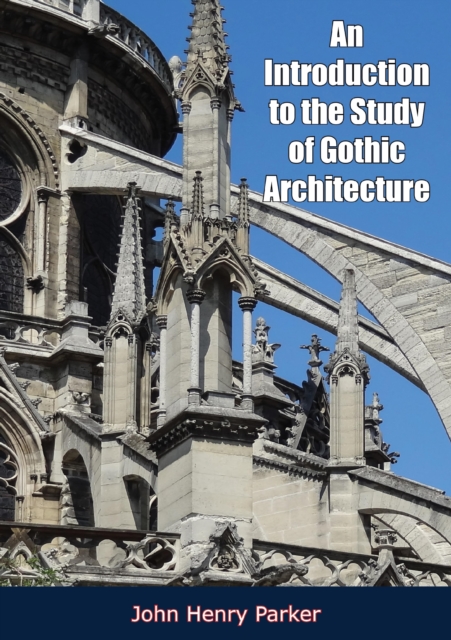
An Introduction to the Study of Gothic Architecture
This popular and important textbook of Gothic architecture, first published in 1849, which ran to at least sixteen editions. The book is divided into the main body of the text, with mostly English examples of the various periods, and a section on foreign styles (French Gothic, Italian, Spanish, Swiss, Belgian, German).-Print ed. John Henry Parker CB (1 March 1806 – 31 January 1884) was an English archaeologist and writer on architecture and publisher. He was born in London, the son of John Parker, a merchant there. He was educated at Manor House School, Chiswick, and was apprenticed in 1821 to his uncle, the Oxford bookseller Joseph Parker (1774?–1850). He succeeded to his uncle's business in 1832, and ran the firm with great success, the most important of his publications being perhaps the series of the Oxford pocket classics. In 1836 he published his Glossary of terms used in Grecian, Roman, Italian, and Gothic architecture, which, published during the Gothic Revival in England, had considerable influence in extending the movement, and supplied valuable inspiration to young architects. In 1848 he edited the fifth edition of Thomas Rickman's Gothic architecture, and in 1849 he published a handbook based on his earlier volume entitled Introduction to the study of Gothic architecture. The completion of Hudson Turner's Domestic architecture of the Middle Ages next engaged his attention, three volumes being published (1853–60). He published Medieval architecture of Chester in 1858 and Architectural antiquities of the city of Wells in 1866. Parker was one of the chief advocates of the restoration of ecclesiastical buildings. In 1863 he and the Oxford Diocesan Architect G.E. Street revised plans for the restoration of St. Andrew's parish church, Chinnor. Parker also designed the triplet of traceried lancet windows in the chancel of St. Nicholas the Confessor, Forest Hill. His son James Parker (1832 or 1833–1912) also practiced as an architect.
eBook

Gothic antiquity : history, romance, and the architectural imagination, 1760-1840
Gothic Antiquity: History, Romance, and the Architectural Imagination, 1760-1840' provides the first sustained scholarly account of the relationship between Gothic architecture and Gothic literature (fiction; poetry; drama) in the late eighteenth and early nineteenth centuries. Although the relationship between literature and architecture is a topic that has long preoccupied scholars of the literary Gothic, there remains, to date, no monograph-length study ofthe intriguing and complex interactions between these two aesthetic forms. Equally, Gothic literature has received only the most cursory of treatments in art-historical accounts of the early Gothic Revival in architecture, interiors, and design. In addressing this gap in contemporary scholarship, 'Gothic Antiquity' seeks to situate Gothic writing in relation to the Gothic-architectural theories, aesthetics, and practices with which it was contemporary, providing closely historicized readings of a wide selection of canonical and lesser-known texts and writers. 0Correspondingly, it shows how these architectural debates responded to, and were to a certain extent shaped by, what we have since come to identify as the literary Gothic mode. In both its 'survivalist' and 'revivalist' forms, the architecture of the Middle Ages in the long eighteenth century was always much more than a matter of style. 0Incarnating, for better or for worse, the memory of a vanished 'Gothic' age in the modern, enlightened present, Gothic architecture, be it ruined or complete, prompted imaginative reconstructions of thenation's past-a notable 'visionary' turn, as the antiquary John Pinkerton put it in 1788, in which Gothic writers, architects, and antiquaries enthusiastically participated. 0.
Book

Toledo Cathedral : building histories in medieval castile
Medieval Toledo is famous as a center of Arabic learning and as a home to sizable Jewish, Muslim, and Christian communities. Yet its cathedral—one of the largest, richest, and best preserved in all of Europe—is little known outside Spain. In Toledo Cathedral, Tom Nickson provides the first in-depth analysis of the cathedral's art and architecture. Focusing on the early thirteenth to the late fourteenth centuries, he examines over two hundred years of change and consolidation, tracing the growth of the cathedral in the city as well as the evolution of sacred places within the cathedral itself. He goes on to consider this substantial monument in terms of its location in Toledo, Spain's most cosmopolitan city in the medieval period. Nickson also addresses the importance and symbolic significance of Toledo's cathedral to the city and the art and architecture of the medieval Iberian Peninsula, showing how it fits in with broader narratives of change in the arts, culture, and ideology of the late medieval period in Spain and in Mediterranean Europe as a whole.
eBook
The stones of Venice : introductory chapters and local indices (printed separately) for the use of travellers while staying in Venice and Verona
\"The Stones of Venice examines Venetian architecture in detail, describing for example over eighty churches. He discusses architecture of Venice's Byzantine, Gothic and Renaissance periods, and provides a general history of the city\"--Wikipedia, June 24, 2019. https://en.wikipedia.org/wiki/The_Stones_of_Venice_(book)
Unknown

Gothic architecture and sexuality in the circle of Horace Walpole
Gothic Architecture and Sexuality in the Circle of Horace Walpole shows that the Gothic style in architecture and the decorative arts and the tradition of medievalist research associated with Horace Walpole (1717–1797) and his circle cannot be understood independently of their own homoerotic culture. Centered around Walpole's Gothic villa at Strawberry Hill in Twickenham, Walpole and his \"Strawberry Committee\" of male friends, designers, and dilettantes invigorated an extraordinary new mode of Gothic design and disseminated it in their own commissions at Old Windsor and Donnington Grove in Berkshire, Lee Priory in Kent, the Vyne in Hampshire, and other sites. Matthew M. Reeve argues that the new \"third sex\" of homoerotically inclined men and the new \"modern styles\" that they promoted—including the Gothic style and chinoiserie—were interrelated movements that shaped English modernity. The Gothic style offered the possibility of an alternate aesthetic and gendered order, a queer reversal of the dominant Palladian style of the period. Many of the houses built by Walpole and his circle were understood by commentators to be manifestations of a new queer aesthetic, and in describing them they offered the earliest critiques of what would be called a \"queer architecture.\" Exposing the role of sexual coteries in the shaping of eighteenth-century English architecture, this book offers a profound and eloquent revision to our understanding of the origins of the Gothic Revival and to medievalism itself. It will be welcomed by architectural historians as well as scholars of medievalism and specialists in queer studies.
eBook


Gothic Pride
Newark's Cathedral Basilica of the Sacred Heart is one of the United States' greatest cathedrals and most exceptional Gothic Revival buildings. Rising from Newark's highest ground and visible for miles, it spectacularly evokes its historic models.Gothic Pridesets Sacred Heart in the context of American cathedral building and, blending diverse fields, accounts for the complex circumstances that produced it.
Calling upon a wealth of primary sources, Brian Regan describes in a compelling narrative the cathedral's almost century-long history. He traces the project to its origins in the late 1850s and the great expectations held by the project's prime movers-all passionate about Gothic architecture and immensely proud of Newark-that never wavered despite numerous setbacks and challenges. Construction did not begin until 1898 and, when completed in 1954, the cathedral became New Jersey's largest church-and the most expensive Catholic church ever built in America. During Pope John Paul II's visit to the United States in 1995, he celebrated evening prayer at the Cathedral. On that occasion, the Cathedral of the Sacred Heart was elevated to a basilica to become the Cathedral Basilica of the Sacred Heart.
Meticulously researched,Gothic Pridebrings to life the people who built, contributed to, and worshipped in Sacred Heart, recalling such remarkable personalities as George Hobart Doane, Jeremiah O'Rourke, Gonippo Raggi, and Archbishop Thomas Walsh. In many ways, the cathedral's story is a lens that lets us look at the history of Newark itself-its rise as an industrial city and its urban culture in the nineteenth century; its transformation in the twentieth century; its immigrants and the profound effects of their cultures, especially their religion, on American life; and the power of architecture to serve as a symbol of community values and pride..
eBook


Paper Thin? The Evidence for 12th-Century Gothic Design Drawings
No Gothic design drawings on paper or parchment have survived from the 12th century, and only a few have survived from the 13th century. For this reason, most recent scholars tend to concur at least broadly with Robert Branner, who argued in an influential 1963 article that such drawings were first produced only after 1200. This conclusion deserves critical re-examination, however, for two principal reasons. First, the continuity of the Gothic architectural tradition in both time and space strongly suggests that early Gothic builders used similar techniques to those used by their late Gothic successors. From this perspective, the lack of surviving design drawings from before 1200 seems likely to reflect their disappearance over time, rather than their not being used in the crucial period when the conventions of Gothic design and construction were first coming into focus. A second argument for the use of drawings in the 12th century comes from consideration of early Gothic buildings, whose complex and carefully calibrated forms would be literally inconceivable without such graphic aids. Churches such as Saint-Denis Abbey and Notre-Dame in Paris, for example, already display a level of geometrical sophistication and coherence that argues strongly for the use of scaled drawings in their original conception.
Journal Article