Catalogue Search | MBRL


Are you sure you want to remove the book from the shelf?

{{itemTitle}}
8
result(s) for
"Architecture, Mameluke Egypt."
Sort by:

Muslim Fortresses in the Levant
During much of the twelfth century the Crusaders dominated the military scene in the Levant. The unification of Egypt and Syria by Saladin gradually changed the balance of power, which slowly begun to tilt in favour of the Muslims. This book examines the development and role of Muslim fortresses in the Levant at the time of the Crusaders and the Mongol invasion, situating the study within a broad historical, political and military context.
Exploring the unification of Egypt with a large part of Syria and its effect on the balance of power in the region, Raphael gives a historical overview of the resulting military strategies and construction of fortresses. A detailed architectural analysis is based on a survey of four Ayyubid and eight Mamluk fortresses situated in what are today the modern states of Jordan, Israel, Southern Turkey and Egypt (the Sinai Peninsula). The author then explores the connection between strongholds or military architecture, and the development of siege warfare and technology, and examines the influence of architecture and methods of rule on the concept of defence and the development of fortifications.
Drawing upon excavation reports, field surveys and contemporary Arabic sources, the book provides the Arabic architectural terminology and touches on the difficulties of reading the sources. Detailed maps of the fortresses in the region, the Mongol invasion routs, plans of sites and photographs assist the reader throughout the book, providing an important addition to existing literature in the areas of Medieval Archaeology, Medieval military history and Middle Eastern studies.
Kate Raphael is a postdoctoral researcher in the Department of Earth and Sciences at the Hebrew University of Jerusalem, Israel. She received her PhD in Medieval Islamic studies at the Hebrew University of Jerusalem, and her research currently focuses on environmental disasters in the Medieval Middle East.
Introduction 1. Ayyubid Fortresses in the Late Twelfth and Early Thirteenth Centuries: Muslims' Apprenticeship 2. Mongolian Siege Warfare and the Defense of Mamluk Fortresses 3. Laying the Foundations: Fortification Work Conducted during the Reign of Baybars (1260-1277), Qalāwūn (1280-1290) and Al-Ashraf Khalīl (1290-1293) 4. Mamluk Power on Display: Fortifications in the Second Half of the Thirteenth Century 5. Military Architecture versus Political and Military Organization
eBook

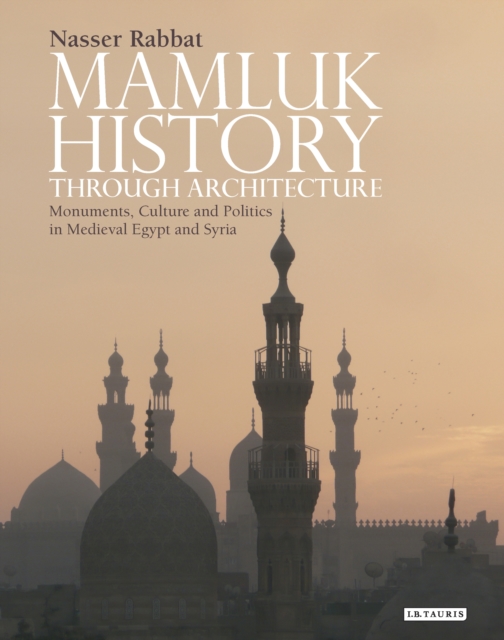
Mamluk History Through Architecture
The most enduring testament to the Mamluk Sultanate is its architecture. Not only do Mamluk buildings embody one of the most outstanding medieval architectural traditions, Mamluk architecture is actually a key to the social history of the period. Analysing Mamluk constructions as a form of communication and documentation as well as a cultural index, “Mamluk History Through Architecture” shows how the buildings mirror the complex - and historically unique - military, political, social and financial structures of Mamluk society. With this original and authoritative study, Nasser Rabbat offers an innovative approach to the history of the Mamluks - through readings of the spectacular architecture of the period. Drawing on examples from throughout both Egypt and Syria, from the Citadel and Al-Azhar Mosque of Cairo to the Mausoleum of al-Zahir Baybars in Damascus, Rabbat demonstrates how Mamluk architecture served to reinforce visually the spirit of the counter-Crusade, when the Muslim world rebounded from the setbacks of the First Crusade. Both holistically and in case studies, Rabbat demonstrates how history is inscribed into and reflected by a culture’s artefacts.
This is a groundbreaking work in the study of architecture and social history in the Middle East and beyond.
eBook
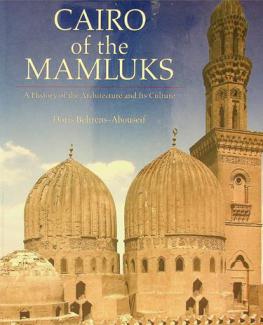

Cairo of the Mamluks : a history of the architecture and its culture
The Arab philosopher Ibn Khaldun described Cairo under the Mamluks as \"\"a city beyond imagination\"\". The Mamluk sultans originated as a slave-based caste rose to rule in the mid-13th century. Accordingly, they designed their capital to be the heart of the Muslim world. It became the focus of their enormous patronage of art and architecture, the stage for their ceremonial rituals, and a memorial to their achievements. This history of Mamluk architecture spans three centuries and examines the monuments of the Mamluks in their social, political and urban context, during the period of their rule (1250-1517). The book displays the multiple facets of Mamluk patronage, and also provides a succinct discussion of the sixty key monuments built in Cairo by the Mamluk sultans. The unique strength of Doris Abouseif s work lies in its scholarly yet engaging presentation of original material, diligently researched in the waqf (Islamic endowments) archives including architectural plans and personal records. A richly illustrated volume with colour photographs, plans and isometric drawings, it will be an essential reference work for scholars and students of the art and architecture of the Islamic world as well as art historians and historians of late medieval Islamic history. -- Amazon.com.
BOOK