
Catalogue Search | MBRL


Are you sure you want to remove the book from the shelf?

{{itemTitle}}
4,967
result(s) for
"Architecture Environmental aspects."
Sort by:


Nature by design : the practice of biophilic design
Biophilia is the theory that people possess an inherent affinity for nature, which developed during the long course of human evolution. In recent years, studies have revealed that this inclination continues to be a vital component to human health and wellbeing. Given the pace and scale of construction today with its adversarial, dominative relationship with nature, the integration of nature with the built environment is one of the greatest challenges of our time. In this sweeping examination, Stephen Kellert describes the basic principles, practices, and options for successfully implementing biophilic design. He shows us what is-and isn't-good biophilic design using examples of workplaces, healthcare facilities, schools, commercial centers, religious structures, and hospitality settings. This book will to appeal to architects, designers, engineers, scholars of human evolutionary biology, and-with more than one hundred striking images of designs-anyone interested in nature-inspired spaces.
eBook


Design for a Vulnerable Planet
We inhabit a vulnerable planet. The devastation caused by natural disasters such as the southern Asian tsunami, Hurricanes Katrina and Ike, and the earthquakes in China's Sichuan province, Haiti, and Chile—as well as the ongoing depletion and degradation of the world's natural resources caused by a burgeoning human population—have made it clear that \"business as usual\" is no longer sustainable. We need to find ways to improve how we live on this planet while minimizing our impact on it. Design for a Vulnerable Planet sounds a call for designers and planners to go beyond traditional concepts of sustainability toward innovative new design that fosters regeneration and resilience. Drawing on his own and others' experiences across three continents, Frederick Steiner advocates design practice grounded in ecology and democracy and informed by critical regionalism and reflection. He begins by establishing the foundation for a more ecological approach to planning and design, adopting a broad view of ecology as encompassing human and natural, urban and wild environments. Steiner explores precedents for human ecological design provided by architect Paul Cret, landscape architect Ian McHarg, and developer George Mitchell while discussing their planning for the University of Texas campus, the Lake Austin watershed, and The Woodlands. Steiner then focuses on emerging Texas urbanism and extends his discussion to broader considerations beyond the Lone Star State, including regionalism, urbanism, and landscape in China and Italy. He also examines the lessons to be learned from human and natural disasters such as 9/11, Hurricane Katrina, and the BP oil spill. Finally, Steiner offers a blueprint for designing with nature to help heal the planet's vulnerabilities.
eBook

Basics climate-friendly planning and building
The construction sector currently accounts for a high proportion of CO2 emissions and gray energy use. This will have to change fundamentally if we are to prevent catastrophic climate change and make urban planning and construction fit for the future. In addition to a paradigm shift in how architects work, we need to rethink how they are trained in higher education. Based on a lifecycle approach and an awareness of resource consumption, this volume in the 'Basics' series explains a wide range of climate-friendly concepts in an easy-to-understand way, inspiring readers to take a closer look at solutions and new approaches in their daily practice. The key factors involved in the various planning stages of buildings are presented and placed in the context of the overall planning.
Book


Vibrant architecture : matter as a codesigner of living structures
\"This book sets out the conditions under which the need for a new approach to the production of architecture in the twenty-first century is established, where our homes and cities are facing increasing pressures from environmental challenges that are compromising our lives and well being. Vibrant architecture embodies a new kind of architectural design practice that explores how lively materials, or 'vibrant matter', may be incorporated into our buildings to confer on them some of the properties of living things, such as movement, growth, sensitivity and self-repair. The theoretical and practical implications of how this may occur are explored through the application of a new group of materials. Characteristically, these substances possess some of the properties of living systems but may not have the full status of being truly alive. They include forms of chemical artificial life such as 'dynamic droplets' or synthetically produced soils. As complex systems, they are able to communicate directly with the natural world using a shared language of chemistry and so, negotiate their continued survival in a restless world. Vibrant architecture may create new opportunities for architectural design practice that venture beyond top-down form-finding programs, by enabling architects to co-design in partnership with human and nonhuman collectives, which result from the production of post natural landscapes. Ultimately, vibrant architecture may operate as an ecological platform for human development that augments the liveliness of our planet, rather than diminishes it\"--Provided by publisher.
Book
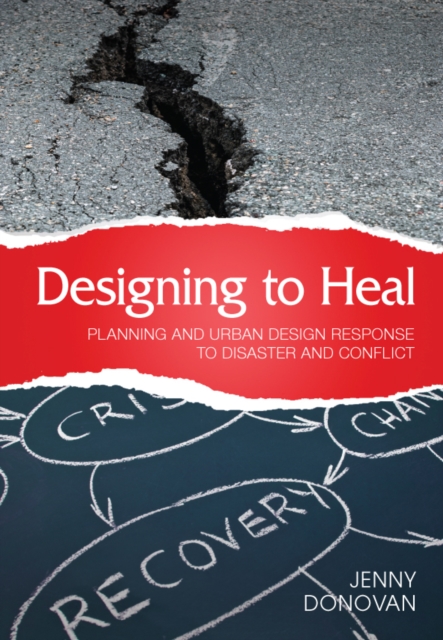
Designing to Heal
Designing to Heal explores what happens to communities that have suffered disasters, either natural or man-made, and what planners and urban designers can do to give the affected communities the best possible chance of recovery. It examines the relationship that people have with their surroundings and the profound disruption to people's lives that can occur when that relationship is violently changed; when the familiar settings for their lives are destroyed and family, friends and neighbours are displaced, incapacitated or killed. The book offers a model of the healing process, outlining the emotional journey that people go on as they struggle to rebuild their lives. It outlines the characteristics of the built environment that may facilitate people to travel as smoothly as possible down this road to recovery and suggests elements of the design process that can help achieve this goal. Designing to Heal highlights the importance of thinking about urban design as a way of nurturing hope and creating the optimal conditions to achieve social objectives.
eBook


Form Follows Energy
Architektur ist Energie. Architektonische Entwürfe entscheiden oft für Jahrzehnte und manchmal Jahrhunderte über den damit verbundenen Energie- und Materialverbrauch. Form Follows Energy analysiert das Verhältnis zwischen Energieströmen und der Form unserer gebauten Umwelt. Es untersucht die Optimierung der Energieflüsse in Architektur und Städtebau und ermittelt daraus neue Ansätze. Die komplexen Zusammenhänge zwischen Architektur und Energie werden in Fallstudien veranschaulicht. Handgezeichnete Diagramme zeigen auf, wie Energieplanungsstrategien genutzt werden können, um maximale Energieeffizienz zu erzielen. Der Autor greift in seiner Darstellung auf fast 30 Jahre Praxis, Lehre und Forschung zurück und stellt ein komplexes Thema für Architekten und Bauingenieure leicht verständlich dar.
Architecture is energy. Lines drawn on paper to represent architectural intentions also imply decades and sometimes centuries of associated energy and material flows. Form Follows Energy is about the relationship between energy and the form of our built environment. It examines the optimisation of energy flows in building and urban design and the implications for form and configuration. It speaks to both architectural and engineering audiences and offers for the first time a truly interdisciplinary overview on the subject, explaining the complex relationships between energy and architecture in an easy to follow manner and using simple diagrams to show how energy design strategies can be used to maximize the energy performance of our built environment, while at the same time leading to new aesthetic qualities and radically new forms in architecture and urban design. Case studies are used to illustrate the theory. The books philosophy is based on the guiding principles underlying nearly 30 years work in practice, research and teaching. It is relatively easy to make something simple seem complicated. To make a complex topic seem simple and easily understandable is far more of a challenge and this is the aim of this book.
eBook