
Catalogue Search | MBRL


Are you sure you want to remove the book from the shelf?

{{itemTitle}}
141
result(s) for
"Architecture Soviet Union."
Sort by:

Behind the Iron Curtain : Confession of a Soviet Architect
\"The prominent architect Felix Novikov was born in 1927, when the famous Constructivist Konstantin Melnikov was at the peak of his career. Novikov tells the dramatic story of Soviet architecture, portraying the conditions he worked in and how he collaborated with the government and other participants during the creative process. He further explains how Soviet design and planning institutes were organized with reference to the Union of the Architects of the USSR and describes the creative ideals of his generation of architects, who are today identified as Soviet Modernists. As a time witness, his memories cannot be recounted in their whole complexity by historians. Novikov also describes some of the conditions that affected his own creative fate and that of others. This book reflects the characteristics of Soviet life and its connections to architects' professional activity. Felix Novikov?s confessions are more than that of an architect; they give a testimony to daily life in the Soviet Union from Stalin to glasnost.\" Cover page 4.
Book

Stories of House and Home
Stories of House and Homeis a social and cultural history of the massive construction campaign that Khrushchev instituted in 1957 to resolve the housing crisis in the Soviet Union and to provide each family its own apartment. Decent housing was deemed the key to a healthy, productive home life, which was essential to the realization of socialist collectivism. Drawing on archival materials, as well as memoirs, fiction, and the Soviet press, Christine Varga-Harris shows how the many aspects of this enormous state initiative-from neighborhood planning to interior design-sought to alleviate crowded, undignified living conditions and sculpt residents into ideal Soviet citizens. She also details how individual interests intersected with official objectives for Soviet society during the Thaw, a period characterized by both liberalization and vigilance in everyday life.
Set against the backdrop of the widespread transition from communal to one-family living,Stories of House and Homeexplores the daily experiences and aspirations of Soviet citizens who were granted new apartments and those who continued to inhabit the old housing stock due to the chronic problems that beset the housing program. Varga-Harris analyzes the contradictions apparent in heroic advances and seemingly inexplicable delays in construction, model apartments boasting modern conveniences and decrepit dwellings, happy housewarmings and disappointing moves, and new residents and individuals requesting to exchange old apartments. She also reveals how Soviet citizens identified with the state and with the broader project of building socialism.
eBook

CCCP : cosmic communist constructions photographed
Photographer Frederic Chaubin reveals 90 buildings sited in fourteen former Soviet Republics which express what could be considered as the fourth age of Soviet architecture. They reveal an unexpected rebirth of imagination, an unknown burgeoning that took place from 1970 until 1990. Contrary to the twenties and thirties, no \"school\" or main trend emerges here. These buildings represent a chaotic impulse brought about by a decaying system. Their diversity announces the end of Soviet Union. Taking advantage of the collapsing monolithic structure, the holes of the widening net, architects revisited all the chronological periods and styles, going back to the roots or freely innovating. Some of the daring ones completed projects that the Constructivists would have dreamt of (Druzhba sanatorium), others expressed their imagination in an expressionist way (Tbilisi wedding palace). A summer camp, inspired by sketches of a prototype lunar base, lays claim to its suprematist influence (Promethee). Then comes the speaking architecture widespread in the last years of the USSR: a crematorium adorned with concrete flames (Kiev crematorium), a technological institute with a flying saucer crashed on the roof (Kiev institute), a political center watching you like a Big Brother (Kaliningrad House of Soviet). This puzzle of styles testifies to all the ideological dreams of the period, from the obsession with the cosmos to the rebirth of privacy and it also outlines the geography of the USSR, showing how local influences made their exotic twists before bringing the country to its end.
BOOK

Stalinist City Planning
By examining how planners and other urban inhabitants experienced, lived, and struggled with socialism and Stalinism, DeHaan offers readers a much broader, more complex picture of planning and planners than has been revealed to date.
eBook

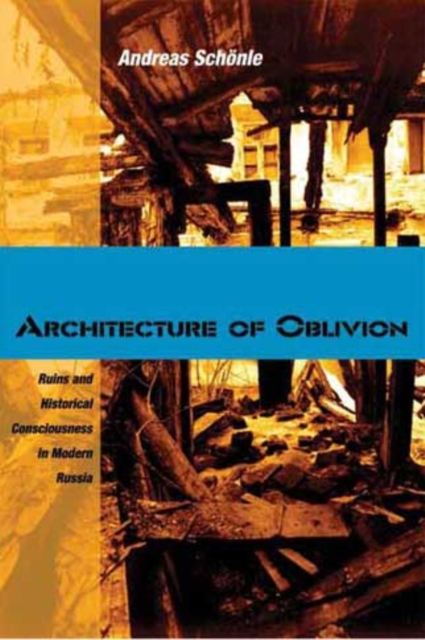
Architecture of Oblivion
Despite attempts to promote the aesthetics of ruins in Russia—from Catherine the Great's construction of fake ruins in imperial parks to Josef Brodsky's elegiac meditations—ruins have never achieved the status they enjoy in Western Europe. While the Soviet Union was notorious for leveling churches, post-Soviet Russia has only intensified the practice of massive destruction and reconstruction. Architecture of Oblivion examines the role of ruins in the development of Russia's historical consciousness from the eighteenth century to the present. Investigating the meaning and functions ruins have acquired in Russian culture, Schönle looks at ideological reasons for the current disregard for the value of ruins and historical buildings, in particular by political authorities, and reveals how ruins have often become a site of resistance to official ideology and an invitation to map out alternative visions of history and of statehood. An interdisciplinary study of Russia's response to ruins has never been attempted, although the topic of ruins has garnered considerable interest in Western Europe and in the U.S. This original work from a leading authority on the subject will appeal to historians of Russian culture and thought, literature and art scholars, and general readers interested in ruins.
eBook


Taking the Soviet Union Apart Room by Room
Taking the Soviet Union Apart Room by
Room investigates what happens to domestic
spaces, architecture, and the lives of urbanites during a
socioeconomic upheaval. Kateryna Malaia analyzes how
Soviet and post-Soviet city dwellers, navigating a crisis of
inadequate housing and extreme social disruption between the late
1980s and 2000s, transformed their dwellings as their countries
transformed around them. Soviet infrastructure remained but, in
their domestic spaces, urbanites transitioned to post-Soviet
citizens.
The two decades after the collapse of the USSR witnessed a major
urban apartment remodeling boom. Malaia shows how, in the context
of limited residential mobility, those remodeling and modifying
their homes formed new lifestyles defined by increased spatial
privacy. Remodeled interiors served as a material expression of a
social identity above the poverty line, in place of the outdated
Soviet signifiers of well-being. Connecting home improvement,
self-reinvention, the end of state socialism, and the lived
experience of change, Malaia puts together a comprehensive portrait
of the era.
Malaia shows both the stubborn continuities and the dramatic
changes that accompanied the collapse of the USSR. Making the case
for similarities throughout the former Soviet empire, this study is
based on interviews and fieldwork done primarily in Kyiv and Lviv,
Ukraine. Many of the buildings described are similar to those
damaged or destroyed by Russian bombings or artillery fire
following the invasion of Ukraine on February 24, 2022. A book
about major historic events written through the lens of everyday
life, Taking Soviet Union Apart is also about the meaning
of home in a dramatically changing world.
eBook

Modernism and the making of the Soviet new man
The creation of Soviet culture in the 1920s and the 1930s was the most radical of modernist projects, both in aesthetic and in political terms. \"Modernism and the Making of the New Man\" explores the architecture of this period as the nexus between aesthetics and politics. The design of the material environment, according to the author, was the social effort that most clearly articulated the dynamic of the socialist project as a negotiation between utopia and reality, the will for progress and the will for tyranny. It was a comprehensive effort that brought together professional architects and statisticians, theatre directors, managers, housewives, pilots, construction workers. What they had in common was the enthusiasm for defining the \"new man\", the ideal citizen of the radiant future, and the settings in which he or she lives.
Book

Chronicles in Stone
Chronicles in Stone is a study of the powerful and pervasive myth of the Russian Northwest, its role in forming Soviet and Russian identities, and its impact on local communities. Combining detailed archival research, participant observation and oral history work, it explores the transformation of three northwestern Russian towns from provincial backwaters into the symbolic homelands of the Soviet and Russian nations. The book's central argument is that the Soviet state exploited the cultural heritage of the Northwest to craft patriotic narratives of the people's genius, heroism and strength that could bind the nation together after 1945. Through sustained engagement with local voices, it reveals the ways these narratives were internalized, revised, and resisted by the communities living in the region. Donovan provides an alternative lens through which to view the rise of Russian patriotic consciousness in the twentieth and twenty-first centuries, adding a valuable regional dimension to our knowledge of Russian nation building and identity politics.
eBook