
Catalogue Search | MBRL


Are you sure you want to remove the book from the shelf?

{{itemTitle}}
44
result(s) for
"Architecture Turkey Istanbul."
Sort by:


Architecture and the Turkish City
Architecture and urban planning have always been used by political regimes to stamp their ideologies upon cities, and this is especially the case in the modern Turkish Republic. By exploring Istanbul's modern architectural and urban history, Murat Gul highlights the dynamics of political and social change in Turkey from the late-Ottoman period until today. Looking beyond pure architectural styles or the physical manifestations of Istanbul's cultural landscape, he offers critical insight into how Turkish attempts to modernise have affected both the city and its population. Charting the diverse forces evident in Istanbul's urban fabric, the book examines late Ottoman reforms, the Turkish Republic's turn westward for inspiration, Cold War alliances and the AK Party's reaffirmation of cultural ties with the Middle East and the Balkans. Telltale signs of these moments - revivalist architecture drawing on Ottoman and Seljuk styles, 1930s Art Deco, post-war International Style buildings and the proliferation of shopping malls, luxurious gated residences and high-rise towers, for example - are analysed and illustrated in extensive detail.Connecting this rich history to present-day Istanbul, whose urban development is characterised anew by intense social stratification, the book will appeal to researchers of Turkey, its architecture and urban planning.
eBook

Hagia Sophia in the long nineteenth century
The papers collected within this volume began as presentations at a symposium held at the Ohio State University in September 2018.
Book
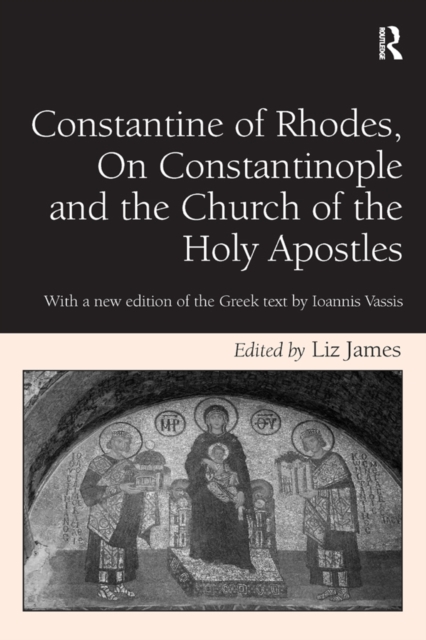
Constantine of Rhodes, on Constantinople and the Church of the Holy Apostles
Constantine of Rhodes's tenth-century poem is an account of public monuments in Constantinople and of the Church of the Holy Apostles. In the opening section of the work, Constantine describes columns and sculptures within the city, seven of which he calls 'wonders'. In the second part of the poem, he portrays the Church of the Holy Apostles, offering an account of its architecture and internal decoration, notably the mosaics, seven of which are also depicted as 'wonders'. On one level, the poem offers an account of what was visible, a sense of city topography and, in the case of the Apostoleion, a vital description of a now-lost building. But it cannot be read as a straightforward description. Rather, Constantine's work offers insights into Byzantine perceptions of works of art. The monuments Constantine decided to portray and the ways in which he chose to describe them say as much, if not more, about the social and cultural milieu in which he operated as about the actual physical appearance of the monuments themselves. Further, the poem itself, as it survives in one fifteenth-century manuscript, raises questions: is it, in its current form, a single poem or is it made up of a compilation of Constantine's writings?
eBook


Modern Educational Building in Late Ottoman Istanbul
In the late Ottoman period, foreign schools played a crucial role in educational modernization and cultural diplomacy. The Haydarpaşa German School, located in Istanbul and established as a branch of the Galata Bourgeois School, exemplifies Ottoman-German interaction in education and colonial architecture. Archival records reveal complex negotiations between the Ottoman administration and the German Embassy, reflecting broader geopolitical and cultural imperialist dynamics. The school follows the city school model, a disciplinary architectural approach emphasizing hierarchy, control, and efficiency, aligning with late 19th-century German pedagogical principles. A comparative analysis of the Galata Bourgeois and Yedikule German Schools shows that all three institutions adhere to the city school typology. Unlike the prevailing Neo-Ottoman or Orientalist styles, these schools adopted a rigid, regimented design, serving as tools of cultural imperialism. Its transformation after World War I and integration into the Turkish education system reflect shifts in foreign educational policies. Recent restoration efforts balance historical preservation with contemporary needs. This study positions the Haydarpaşa German School as both an architectural artifact and a colonial instrument, contributing to discussions on cultural imperialism, modernization, and education in the late Ottoman period.
Journal Article

Architecture and the Turkish city : an urban history of Istanbul since the Ottomans
Architecture and urban planning have always been used by political regimes to stamp their ideologies upon cities, and this is especially the case in the modern Turkish Republic. By exploring Istanbul's modern architectural and urban history, Murat Gèul highlights the dynamics of political and social change in Turkey from the late Ottoman period until today. Looking beyond pure architectural styles or the physical manifestations of Istanbul's cultural landscape, he offers critical insight into how Turkish attempts to modernise have affected both the city and its population. Charting the diverse forces evident in Istanbul's urban fabric, the book examines late Ottoman reforms, the Turkish Republic's turn westward for inspiration, Cold War alliances and the AK Party's reaffirmation of cultural ties with the Middle East and the Balkans. Telltale signs of these moments - revivalist architecture drawing on Ottoman and Seljuk styles, 1930s Art Deco, post-war International Style buildings and the proliferation of shopping malls, luxurious gated residences and high-rise towers, for example - are analysed and illustrated in extensive detail. Connecting this rich history to present-day Istanbul, whose urban development is characterised anew by intense social stratification, the book will appeal to researchers of Turkey, its architecture and urban planning.
Book

Urban Neoliberalism with Islamic Characteristics
This paper discusses the changing urban policy framework in Turkey through a detailed analysis of a unique coupling of neoliberalism and Islamism. In this, rather than political projects with clear ultimate ends, both neoliberalism and Islamism are approached as distinct political rationalities aiming to reconfigure all aspects of social life. Turkey's Justice and Development Party has successfully established networks of economic and political interdependence (or has tapped into existing networks) by appeasing both the emergent Islamic capitalist class through lucrative contracts and business-friendly reforms, and the urban poor through gracious gestures ingrained in traditional Islamic community values and morality. The working of this co-articulation is examined in the case of an urban renewal project in a peripheral neighbourhood in Istanbul.
Journal Article

Constantinopolis/Istanbul : cultural encounter, imperial vision, and the construction of the Ottoman capital
\"Studies the reconstruction of Byzantine Constantinople as the capital city of the Ottoman empire following its capture in 1453, delineating the complex interplay of socio-political, architectural, visual, and literary processes that underlay the city's transformation\"--Provided by publisher.
Book

Adaptive Reuse of High-Rise Buildings for Housing: A Study of Istanbul Central Business District
The abrupt shift to remote work due to the Covid-19 pandemic increased vacant office spaces globally, especially in high-rent central business districts (CBDs). These vacant office spaces offer the potential for conversion into housing, addressing the shortage of affordable housing in central areas. Additionally, this topic presents a unique experimental ground for architecture students. This study focuses on the Istanbul CBD as a case study, examining the historical developments that led to a rise in office vacancy rates and housing inequality, and exploring the potential for adaptive reuse of these vacant office buildings. A key focus of this study is to underline the pedagogical value of adaptive reuse, highlighting how such projects can inspire more diverse and equitable housing models, fostering experimental and sustainable design approaches. It systematically evaluates the outcomes of a 4th-year architectural design studio that focuses on the adaptive reuse of the Tat Towers in the Istanbul CBD, a structurally vacant high-rise office building, and asks: How does the context of adaptive reuse enable a different design approach, and, potentially, new spatial norms and standards to emerge, and how might this hold a pedagogical value for architecture education? Following these questions, the article discusses how norms and standards are not only culturally but also typologically contextual, and how the students have explored how norms and standards might change, outlining new design approaches to adaptive reuse.
Journal Article