
Catalogue Search | MBRL


Are you sure you want to remove the book from the shelf?

{{itemTitle}}
12
result(s) for
"Architecture Vatican City."
Sort by:

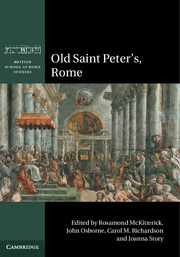
Old Saint Peter's, Rome
St Peter's Basilica in Rome is arguably the most important church in Western Christendom, and is among the most significant buildings anywhere in the world. However, the church that is visible today is a youthful upstart, only four hundred years old compared to the twelve-hundred-year-old church whose site it occupies. A very small proportion of the original is now extant, entirely covered over by the new basilica, but enough survives to make reconstruction of the first St Peter's possible and much new evidence has been uncovered in the past thirty years. This is the first full study of the older church, from its late antique construction to Renaissance destruction, in its historical context. An international team of historians, art historians, archaeologists and liturgists explores aspects of the basilica's history, from its physical fabric to the activities that took place within its walls and its relationship with the city of Rome.
eBook

The Sistine Chapel : paradise in Rome
\"The Sistine Chapel: Paradise in Rome is a scholarly yet accessible history of the Sistine Chapel. Through a study of the main campaigns to adorn the chapel, Ulrich Pfisterer argues that art transformed the chapel into a pathway to the kingdom of God, legitimizing the absolute authority of the popes\"--Provided by publisher.
Book

Time Matter(s): Invention and Re-Imagination in Built Conservation
Even though the idea of altering an existing building is presently a well established practice within the context of adaptive reuse, when the building in question is a 'mnemonic building', of recognized heritage value, alterations are viewed with suspicion, even when change is a recognized necessity. This book fills in a blind spot in current architectural theory and practice, looking into a notion of conservation as a form of invention and imagination, offering the reader a counter-viewpoint to a predominant western understanding that preservation should be a 'still shot' from the past. Through a micro-historical study of a Renaissance concept of restoration, a theoretical framework to question the issue of conservation as a creative endeavor arises. It focuses on Tiberio Alfarano's 1571 ichnography of St. Peter's Basilica in the Vatican, into which a complex body of religious, political, architectural and cultural elements is woven. By merging past and present temple's plans, he created a track-drawing questioning the design pursued after Michelangelo's death (1564), opening the gaze towards other possible future imaginings. This book uncovers how the drawing was acted on by Carlo Maderno (1556-1629), who literally used it as physical substratum to for new design proposals, completing the renewal of the temple in 1626. Proposing a hybrid architectural-conservation approach, this study shows how these two practices can be merged in contemporary renovation. By creating hybrid drawings, the retrospective and prospective gaze of built conservation forms a continuous and contiguous reality, where a pre-existent condition engages with future design rejoining multiple temporalities within continuity of identity. This study might provide a paradigmatic and timely model to retune contemporary architectural sensibility when dealing with the dilemma between design and preservation when transforming a building of recognized significance.
eBook


Rome and environs
This superb guide brings the work of Filippo Coarelli, one of the most widely published and well-known scholars of Roman topography, archeology and art, to a broad English-language audience. Conveniently organized by walking tours and illustrated throughout with clear maps, drawings, and plans, Rome and Environs: An Archaeological Guide covers all of the major, and an unparalleled number of minor, ancient sites in the city, and, unlike most other guides of Rome, includes major and many minor sites within easy reach of the city, such as Ostia Antica, Palestrina, Tivoli, and the many areas of interest along the ancient Roman roads. An essential resource for tourists interested in a deeper understanding of Rome's classical remains, it is also the ideal book for students and scholars approaching the ancient history of one of the world's most fascinating cities. • Covers all the major sites including the Capitoline, the Roman Forum, the Imperial Fora, the Palatine Hill, the Valley of the Colosseum, the Esquiline, the Caelian, the Quirinal, and the Campus Martius. • Discusses important clusters of sites-one on the area surrounding Circus Maximus and the other in the vicinity of the Trastevere, including the Aventine and the Vatican. • Covers the history and development of the city walls and aqueducts. • Follows major highways leading outside of the city to important and fascinating sites in the periphery of Rome. • Features 189 maps, drawings, and diagrams, and an appendix on building materials and techniques. • Includes an updated and expanded bibliography for students and scholars of Ancient Rome.
eBook

Experiments of Network Literacy for Urban Designers: Bridging Information Design and Spatial Morphology
Urban morphology has long been studied through typologies, spatial configurations, and historical change, yet cities are not static artifacts but dynamic environments continually reshaped by people, infrastructures, and politics. This article brings Actor–Network Theory (ANT) into dialogue with Aldo Rossi’s notion of the locus to rethink urban design as both enduring form and relational process. Building on Manuel Lima’s taxonomy, the study develops a methodological workflow that translates street networks into visualizations, pairing embeddings with topographic maps to highlight structural patterns. Applied to a comparative set of cities, the analysis distinguishes three broad morphological tendencies—archetypal, geometrical, and relational—each reflecting different logics of urban organization. The results show how scale and connectivity condition the interpretability of embeddings, revealing both alignments and divergences between cartographic and topological representations. Beyond empirical findings, the article frames network literacy as a meeting ground for design theory, science and technology studies, and information visualization. It concludes by proposing that advancing urban morphology today requires not only new computational tools but also sustained interdisciplinary collaboration across design, urban studies, and data science.
Journal Article

The sanctuary's spatialization in the review L'Art sacre (1954-1969)
The announce of the Second Vatican Council led the theorists and the experts of worship to question the relations between ritual and architecture. As a laboratory of liturgy, the Dominican review L'Art sacre indicates which methodologies introduced a transformation of the sanctuary from now on conceived as a the place of a renewed ritual experience. Adapted from the source document.
Journal Article

The Seven Hills of Rome
From humble beginnings, Rome became perhaps the greatest
intercontinental power in the world. Why did this historic city
become so much more influential than its neighbor, nearby Latium,
which was peopled by more or less the same stock? Over the years,
historians, political analysts, and sociologists have discussed
this question ad infinitum, without considering one
underlying factor that led to the rise of Rome--the geology now
hidden by the modern city.
This book demonstrates the important link between the history of
Rome and its geologic setting in a lively, fact-filled narrative
sure to interest geology and history buffs and travelers alike. The
authors point out that Rome possessed many geographic advantages
over surrounding areas: proximity to a major river with access to
the sea, plateaus for protection, nearby sources of building
materials, and most significantly, clean drinking water from
springs in the Apennines. Even the resiliency of Rome's
architecture and the stability of life on its hills are underscored
by the city's geologic framework.
If carried along with a good city map, this book will expand the
understanding of travelers who explore the eternal city's streets.
Chapters are arranged geographically, based on each of the seven
hills, the Tiber floodplain, ancient creeks that dissected the
plateau, and ridges that rise above the right bank. As an added
bonus, the last chapter consists of three field trips around the
center of Rome, which can be enjoyed on foot or by using public
transportation.
eBook

Time Matter(s)
Even though the idea of altering an existing building is presently a well established practice within the context of adaptive reuse, when the building in question is a 'mnemonic building', of recognized heritage value, alterations are viewed with suspicion, even when change is a recognized necessity. This book fills in a blind spot in current architectural theory and practice, looking into a notion of conservation as a form of invention and imagination, offering the reader a counter-viewpoint to a predominant western understanding that preservation should be a 'still shot' from the past. Through a micro-historical study of a Renaissance concept of restoration, a theoretical framework to question the issue of conservation as a creative endeavor arises. It focuses on Tiberio Alfarano's 1571 ichnography of St. Peter's Basilica in the Vatican, into which a complex body of religious, political, architectural and cultural elements is woven. By merging past and present temple's plans, he created a track-drawing questioning the design pursued after Michelangelo's death (1564), opening the gaze towards other possible future imaginings. This book uncovers how the drawing was acted on by Carlo Maderno (1556-1629), who literally used it as physical substratum to for new design proposals, completing the renewal of the temple in 1626. Proposing a hybrid architectural-conservation approach, this study shows how these two practices can be merged in contemporary renovation. By creating hybrid drawings, the retrospective and prospective gaze of built conservation forms a continuous and contiguous reality, where a pre-existent condition engages with future design rejoining multiple temporalities within continuity of identity. This study might provide a paradigmatic and timely model to retune contemporary architectural sensibility when dealing with the dilemma
between design and preservation when transforming a building of recognized significance.
eBook